35,000+ smart investors are already getting financial news, market signals, and macro shifts in the economy that could impact their money next with our FREE weekly newsletter. Get ahead of what the crowd finds out too late. Click Here to Subscribe for FREE.
Canada’s effort to sell more of its energy beyond the United States has taken another concrete step. Ksi Lisims LNG and Germany’s Securing Energy for Europe, or SEFE, have finalized a binding 20-year agreement for one million tonnes of liquefied natural gas annually, with deliveries expected to begin in the early 2030s.
The contract turns an agreement reached in principle in May into a long-term commercial commitment with Germany’s federally owned energy company. It also gives Prime Minister Mark Carney’s trade-diversification strategy a tangible energy deal to point to as Ottawa tries to reduce Canada’s historic dependence on the U.S. market. Yet this remains a bet on the future: Ksi Lisims has not begun exporting LNG, and a final investment decision on the multibillion-dollar British Columbia development is still a critical step before the promised gas can reach global buyers.
The German Agreement Is Now Binding, Not Just a Political Promise
Canada Locks In 20-Year German LNG Deal as Carney Pushes Energy Exports Beyond the U.S.
- The German Agreement Is Now Binding, Not Just a Political Promise
- Carney’s Trade Strategy Is Built Around Reducing Canada’s U.S. Dependence
- A Berlin Trade Mission Helped Turn Energy Diplomacy Into Business
- Germany Wants Canadian LNG as It Reduces Other Energy Dependencies
- German Buyers Now Control a Significant Slice of Ksi Lisims’ Planned Output
- The Export Terminal Still Has to Be Built
- Indigenous Leadership Is Central to the Project, but Support Is Not Universal
- The Low-Emissions Claim Comes With an Important Qualification
- The Real Significance Is Optionality for Both Canada and Germany
The biggest change in the latest announcement is the legal and commercial status of the deal. In May, Ksi Lisims LNG and SEFE signed a Heads of Agreement covering one million tonnes of LNG per year for up to 20 years. On October 26, the companies announced that they had progressed to a binding sale and purchase agreement. If deliveries continue for the entire term at the contracted annual volume, the arrangement would cover roughly 20 million tonnes of Canadian LNG.
The contract is between Ksi Lisims LNG and SEFE rather than a government-to-government purchase agreement, although both Canadian and German governments have strongly supported the relationship. SEFE is owned by Germany’s federal government. The LNG will be purchased on a free-on-board basis, meaning SEFE takes responsibility for the cargo once it is loaded at the Canadian export facility. Crucially, SEFE says the volumes will have destination flexibility. That means the contract strengthens German and European energy security without requiring every Canadian cargo to physically arrive at a German terminal.
Carney’s Trade Strategy Is Built Around Reducing Canada’s U.S. Dependence
The deal fits directly into one of Carney’s central economic priorities: selling substantially more Canadian goods and resources to countries other than the United States. That challenge is particularly stark in natural gas. In 2024, essentially all of Canada’s exported natural gas went south through pipelines to the U.S. Canada’s geography and decades of integrated North American infrastructure left producers with few large-scale alternatives for reaching overseas customers.
That began changing when LNG Canada in Kitimat started exports in June 2025. The Canada Energy Regulator says LNG Canada exported an average of about 0.295 billion cubic feet per day during 2025, all to East Asia, while Canada continued sending roughly 8.6 billion cubic feet per day of other natural gas exports almost entirely to the United States. Ottawa now wants that balance to change dramatically. The federal government says its diversification plans could raise the share of Canadian natural-gas exports going outside the U.S. from less than 0.01% in 2024 to an estimated 55% by the early-to-mid 2030s.
A Berlin Trade Mission Helped Turn Energy Diplomacy Into Business
The SEFE contract did not emerge in isolation. Carney travelled to Germany with Energy and Natural Resources Minister Tim Hodgson in August 2025 as Canada sought deeper European relationships in energy, critical minerals and strategic industries. During that visit, Canadian officials publicly committed to discussions about supplying LNG to German buyers. Ksi Lisims executives were also part of the Canadian delegation, and Ottawa says contacts made during that mission contributed directly to the discussions with SEFE.
That sequence matters because it illustrates what the Carney government means when it talks about using diplomacy to diversify trade. The initial political outreach was followed by a preliminary commercial agreement in May 2026 and, five months later, a binding contract. Canada and Germany have meanwhile expanded their broader relationship, launching negotiations toward a strategic partnership covering energy, investment, security, technology and critical minerals. Germany is already Canada’s largest merchandise-trading partner within the European Union, giving Ottawa an established economic relationship on which to build rather than forcing Canadian exporters to develop a major new market from scratch.
Germany Wants Canadian LNG as It Reduces Other Energy Dependencies
For Germany, the Canadian agreement is part of a much larger reshaping of its gas supply system. The country spent decades relying heavily on pipeline gas from Russia before Moscow’s invasion of Ukraine and the subsequent collapse of that relationship forced Germany to rapidly build LNG import capacity and find alternative suppliers. SEFE itself reflects that transformation. Formerly known as Gazprom Germania, the company came under German government control during the 2022 energy crisis and is now wholly owned by the federal government.
Germany has since become heavily dependent on American LNG. Its federal network regulator reported that German LNG terminals handled 106 terawatt-hours of natural gas in 2025, equal to 10.3% of the country’s total gas imports. About 96% of those LNG imports came from the United States. Canadian supply therefore offers another layer of diversification. The timing is also important because the European Union is phasing out Russian gas: long-term Russian LNG imports are scheduled to be prohibited from January 1, 2027. Germany is not simply searching for more gas; it is trying to avoid replacing one concentrated dependency with another.
German Buyers Now Control a Significant Slice of Ksi Lisims’ Planned Output
SEFE is not the only German company betting on Ksi Lisims. In July, German energy group Uniper finalized its own binding 20-year agreement for two million tonnes of LNG annually, with deliveries expected from 2032. Combined with SEFE’s newly binding one-million-tonne contract, German buyers now have firm agreements covering three million tonnes per year — one quarter of Ksi Lisims’ proposed 12-million-tonne annual capacity.
The latest SEFE agreement also pushes Ksi Lisims closer to the level of contracted sales generally needed to support financing for a project of this scale. The developers say seven million tonnes of annual capacity are now covered by binding contracts. Earlier agreements include two million tonnes per year each with Shell and TotalEnergies, two million with Uniper and one million with SEFE. Preliminary agreements covering another two million tonnes have been announced with Australia’s Santos and Britain’s Centrica. Altogether, binding and preliminary commitments now cover nine million tonnes, or three quarters of planned capacity, although the preliminary deals still need to become definitive sales contracts.
The Export Terminal Still Has to Be Built
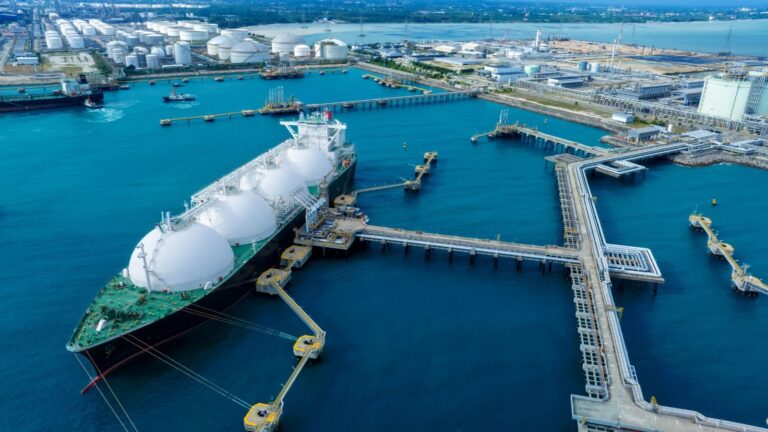
Commercial momentum should not be confused with an operating LNG plant. Ksi Lisims remains a proposed project at Wil Milit on Pearse Island in northwestern British Columbia, on Nisga’a Nation treaty lands. The plan calls for as many as two floating liquefaction structures capable of producing a combined 12 million tonnes of LNG annually. The facility would be supplied by the Prince Rupert Gas Transmission pipeline running roughly 800 kilometres across northern B.C., while an expanded electricity network would eventually connect the terminal to BC Hydro power.
The project received its British Columbia environmental assessment certificate in September 2025 and was subsequently referred to Ottawa’s Major Projects Office. Federal estimates put combined investment associated with Ksi Lisims, its gas pipeline and required transmission infrastructure at more than C$30 billion. Ottawa says the development could contribute more than C$15 billion to Canadian GDP over 30 years. Those estimates depend on construction and operation actually proceeding. The developers were still working toward a final investment decision when the SEFE contract was announced, making the new long-term sales commitments particularly important for demonstrating predictable future revenue to lenders and investors.
Indigenous Leadership Is Central to the Project, but Support Is Not Universal
Ksi Lisims differs from many earlier Canadian resource projects because the Nisga’a Nation is not simply being consulted about a development proposed on its territory. It is one of the project partners alongside Western LNG and Rockies LNG, a consortium involving Canadian natural-gas producers. Nisga’a leaders have presented the development as a way to generate employment, training, contracting opportunities and long-term revenues while exercising greater control over resource development on Nisga’a lands.
The broader Indigenous picture is more complicated. Ksi Lisims and the associated PRGT pipeline have signed agreements with several other First Nations, including Gitxaała, Lax Kw’alaams and Metlakatla. At the same time, some Gitxsan and Gitanyow hereditary leaders have opposed aspects of the pipeline and argued that consultation, environmental review and protection of their territories have been inadequate. Legal challenges have also focused on the province’s decision that the older PRGT project had been “substantially started,” allowing its environmental certificate to remain in force. The project therefore demonstrates both the growing role of Indigenous nations as owners and proponents of major infrastructure and the reality that Indigenous communities do not hold a single position on resource development.
The Low-Emissions Claim Comes With an Important Qualification
Ksi Lisims has been marketed as an unusually low-emissions LNG facility because its liquefaction process is intended to rely heavily on British Columbia’s hydroelectric grid rather than burning large amounts of natural gas to power compressors. Federal officials have said the fully electrified operation could have emissions about 94% below the global average for LNG facilities. The project’s own planning documents estimate an operating emissions intensity of roughly 0.02 tonnes of carbon-dioxide equivalent per tonne of LNG once connected to hydropower.
That figure should not be interpreted as meaning Canadian LNG would be carbon-free. Liquefaction is only one part of the gas supply chain. Natural-gas production, methane leakage, processing, pipeline transportation, ocean shipping and eventual combustion also create greenhouse-gas emissions. Those broader effects were among the issues raised during British Columbia’s environmental-assessment process, and environmental groups have argued that new 20-year contracts risk extending fossil-fuel use well into the 2050s. The commercial argument is that lower-emission Canadian production can provide secure gas while energy systems transition; the climate debate centres on how much gas will still be needed and whether LNG actually displaces higher-emitting fuels.
The Real Significance Is Optionality for Both Canada and Germany
For Canada, the most important aspect of the SEFE agreement may be that it gives western Canadian natural gas another potential route to world prices instead of leaving producers overwhelmingly dependent on one customer. Ksi Lisims would join LNG Canada and other planned West Coast developments in turning British Columbia into a gateway for overseas gas exports. That is exactly the type of infrastructure Carney has tied to his promise to double non-U.S. exports over the next decade and strengthen Canada’s ability to withstand trade or political pressure from Washington.
Germany gains a different kind of flexibility. SEFE obtains long-term access to Canadian supply at a time when Europe is eliminating Russian LNG and Germany remains heavily reliant on American cargoes. Because the agreement includes destination flexibility, SEFE can use Canadian LNG as part of a global portfolio rather than treating it as a simple point-to-point shipment between British Columbia and Germany. The contract does not guarantee Ksi Lisims will be built, nor does it solve every environmental, financing or infrastructure question. What it does accomplish is significant: a diplomatic ambition that began with Canadian-German energy talks has now become a binding 20-year commercial commitment.
This Options Discord Chat is The Real Deal
While the internet is scoured with trading chat rooms, many of which even charge upwards of thousands of dollars to join, this smaller options trading discord chatroom is the real deal and actually providing valuable trade setups, education, and community without the noise and spam of the larger more expensive rooms. With a incredibly low-cost monthly fee, Options Trading Club (click here to see their reviews) requires an application to join ensuring that every member is dedicated and serious about taking their trading to the next level. If you are looking for a change in your trading strategies, then click here to apply for a membership.