35,000+ smart investors are already getting financial news, market signals, and macro shifts in the economy that could impact their money next with our FREE weekly newsletter. Get ahead of what the crowd finds out too late. Click Here to Subscribe for FREE.
Two Chinese polar research ships moving north through the Bering Sea would once have attracted mostly scientific interest. In July 2026, they drew something else as well: sustained attention from North American security forces. The U.S. Coast Guard publicly confirmed that it monitored Xue Long and Xue Long 2 as they transited through the U.S. exclusive economic zone and over the extended continental shelf. Days later, Canadian and American vessels completed an 800-mile combined Arctic patrol through the Bering Sea and Bering Strait. The sequence reflects a changing Arctic, where scientific expeditions, commercial ambitions and national-security concerns increasingly overlap. The Chinese ships were not accused of violating international law, but their presence showed why Canada and the United States now treat maritime awareness in the North as a permanent requirement rather than an occasional exercise.
A Quiet Watch in the Bering Sea
Canada and U.S. Quietly Shadow China’s ‘Snow Dragon’ Ships in the Arctic
The word “shadowing” can sound more dramatic than the public record. What the U.S. Coast Guard described was active monitoring. In mid-July, the service said USCGC Munro was operating under Operation Frontier Sentinel as Xue Long moved north through the U.S. exclusive economic zone and over the U.S. extended continental shelf in the Bering Sea. Xue Long 2 was also heading toward the Arctic. The Coast Guard said these were the first Chinese vessels it had tracked through that area during the 2026 season.
That distinction matters. Foreign vessels can navigate through an exclusive economic zone under international law, and the Coast Guard did not say the two ships were being intercepted or forced to alter course. Its concern was awareness: knowing where the vessels were, what they declared they were doing and whether any scientific activity required prior permission. In a region where response times can be long and infrastructure sparse, simply having a ship close enough to observe can be strategically significant.
Canada Joined the Same Operating Picture
Canada entered the same operating picture only days later. From July 20 to 24, U.S. and Canadian maritime forces conducted Operation TUNDRA MERLIN, a five-day combined sail covering about 800 miles through the Bering Sea and Bering Strait. The formation included the U.S. Coast Guard cutters Munro, Storis and Fir along with the Royal Canadian Navy’s HMCS Max Bernays. American military officials said the patrol was designed to improve interoperability, maritime domain awareness and continental defence.
The timing is important, but so is precision. Public releases do not establish that Max Bernays sailed directly beside Xue Long or Xue Long 2 in 2026. What they do show is that Canada joined a coordinated patrol in the same strategic approaches shortly after Munro had been monitoring the Chinese ships. That was not an isolated Canadian interest. In 2025, a Royal Canadian Air Force CP-140 Aurora monitored Xue Long 2 in international waters off North America, while Max Bernays operated farther north and later reached 81 degrees north latitude, a record for a Royal Canadian Navy ship at the time.
Why the ‘Snow Dragons’ Draw Attention
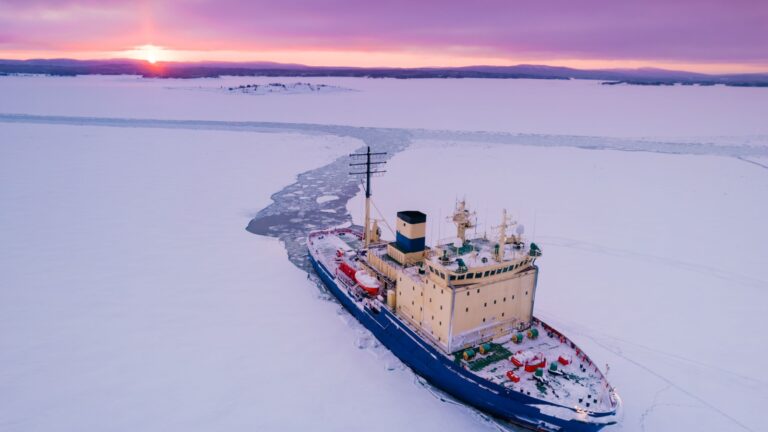
The “Snow Dragon” name can make the vessels sound almost ceremonial, but both are substantial polar research platforms. Xue Long is about 167 metres long, has a loaded displacement of roughly 21,025 tonnes and a stated endurance of 20,000 nautical miles. Xue Long 2 is smaller at 122.5 metres, but it was purpose-built for modern polar science and can continuously break ice about 1.5 metres thick at two to three knots. Its stated endurance is also 20,000 nautical miles.
Those capabilities explain why governments pay attention without needing to assume hostile intent. China’s 16th Arctic scientific expedition departed Dalian in early July 2026 with Xue Long, Xue Long 2 and Jidi, with the research vessel Tansuo 3 also expected to participate. Beijing said the mission would focus on global climate change and its effects. At the same time, Canada’s Arctic policy explicitly notes that some Chinese polar research activity can be dual-use. Oceanographic and environmental data may have legitimate scientific value while also improving knowledge of waters that matter for navigation, surveillance and future operations. No public evidence cited by North American authorities proves these two ships were conducting espionage.
Beijing’s Arctic Ambitions Go Beyond One Expedition
China’s Arctic presence did not begin with the 2026 voyage. Beijing’s 2018 Arctic policy describes China as a “Near-Arctic State,” a term of its own choosing, and says the country has interests in scientific research, shipping, resource development and environmental protection. China began Arctic expeditions in 1999, established the Yellow River research station in Svalbard in 2004 and became an observer at the Arctic Council in 2013. The policy also promotes the idea of a “Polar Silk Road” linked to emerging Arctic shipping routes.
That combination helps explain why North American governments see each research season as part of a longer strategic pattern. Beijing presents its activities as lawful participation in a region whose climate and shipping changes have global consequences. Canada, meanwhile, says China is seeking a larger role in Arctic affairs and treats some research as potentially useful for both civilian and military purposes. Those positions are not mutually exclusive. A vessel can conduct real climate science and still generate information with strategic value. The security question is therefore less about proving hidden intent on a single voyage and more about understanding the cumulative knowledge and access China is building over time.
The Legal Line Runs Through Research, Not Simply Sailing
The legal boundary in the Arctic is more complicated than a simple question of whether a foreign ship is present. The U.S. Coast Guard noted that foreign vessels may operate in the American exclusive economic zone and over the extended continental shelf in accordance with international law. Marine scientific research is different: when conducted in another state’s exclusive economic zone or continental shelf, it can require that coastal state’s consent, along with conditions governing the research and sharing of data.
Canada applies the same basic distinction in its Arctic policy. Ottawa says it will review foreign marine-scientific-research requests in Canadian jurisdiction and will protect its sovereign rights while cooperating where interests align. There is also precedent involving Xue Long itself. In 2017, the Chinese icebreaker requested Canadian consent before navigating Canadian Arctic waters, and Canada granted it after determining that the vessel would comply with applicable laws and regulations. That episode is useful because it shows how Arctic competition often works in practice: not through dramatic confrontations, but through permits, notifications, tracking, legal assertions and the quiet accumulation of operational knowledge.
A Warmer Arctic Raises the Stakes
The Arctic is attracting more attention partly because the physical environment is changing. The U.S. National Snow and Ice Data Center reported that Arctic sea ice reached a 2025 summer minimum of about 4.60 million square kilometres, the tenth-lowest minimum in the 47-year satellite record. It also noted that the 19 lowest annual minimums in that record have all occurred in the most recent 19 years. NOAA has described the Arctic as warming several times faster than the planet as a whole.
Less ice does not make the region easy. Severe weather, darkness, distance and limited infrastructure still shape every operation. But changing ice conditions can create longer or more practical windows for research, shipping and government patrols in some areas. That increases the value of persistent surveillance and search-and-rescue capacity. For northern communities, the security debate is not abstract. More traffic can bring economic opportunities and scientific cooperation, but it also raises questions about accidents, pollution response, sovereignty and who has the ability to act quickly when something goes wrong far from major bases and ports.
The Bigger Story Is Persistent Presence
The larger story is not one pair of Chinese ships. It is the normalization of year-after-year Arctic presence by China, Canada and the United States. Ottawa’s current Arctic policy calls for stronger maritime awareness, new patrol and icebreaking capacity and deeper continental defence with Washington. Canada has also committed more than $6 billion to an Arctic over-the-horizon radar system developed with Australia, with initial capability anticipated around the end of 2029. The system is intended to detect and track threats approaching North America across northern air and maritime routes.
At sea, exercises such as TUNDRA MERLIN show what that strategy looks like operationally: Canadian and American crews sharing the same approaches, practicing coordination and building a common picture before a crisis occurs. China is likely to continue sending capable research vessels north because its scientific, commercial and strategic interests all point in that direction. North America’s response appears increasingly consistent as well. Rather than treating every Chinese voyage as a provocation, Canada and the United States are building the ability to watch, verify and respond. In the modern Arctic, quiet persistence may matter more than dramatic confrontation.
This Options Discord Chat is The Real Deal
While the internet is scoured with trading chat rooms, many of which even charge upwards of thousands of dollars to join, this smaller options trading discord chatroom is the real deal and actually providing valuable trade setups, education, and community without the noise and spam of the larger more expensive rooms. With a incredibly low-cost monthly fee, Options Trading Club (click here to see their reviews) requires an application to join ensuring that every member is dedicated and serious about taking their trading to the next level. If you are looking for a change in your trading strategies, then click here to apply for a membership.