35,000+ smart investors are already getting financial news, market signals, and macro shifts in the economy that could impact their money next with our FREE weekly newsletter. Get ahead of what the crowd finds out too late. Click Here to Subscribe for FREE.
A proposed artificial-intelligence data centre in Olds has run into one of the clearest regulatory limits yet on Alberta’s push to attract enormous computing projects. On August 17, the Alberta Utilities Commission denied Synapse Real Estate Corp.’s application for a 1,400-megawatt natural-gas power plant that would have supplied a large data-centre campus inside the central Alberta town.
The decision was not a rejection of data centres as an industry. Instead, the regulator focused heavily on location. The proposed industrial complex would have sat remarkably close to established neighbourhoods, with the project boundary roughly 30 metres from the first row of properties across a residential road. For a project involving gigawatts of generating capacity and hundreds of backup diesel generators, that proximity became the central issue the developer could not overcome.
The Regulator Rejected the Power Plant, Not Data Centres in General
Alberta Rejects 1.4-GW Data-Centre Power Project With Homes Just 30 Metres From Site Boundary
- The Regulator Rejected the Power Plant, Not Data Centres in General
- The Energy Infrastructure Was Enormous Even by Alberta Standards
- Some Homes Would Have Been About 30 Metres From the Boundary
- Synapse Had Already Been Through One Failed Application
- Public Participation Reached an Extraordinary Level
- Industrial Zoning Was Not Enough to Secure Approval
- Alternative Sites Became a Critical Weakness in Synapse’s Case
- Billions in Investment and Thousands of Jobs Were Still on the Table
- The Off-Grid Design Reflects Alberta’s Larger Data-Centre Challenge
- The Decision Could Influence Alberta’s Next Wave of AI Projects
The distinction at the heart of the decision matters. Synapse sought Alberta Utilities Commission approval for a 1,400-megawatt combined-cycle natural-gas power plant that would operate beside and supply a large data centre. The commission denied that power-generation application after concluding that Synapse had not demonstrated that placing such a large thermal facility at the proposed Olds location was in the public interest.
The AUC was also careful about what its ruling did not decide. It explicitly noted that it does not approve or regulate data centres themselves. Municipal governments handle matters such as land use and development permits, while provincial agencies oversee other environmental and infrastructure approvals. That leaves an important nuance: the ruling delivers a major setback to Synapse’s proposed configuration, because its computing campus depended on the gas plant, but it should not be interpreted as a province-wide rejection of large AI data centres.
The Energy Infrastructure Was Enormous Even by Alberta Standards
The proposed gas plant alone would have had 1,400 megawatts of nameplate capacity. Synapse planned 20 natural-gas combustion turbines along with 10 heat-recovery steam generators feeding 10 steam turbines. The equipment would have been divided into 10 modular generating units, each capable of producing roughly 140 megawatts. The electricity was intended exclusively for the accompanying data centre rather than for Alberta’s public electricity grid.
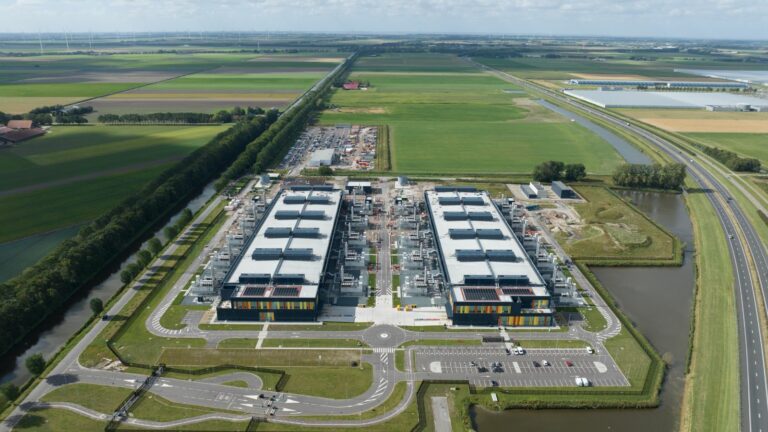
Then came the backup system. Synapse proposed 600 emergency diesel generators with a combined capability of 1,800 megawatts. Taken together, the main plant and backup generators represented 3,200 megawatts of installed generating capacity. The AUC described the proposal as unprecedented in the combination of its scale and proximity to homes. The overall power-generation and data-centre complex would have occupied about 273 acres, or 110.5 hectares — approximately one-tenth of the geographical size of Olds.
Some Homes Would Have Been About 30 Metres From the Boundary
The distance between the proposed development and existing neighbourhoods ultimately became one of the most striking facts in the proceeding. According to the AUC, the project boundary would have been approximately 30 metres from the edge of the first row of properties on the opposite side of a residential road. This was not an isolated industrial site kilometres from established housing; it was directly beside an existing community.
Synapse identified more than 700 residences within 800 metres of the project lands. Its consultation material also identified more than 1,000 residences within a two-kilometre notification radius. Nearby development included not only homes but shops, restaurants and hotels. Residents raised concerns covering noise, air emissions, emergency management, property impacts and the broader compatibility of a major thermal generating complex with an established town. The commission concluded that the problem went beyond whether individual technical effects could potentially be mitigated.
Synapse Had Already Been Through One Failed Application
The August decision came after an unusually turbulent regulatory journey. Synapse originally applied for approval earlier in 2026, but the AUC closed that proceeding on March 6 without ruling on whether the project was ultimately in the public interest. The regulator cited significant deficiencies in the original filing, including errors, incomplete information, internal inconsistencies and shortcomings in public consultation.
Synapse returned quickly. A second application was filed on April 3, giving the company another opportunity to make its case. The new proceeding included additional consultation material, technical evidence and responses to questions from the commission. That history is important because the final denial was fundamentally different from the March closure. This time, the regulator had enough information to reach the merits of the central issue. After reviewing the record and asking Synapse two rounds of written questions, it concluded that further proceedings were unnecessary because the proposed location itself could not be justified.
Public Participation Reached an Extraordinary Level
The scale of community involvement offered another indication of how deeply the proposal had affected Olds. The AUC received statements of intent to participate from approximately 1,500 interested parties. Ultimately, 919 interveners were granted standing, including the Olds Residents for Responsible Development Group. The commission described the proceeding as unusual because of the number of residents living close to the proposed infrastructure and the level of participation that followed.
Those numbers did not automatically decide the case. The AUC specifically cautioned that the volume of objections alone does not determine whether a project is in the public interest. Still, the participation showed how widely the location was perceived as potentially consequential. Synapse conducted mailouts, door-to-door outreach, open houses, information sessions and meetings with municipal representatives. Yet concerns about location remained persistent. For residents whose homes could have faced a vast energy-and-computing complex across the road, the discussion was far from abstract.
Industrial Zoning Was Not Enough to Secure Approval
Synapse argued that its chosen property was within a light-industrial district and that a data centre was a discretionary use there. The company also took the position that the generating plant would be incidental and subordinate to the data-centre operation. But municipal zoning did not settle the question before the provincial regulator.
The AUC explained that local planning decisions are relevant but do not determine whether a power plant satisfies Alberta’s broader public-interest test. Under its mandate, the commission must weigh social, economic, environmental and other effects. It can therefore reach a different conclusion about a generating facility even when municipal planning rules may allow industrial development on the land. The Town of Olds has separately said it does not currently have an active development-permit application from Synapse. In practical terms, the project still faced multiple layers of approval even before the AUC rejected its proposed power source.
Alternative Sites Became a Critical Weakness in Synapse’s Case
Synapse told the regulator that it had examined alternative locations in Rocky View County, Mountain View County and Ponoka County, including properties farther from established population centres. It argued that the Olds site offered a favourable combination of infrastructure, workforce access, compatible land use and reduced effects on agricultural land. The company also noted that the property formed part of the town’s Northeast Area Structure Plan.
The commission accepted that Synapse had reasons for preferring Olds but found that preference insufficient for a facility this large. Because the power plant would have supplied the data centre directly rather than requiring a particular Alberta grid interconnection, the AUC found less justification for placing it beside existing neighbourhoods. A new natural-gas pipeline would have been required regardless. In the commission’s assessment, Synapse had not convincingly demonstrated why comparable benefits could not be achieved at a location offering substantially greater separation from homes and businesses.
Billions in Investment and Thousands of Jobs Were Still on the Table
The controversy was never simply a choice between economic development and no development. When the project was announced, Synapse and the Town of Olds described a proposed investment worth approximately $10 billion. Projections associated with the development included roughly 2,000 construction jobs during the build-out and more than 1,000 long-term technology, operations and related positions once the campus reached full scale.
Those numbers helped explain why municipal officials had viewed data centres as a potentially transformative opportunity. A development of that magnitude could broaden the property-tax base, support local businesses and diversify an economy rooted partly in agriculture and traditional industries. The AUC did not dismiss those benefits. Its final decision explicitly acknowledged potential investment, employment and municipal tax revenue. But regulators concluded that economic upside was not enough to overcome the absence of a compelling justification for positioning the power infrastructure immediately beside an established residential and commercial community.
The Off-Grid Design Reflects Alberta’s Larger Data-Centre Challenge
Synapse planned to generate the computing campus’s electricity itself rather than draw its main supply from Alberta’s interconnected grid. That approach fits an increasingly important provincial reality. Data centres can consume electricity on the scale of cities, and Alberta has seen an extraordinary wave of proposals seeking power. In June 2025, the Alberta Electric System Operator said 29 proposed data-centre projects seeking connections represented more than 16 gigawatts of potential demand.
For perspective, AESO used roughly 1,400 megawatts as the comparable load for Edmonton when discussing the surge. Alberta has consequently encouraged developers to consider bringing their own generation rather than expecting the existing grid to absorb every proposed project. Synapse followed that model, but self-generation created its own planning challenge: a huge industrial power complex still had to be located somewhere. The Olds decision shows that avoiding a major grid connection does not remove questions about where that generation belongs.
The Decision Could Influence Alberta’s Next Wave of AI Projects
Alberta continues to actively pursue AI and data-centre investment. Its provincial strategy highlights available energy, natural gas, a cool climate and opportunities for economic diversification, while officials have been working through policies intended to accommodate extremely large computing loads. Other billion-dollar projects are already advancing, including Meta’s announced $13-billion Alberta data-centre development in Sturgeon County, designed initially around approximately one gigawatt of computing capacity.
At the same time, the government has begun holding public town halls on AI data-centre development as communities ask harder questions about power, water, emissions, land use and local benefits. The Synapse ruling arrives squarely in the middle of that debate. It does not close Alberta to hyperscale computing projects, nor does it establish a simple minimum setback applicable everywhere. What it does establish is a powerful precedent in practice: developers proposing city-scale energy infrastructure beside established neighbourhoods should expect regulators to demand a persuasive explanation for why that particular location is necessary.
This Options Discord Chat is The Real Deal
While the internet is scoured with trading chat rooms, many of which even charge upwards of thousands of dollars to join, this smaller options trading discord chatroom is the real deal and actually providing valuable trade setups, education, and community without the noise and spam of the larger more expensive rooms. With a incredibly low-cost monthly fee, Options Trading Club (click here to see their reviews) requires an application to join ensuring that every member is dedicated and serious about taking their trading to the next level. If you are looking for a change in your trading strategies, then click here to apply for a membership.