35,000+ smart investors are already getting financial news, market signals, and macro shifts in the economy that could impact their money next with our FREE weekly newsletter. Get ahead of what the crowd finds out too late. Click Here to Subscribe for FREE.
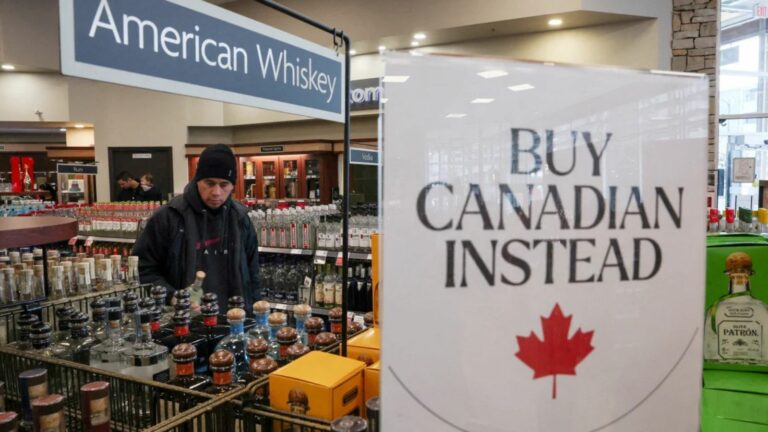
Canada’s strained economic relationship with the United States is increasingly showing up in everyday purchasing decisions. A new Research Co. poll finds 58% of Canadians say they are avoiding U.S.-origin goods when a non-American alternative is available, up from 55% in June. The divide is particularly noticeable across past federal voting patterns: 71% of respondents who voted Liberal in 2025 reported avoiding American goods, compared with 46% of Conservative voters and 76% of NDP voters.
The numbers point to a consumer response that has lasted well beyond the first months of tariff tensions. Yet the picture is more complicated than a simple nationwide boycott. Age, price, product availability and Canada’s deeply integrated supply chains all influence what ultimately ends up in the shopping cart.
Avoiding American Goods Has Become More Common Since June
58% of Canadians Are Avoiding U.S. Goods—71% of Liberal Voters vs. 46% of Conservatives: Poll
- Avoiding American Goods Has Become More Common Since June
- The Political Divide Is Large, but the Poll Does Not Explain Why
- Older Canadians Are Much More Likely to Avoid U.S. Products
- The Response Extends Beyond Products on Store Shelves
- Other Polling Shows a Similar Pattern, Though the Questions Differ
- Retail Data Suggests Some of the Sentiment Reached the Checkout
- Price Remains a Major Limit on Buying Canadian
- Canada’s Dependence on U.S. Supply Makes Complete Avoidance Difficult
- Interest in Alternatives Extends to Canada’s Broader Trade Relationships
- The 58% Figure Is Best Read as a Measure of Reported Behaviour
The headline number is significant partly because it has moved upward rather than fading as the trade dispute has continued. Research Co. found 58% of Canadian adults saying they were avoiding goods originating in the United States when a non-American substitute was available. When the company asked the same question in June, the figure was 55%. That is a relatively modest three-point increase, but it indicates that the behaviour remained widespread several months later rather than disappearing after an initial burst of attention.
That distinction matters when interpreting the result. The question did not ask whether Canadians refuse to buy every American product. It specifically included the condition that a non-American alternative be available. A shopper might therefore continue buying an American product when no practical substitute exists while choosing Canadian, European, Mexican or Asian alternatives in another aisle. Research Co.’s September polling was conducted among 1,003 Canadian adults from September 21 to 23, 2026.
The Political Divide Is Large, but the Poll Does Not Explain Why
Purchasing behaviour varied substantially according to how respondents said they voted in the 2025 federal election. Among Liberal voters, 71% reported avoiding U.S.-origin goods when alternatives were available. The figure was even higher among NDP voters at 76%. Among respondents who voted Conservative, the share was 46%. The same data tables show that 43% of Conservative voters selected “none of these” when asked about several forms of U.S.-related avoidance, compared with 15% of Liberal voters and 11% of NDP voters.
Those differences establish an association between past vote and reported consumer behaviour, but they do not establish a cause. The polling does not determine whether partisan views themselves drove shopping choices, nor does it isolate other factors such as age, geography, household finances or product preferences. The subgroup figures also come from smaller portions of the overall 1,003-person sample, making them inherently less precise than the national estimate. They are best understood as evidence of a substantial divide within this particular poll, rather than proof of why that divide exists.
Older Canadians Are Much More Likely to Avoid U.S. Products
Age produced another striking difference. Research Co. found 70% of respondents aged 55 and older saying they were avoiding American goods when alternatives existed. That compared with 54% among Canadians aged 35 to 54 and 50% among adults aged 18 to 34. The result is consistent with earlier Canadian consumer research that has repeatedly found stronger buy-Canadian or avoid-American behaviour among older shoppers, although the exact percentages vary depending on question wording and methodology.
Regional differences were present but narrower. The Research Co. tables showed avoidance at 65% in Saskatchewan and Manitoba, 60% in Alberta, 59% in Quebec and 58% in Ontario. British Columbia registered 56%, while Atlantic Canada stood at 53%. Those figures should be read cautiously because regional subsamples are considerably smaller than the national sample. Still, the results suggest the behaviour is not confined to one province or one part of the country. In every region measured, at least half of respondents reported avoiding U.S. goods when an alternative was available.
The Response Extends Beyond Products on Store Shelves
Consumer goods are only one part of the response captured by Research Co. One-third of Canadians, or 33%, said they were avoiding American restaurant franchises operating in Canada. That was six percentage points higher than in June. Another 28% said they were avoiding American entertainment options, up three points. These choices can involve everything from restaurant visits to subscriptions and other discretionary purchases, although the poll does not break individual categories down further.
Travel moved in the opposite direction. Twenty-nine per cent said they had cancelled a planned U.S. trip, compared with 32% in June. Broader government travel data also illustrate why self-reported attitudes and actual border traffic should not be treated as identical measures. Statistics Canada reported Canadian visits to the United States were down 10.6% year over year in the first quarter of 2026, but preliminary August figures later showed Canadian-resident return trips from the U.S. by air and automobile up 8.8% from August 2025. Travel patterns can therefore rebound even while a sizeable minority reports avoiding U.S. trips.
Other Polling Shows a Similar Pattern, Though the Questions Differ
Research Co. is not alone in finding persistent resistance to American products. Abacus Data reported on October 1 that 77% of Canadians in its September research said they would either avoid American products entirely or buy as few of them as possible. That combined figure was almost unchanged from the 78% recorded when Abacus asked comparable questions in February 2025. The September research included 1,479 Canadian adults and was conducted from September 4 to 9.
Abacus also found movement from intention toward reported action. The proportion saying they had already tried not to buy American products rose from 38% in February 2025 to 51% in September 2026. Those numbers should not be compared directly with Research Co.’s 58%, because Abacus uses different questions and response categories. The value of the comparison is directional: separate research firms, asking Canadians about the issue in different ways, continue to find substantial numbers reporting efforts to reduce purchases connected to the United States.
Retail Data Suggests Some of the Sentiment Reached the Checkout
Polling can measure what people say they intend to do, but retail data offers another perspective. NielsenIQ reported in June 2025 that U.S. products were experiencing year-to-date sales softness in Canada, including a 6.9% decline for U.S.-origin food products and a 4.5% decline in personal care. Canadian-made food products, meanwhile, were gaining share even though NIQ reported their average unit price was 16% higher in the categories it examined.
Those figures come from an earlier phase of the trade dispute and should not be presented as a measurement of Canadian buying patterns in late 2026. They are nevertheless useful evidence that at least part of the reported shift showed up in actual retail performance rather than existing solely as an opinion-poll response. Angus Reid Institute also cited NielsenIQ retail tracking when discussing Canadian purchasing behaviour in July 2026. The broader picture is therefore one of measurable pressure on some U.S.-made categories, alongside the more recent polling showing that avoidance intentions remain widespread.
Price Remains a Major Limit on Buying Canadian
Political and national considerations may influence a purchase, but affordability still imposes a practical limit. Abacus Data research conducted from June 25 to July 2, 2026 found 53% of Canadians said they often or almost always went out of their way to choose a Canadian product over a non-Canadian one. Yet willingness dropped considerably when respondents were confronted with a noticeably higher Canadian price.
Only 19% said they would buy the Canadian option anyway when it cost noticeably more. Another 43% said they would choose Canadian for some purchases and the cheaper product for others, while 34% said they would simply buy whichever option was less expensive. That helps explain why avoiding U.S. products can be widespread without becoming universal. Households dealing with grocery bills, housing expenses and other costs may prefer a Canadian or non-American product but still make decisions category by category. In practice, origin competes with price, quality, availability, brand familiarity and convenience every time a purchase is made.
Canada’s Dependence on U.S. Supply Makes Complete Avoidance Difficult
Even a determined consumer operates inside one of the world’s most integrated bilateral trading relationships. Statistics Canada reported that 58.8% of Canada’s merchandise imports came from the United States in 2025, although that was down from 62.3% in 2024. In July 2026 alone, Canada imported approximately $44.6 billion in merchandise from the United States out of $75.4 billion in total goods imports. American inputs are also embedded in products assembled or processed in Canada, making nationality more complicated than the logo printed on a package.
Labelling rules add another layer. The Competition Bureau says a non-food good marketed as “Made in Canada” generally needs at least 51% of direct production or manufacturing costs incurred in Canada, along with its last substantial transformation occurring here and an appropriate qualifier. “Product of Canada” carries a substantially higher threshold. Food has separate federal guidance, and a “Made in Canada” food can contain imported ingredients if the last substantial transformation occurred in Canada and the label contains the proper qualification.
Interest in Alternatives Extends to Canada’s Broader Trade Relationships
The same Research Co. poll indicates that consumer avoidance is occurring alongside broader public interest in trading with countries beyond the United States. Seventy-five per cent said Canada should seriously consider enhancing trade with Mexico, while 76% said the same about Japan. Support stood at 77% for Australia and New Zealand, 77% for the United Kingdom and 77% for the European Union. Sixty-one per cent supported considering stronger trade with China.
Actual merchandise flows have also been shifting. Statistics Canada reported that Canadian exports to countries other than the United States climbed 7.4% in July 2026 to a record $25.6 billion. Non-U.S. destinations accounted for 33.7% of Canadian merchandise exports that month. One month cannot establish a permanent restructuring of Canadian trade, and commodity movements can create large fluctuations. Still, the combination illustrates how the public conversation about shopping choices is taking place at the same time businesses and policymakers are paying more attention to markets outside the United States.
The 58% Figure Is Best Read as a Measure of Reported Behaviour
Research Co.’s results are based on an online poll of 1,003 Canadian adults conducted September 21 to 23. The company says the responses were statistically weighted using Canadian census figures for age, gender and region and reports an overall margin of error of plus or minus 3.1 percentage points, 19 times out of 20. Estimates for individual voter, age and regional groups carry more uncertainty because those groups contain fewer respondents than the complete national sample.
There is another important limitation: the poll records what people say they are doing. It does not measure the percentage of household spending that has moved away from American products, nor does it track individual receipts or determine how accurately shoppers identify product origin. The question also includes the important qualifier that a non-American alternative must be available. Taken together with Abacus and NIQ research, however, the evidence indicates that avoiding U.S. products has remained a meaningful feature of Canadian consumer behaviour well beyond the earliest stage of the trade dispute.
This Options Discord Chat is The Real Deal
While the internet is scoured with trading chat rooms, many of which even charge upwards of thousands of dollars to join, this smaller options trading discord chatroom is the real deal and actually providing valuable trade setups, education, and community without the noise and spam of the larger more expensive rooms. With a incredibly low-cost monthly fee, Options Trading Club (click here to see their reviews) requires an application to join ensuring that every member is dedicated and serious about taking their trading to the next level. If you are looking for a change in your trading strategies, then click here to apply for a membership.