35,000+ smart investors are already getting financial news, market signals, and macro shifts in the economy that could impact their money next with our FREE weekly newsletter. Get ahead of what the crowd finds out too late. Click Here to Subscribe for FREE.
Economic confidence can deteriorate long before every national indicator flashes red. Fresh Financial Times/Focaldata findings show more than 53% of registered U.S. voters saying their personal finances have worsened since Donald Trump returned to the White House in January 2025. That finding arrives at an especially sensitive moment: selected Canadian imports are scheduled to face additional 50% U.S. duties beginning at 12:01 a.m. ET on August 19.
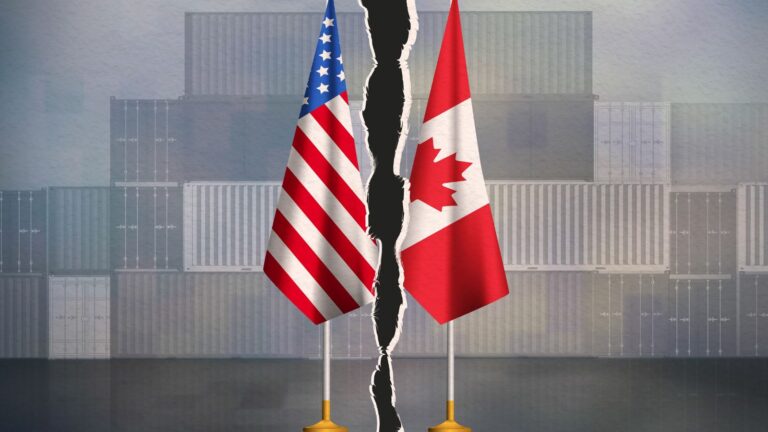
The measures are narrower than a blanket tariff on everything Canada sells to the United States, but they still land inside one of the world’s most deeply integrated trading relationships. With Americans already expressing frustration about prices, wages and the economy’s direction, the approaching deadline is becoming more than a bilateral trade dispute. It is also a test of whether Trump’s tariff strategy can deliver its promised benefits without intensifying the affordability pressures voters say they already feel.
The 53% Figure Is a Personal-Finance Warning
53% of U.S. Voters Say They’re Worse Off Under Trump as His 50% Canada Tariff Deadline Nears: FT Poll
- The 53% Figure Is a Personal-Finance Warning
- The Discontent Extends Beyond Democratic Voters
- The 50% Canada Tariff Deadline Comes at a Delicate Moment
- Negotiators Are Still Talking, but a Deal Is Not Assured
- Inflation Has Cooled From Earlier Peaks, but Affordability Remains a Problem
- Jobs, Spending and Consumer Confidence Are Sending Softer Signals
- Canada Is Not Just Another Overseas Supplier
- Research Shows Why Tariffs Can Find Their Way Back to U.S. Consumers
- USMCA Uncertainty Makes the Dispute Larger Than a Single Tariff Deadline
- The November Midterms Turn the Tariff Fight Into a Political Test
The Financial Times findings offer a striking snapshot of how Americans perceive their economic circumstances. The nationwide online research, conducted by Focaldata from August 7 through August 10, included 1,913 registered voters and carried a margin of error of plus or minus 2.9 percentage points. More than 53% said their finances had deteriorated since Trump returned to office in January 2025. Just as notably, nearly two-thirds said the economy was heading in the wrong direction, while only about one-quarter thought it was moving the right way.
Those answers do not prove that every respondent has objectively lost purchasing power, nor do they establish that any single Trump policy caused the deterioration. Personal financial assessments capture everything from grocery bills and rent to borrowing costs, job security and household debt. Politically, however, perception matters enormously. A family that can still pay its bills but has stopped eating out, postponed replacing a vehicle or become nervous about the next credit-card statement may still conclude that its economic position has worsened. That sentiment becomes especially consequential when another major tariff deadline is only days away.
The Discontent Extends Beyond Democratic Voters
The politically difficult part of the FT findings is not simply that a majority reported being worse off. Almost 57% of independents said their finances had deteriorated, while nearly one-quarter of self-identified Republicans said the same. Trump’s overall job performance also received a 55% disapproval rating, and his net approval among Republicans fell eight percentage points compared with the previous month’s reading. Those numbers suggest that dissatisfaction is reaching constituencies the White House needs to keep economically confident.
Inflation and living costs appear to be an even larger vulnerability. Sixty-four percent of registered voters disapproved of Trump’s handling of inflation and the cost of living, including almost seven in 10 independents and roughly one-third of Republicans. That matters because affordability is experienced in small, repetitive moments: a higher weekly grocery total, a costlier commute or a monthly payment that leaves less room for savings. The White House has countered that its agenda is lowering costs, expanding domestic employment and cutting taxes. Yet as the November midterms approach, the administration must persuade voters that those policies are improving household finances rather than merely promising improvement later.
The 50% Canada Tariff Deadline Comes at a Delicate Moment
The August 19 deadline is significant, but its scope needs to be understood precisely. Trump signed three proclamations under Section 338 of the Tariff Act of 1930 on July 20, imposing additional 50% duties on specified categories of Canadian goods. The White House says the covered products range from items such as wine and hockey equipment to cement, while the measures address separate disputes involving alcohol, dairy and motor vehicles. The additional duties are scheduled to begin at 12:01 a.m. Eastern time on August 19.
This is not a universal 50% levy on everything entering the United States from Canada. The White House says energy, potash, goods already covered by Section 232 tariffs and certain other products, including some fish and critical minerals, are excluded. Reuters estimated that the measures cover roughly $20 billion of Canadian imports, equivalent to about 5.2% of U.S. goods imports from Canada in 2025. Even so, the unusual use of a trade provision that had gone largely dormant for decades adds uncertainty for companies trying to determine what their imported materials will cost after the deadline.
Negotiators Are Still Talking, but a Deal Is Not Assured
Canadian and U.S. officials have not spent the final stretch before the deadline sitting idle. Canada’s trade minister, Dominic LeBlanc, has made repeated trips to Washington, while Canada’s chief trade negotiator, Janice Charette, has also been involved. Reuters reported that LeBlanc had met U.S. Trade Representative Jamieson Greer four times over a three-week period. Canada’s government has simultaneously kept provincial and territorial trade officials briefed as negotiations have continued.
The tone surrounding those negotiations has shifted from day to day. On August 13, Reuters reported that a Canadian source believed discussions were progressing and that Washington also wanted an agreement before August 19. By August 14, however, reporting indicated the two governments remained far apart on a draft deal despite frequent meetings. That contrast illustrates how fluid high-stakes trade bargaining can become near a deadline. For manufacturers and retailers, meanwhile, the practical problem is immediate: purchasing contracts, shipping schedules and pricing decisions cannot always wait for politicians to decide whether a threatened tariff will actually take effect.
Inflation Has Cooled From Earlier Peaks, but Affordability Remains a Problem
The latest inflation numbers are not uniformly negative. U.S. consumer prices rose 0.1% in July and 3.4% from a year earlier, according to the Bureau of Labor Statistics. Core inflation, which excludes food and energy, was running at 2.5% year over year. But several categories remained uncomfortable for household budgets. Food prices were 3.0% higher than a year earlier, while energy prices were up 14.7%. Gasoline prices were 24.6% above their July 2025 level despite declining during the latest month.
The distinction between slower inflation and lower prices is crucial. Inflation can moderate while the accumulated price level that households face remains elevated. A grocery basket that rose sharply over several years does not suddenly become inexpensive because its latest annual increase becomes smaller. Wage data provide another reason for caution: BLS figures showed real average hourly earnings slipping 0.2% between July 2025 and July 2026. That is a modest decline, but it helps explain how voters can hear relatively reassuring economic statistics while still feeling that their purchasing power is under pressure.
Jobs, Spending and Consumer Confidence Are Sending Softer Signals
Other recent indicators reinforce the sense that the economy is neither collapsing nor operating without strain. U.S. nonfarm payrolls declined by 23,000 in July, according to the Bureau of Labor Statistics, while the unemployment rate remained around 4.1%. Employment weakness was particularly visible in areas including retail trade and local government education, even as health-care employment continued to trend upward. The relatively stable unemployment rate therefore sits alongside a much weaker pace of job creation than Americans experienced earlier in the expansion.
Household behavior is showing caution as well. Retail sales dropped 0.6% in July, Reuters reported, marking the first monthly decline in nine months. Preliminary University of Michigan figures put consumer sentiment at 51.0 in August, down from 55.2 in July, while consumers’ year-ahead inflation expectations edged up to 4.3%. None of those data points alone establishes a recession. Together, however, they illustrate why another trade-cost shock attracts attention. When consumers are already becoming more selective about spending, even localized price increases can carry outsized economic and political consequences.
Canada Is Not Just Another Overseas Supplier
The potential impact of tariffs cannot be judged solely by the roughly $20 billion of imports directly targeted. Canada and the United States operate one of the world’s largest bilateral trading relationships, with supply chains built around decades of cross-border commerce. U.S. Trade Representative data show that goods trade between the two countries totaled about $719.5 billion in 2025. The United States exported approximately $336.5 billion in goods to Canada while importing about $383 billion.
That integration means tariffs can affect businesses that never think of themselves as participants in international trade. A U.S. contractor buying material from a distributor, a manufacturer sourcing an intermediate component or a retailer stocking Canadian-made merchandise can encounter costs generated several stages earlier in the supply chain. Canada’s dependence on the relationship is also substantial: the U.S. remained the destination for roughly 72% of Canadian goods exports in 2025, even after that share declined from the previous year. The new tariffs therefore create risks on both sides of the border—lower Canadian sales on one side and potentially more expensive or harder-to-source inputs on the other.
Research Shows Why Tariffs Can Find Their Way Back to U.S. Consumers
Tariffs are legally collected from importers at the U.S. border, but economists have long debated how the ultimate burden is divided among importers, foreign suppliers, businesses and consumers. Research from the Federal Reserve examining the broader tariff increases implemented through November 2025 estimated that they had raised core goods prices by about 3.1% through February 2026 and added approximately 0.8% to the overall core personal consumption expenditures price index. Those estimates cover the broader tariff program rather than the new Canada-specific duties.
Other research points in a similar direction. A New York Federal Reserve analysis estimated that U.S. buyers absorbed roughly 94% of the economic incidence of tariff increases during the first eight months of 2025 because foreign exporters reduced their prices only modestly. Earlier academic work examining the 2018 trade war also found substantial domestic incidence. That does not mean a 50% tariff automatically produces a 50% increase on a store shelf. Companies can compress margins, alter suppliers, change products or absorb some costs. But the evidence makes additional price pressure a legitimate concern when voters are already focused intensely on affordability.
USMCA Uncertainty Makes the Dispute Larger Than a Single Tariff Deadline
The confrontation with Canada is unfolding alongside a broader debate about the future of the U.S.-Mexico-Canada Agreement. During the pact’s first scheduled joint review on July 1, the Trump administration declined to extend USMCA in its current form. That decision did not terminate the agreement or immediately eliminate its existing trading rules. Instead, the pact remains in force and, without a later extension agreement, is scheduled to expire in 2036 while the three countries move through annual reviews.
Washington is simultaneously pushing for changes to regional manufacturing rules. Reuters reported that a U.S. proposal would require vehicles to contain at least 50% U.S.-made content to receive preferential treatment while also raising the existing 75% North American content requirement. Estimates from two Detroit automakers suggested the proposed changes could add at least $2 billion in annual costs for each company. Those proposals remain part of negotiations rather than settled policy, but they demonstrate what is at stake. Businesses planning factories and supply networks make decisions years in advance, so prolonged uncertainty about tariffs and rules of origin can influence investment before any agreement formally changes.
The November Midterms Turn the Tariff Fight Into a Political Test
The FT findings give the Canada deadline a political dimension that stretches well beyond bilateral trade. Registered voters in the research gave Democrats a five-point advantage over Republicans—44% to 39%—when asked which party they were likely to support in November. The same research found voters giving Democrats an advantage on inflation and the cost of living as well as on jobs and the economy, policy areas Republicans have often relied on as electoral strengths. A single national reading is not an election forecast, but it does show where political pressure is building.
Trump’s argument is different. The administration says the Canadian tariffs are designed to counter what it describes as discriminatory treatment of American autos, alcohol and dairy products and to create better conditions for U.S. production and workers. Section 338 also gives the president flexibility to suspend, revoke, amend or supplement the proclamations, meaning August 19 is an important deadline rather than an irreversible endpoint. The coming days will therefore test two competing propositions: whether additional trade pressure can extract concessions from Canada, and whether American voters will tolerate the possibility of higher costs while that strategy plays out.
This Options Discord Chat is The Real Deal
While the internet is scoured with trading chat rooms, many of which even charge upwards of thousands of dollars to join, this smaller options trading discord chatroom is the real deal and actually providing valuable trade setups, education, and community without the noise and spam of the larger more expensive rooms. With a incredibly low-cost monthly fee, Options Trading Club (click here to see their reviews) requires an application to join ensuring that every member is dedicated and serious about taking their trading to the next level. If you are looking for a change in your trading strategies, then click here to apply for a membership.