35,000+ smart investors are already getting financial news, market signals, and macro shifts in the economy that could impact their money next with our FREE weekly newsletter. Get ahead of what the crowd finds out too late. Click Here to Subscribe for FREE.
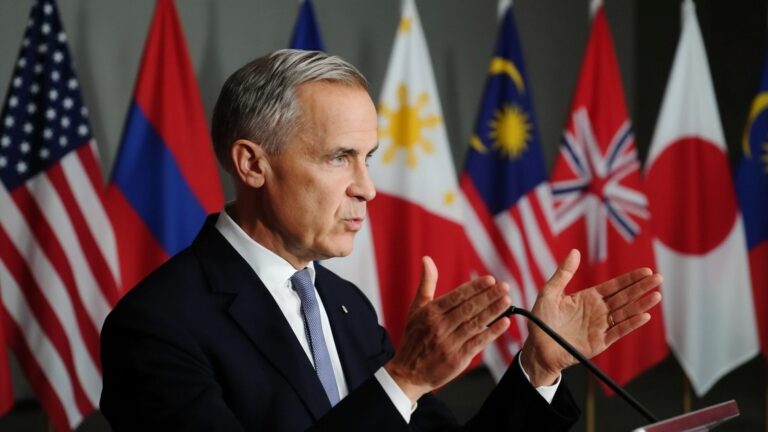
Prime Minister Mark Carney says the harshest criticism of Canada’s military coming from Washington has not come up in his conversations with the man at the top of the U.S. chain of command.
On November 25, Carney revealed that President Donald Trump had not personally raised the concerns recently outlined by the Pentagon, even as American defence officials publicly questioned Canada’s ability to protect North America.
The contrast is striking. While the Pentagon has delivered an unusually blunt assessment of Canada’s military readiness, Carney says his discussions with Trump have focused on resolving international conflicts rather than Canadian defence shortcomings.
The disagreement comes at a sensitive moment for Canada-U.S. relations, with Ottawa increasing military spending, reconsidering major American weapons purchases and attempting to strengthen its defence independence without undermining one of the world’s closest military partnerships.
Carney Says His Conversations With Trump Tell a Different Story
Carney Says Trump Has Never Raised Canada’s Military Shortcomings With Him Despite Pentagon’s Public Rebuke
- Carney Says His Conversations With Trump Tell a Different Story
- Pentagon Accuses Canada of Falling Short in Defending North America
- Pentagon’s Restrictions Add Another Layer to the Dispute
- Canada’s Defence Minister Pushes Back Against Washington
- Canada’s Defence Spending Is Increasing, but Washington Wants More
- The F-35 Fighter Jet Review Has Become a Major Flashpoint
- NORAD and the Arctic Make the Disagreement More Significant
- Military Recruitment Is Improving, but Readiness Remains a Challenge
- Trade Tensions Are Complicating the Defence Relationship
Carney’s comments on Wednesday, November 25, were not a denial that Canada’s military faces challenges. Instead, they highlighted a distinction between what American defence officials have said publicly and what the prime minister has heard directly from Trump. Speaking to reporters on Parliament Hill, Carney explained that their conversations have centred on resolving international conflicts rather than Canada’s military spending. Despite the Pentagon’s unusually direct criticism, the issue had not come up in those discussions.
That distinction matters because Trump is commander-in-chief of the U.S. armed forces, while Defence Secretary Pete Hegseth oversees the Pentagon. Carney specifically invoked that chain of command when responding to the controversy. However, his account establishes only what Trump has discussed with him, not whether the president agrees or disagrees with the Pentagon’s assessment. For Canadian officials navigating increasingly complicated relations with Washington, the difference between a public departmental rebuke and a direct presidential demand could shape how the disagreement is handled.
Pentagon Accuses Canada of Falling Short in Defending North America
The controversy began with a Pentagon fact sheet made public on November 23, criticizing Canada’s military readiness and questioning whether Ottawa was doing enough to defend the continent. American defence officials argued that years of insufficient investment had weakened Canada’s armed forces, leaving significant gaps in their ability to contribute to shared security. The criticism went beyond spending commitments, raising concerns about operational readiness across the air force, navy and army.
The figures were particularly striking. Canada’s own 2025-26 defence report showed that just 41.9% of its key aerospace fleets were serviceable, compared with 53.91% of key maritime fleets and 48% of key land fleets. These figures concern equipment availability, rather than the proportion of the entire military capable of fighting. The same report found that 61% of Canadian military force elements met established readiness targets, against a goal of at least 90% by 2032. Those numbers demonstrate that Canada’s military faces genuine operational challenges, even as Ottawa disputes the Pentagon’s confrontational approach.
Pentagon’s Restrictions Add Another Layer to the Dispute
The Pentagon’s criticism followed another controversial development in the Canada-U.S. defence relationship. Defence Secretary Pete Hegseth issued classified guidance restricting certain interactions between American and Canadian military personnel. Republican Senator Mike Rounds later explained that the restrictions primarily concerned attendance at Canadian think-tank events, conferences and social engagements. Pentagon officials maintained that the changes would not interfere with intelligence sharing, NATO operations or cooperation through the North American Aerospace Defense Command, commonly known as NORAD.
The restrictions nevertheless carry symbolic significance. In May 2026, Washington had already paused participation in the Permanent Joint Board on Defence, an advisory body established in 1940 to strengthen continental security cooperation. For generations, military officials on both sides of the border have worked together through formal agreements and personal relationships developed over years of collaboration. Limiting those interactions could make an already complicated diplomatic relationship more difficult. Although daily military operations have reportedly continued, the moves suggest that Washington is increasingly willing to use established defence relationships to pressure Ottawa over military spending and procurement decisions.
Canada’s Defence Minister Pushes Back Against Washington
Defence Minister David McGuinty responded forcefully to the Pentagon’s accusations on November 24, emphasizing that Canada makes its own decisions about national defence. When questioned about American expectations regarding Canada’s military spending, McGuinty declared that Canada was a sovereign country and did not report to the United States. His remarks came as the federal government faced growing pressure to demonstrate that its military spending commitments were credible and that its procurement plans could meet the country’s security needs.
McGuinty also emphasized that the practical relationship between the two militaries remained intact. Cooperation through NORAD, NATO and other bilateral arrangements was continuing despite the public disagreement. His position reflected a delicate challenge for Ottawa: maintaining essential cooperation with the United States while resisting the suggestion that Washington should dictate Canadian defence policy. Carney’s comments the following day reinforced that approach, but with a different emphasis. Rather than directly challenging the Pentagon’s authority, the prime minister pointed to his own conversations with Trump as evidence that the public criticism had not become a central issue in their discussions.
Canada’s Defence Spending Is Increasing, but Washington Wants More
Canada has substantially increased military spending under Carney’s government. In fiscal 2025-26, the country reached NATO’s previous benchmark of spending 2% of gross domestic product on defence. The federal government’s November 2026 budget subsequently outlined a further increase, projecting combined defence and security-related spending of 4.1% of GDP by 2027-28. That includes approximately 2.6% of GDP devoted to core defence expenditures. Ottawa presents these commitments as evidence that Canada is taking greater responsibility for its own security.
However, NATO’s expectations have also changed. At the alliance’s June 2025 summit in The Hague, members agreed to work toward spending 5% of GDP on defence and related security investments by 2035, including at least 3.5% for core military requirements. The agreement also provides for a review in 2029. Canada’s Parliamentary Budget Officer has questioned the clarity of Ottawa’s longer-term spending plans, arguing that the pathway to the full 5% commitment remains uncertain. The central dispute is therefore not simply whether Canada is spending more, but whether those increases will deliver the military capabilities its allies expect.
The F-35 Fighter Jet Review Has Become a Major Flashpoint
One of the biggest disagreements involves Canada’s planned purchase of 88 American-made F-35 fighter jets from Lockheed Martin. Carney ordered a review of the acquisition in March 2025, as tensions escalated over American tariffs and Trump’s threats toward Canadian sovereignty. By late October 2026, Canada had committed funding for at least the first 16 aircraft and received its first two F-35s for training purposes. However, the broader purchase remained under review, leaving uncertainty surrounding the eventual composition of Canada’s next fighter fleet.
Ottawa has also examined the possibility of purchasing Swedish-made Gripen fighters from Saab, potentially creating additional manufacturing opportunities in Canada. The Pentagon has warned that operating two types of fighter aircraft could complicate training, maintenance and staffing at a time when the Canadian Armed Forces already face personnel shortages. For Ottawa, the decision involves balancing military effectiveness, economic benefits and dependence on American defence technology. For Washington, the potential loss of a major weapons contract adds another source of friction. No final decision on the full fighter fleet had been announced as of November 25.
NORAD and the Arctic Make the Disagreement More Significant
Canada and the United States share an unusually integrated defence relationship through NORAD, established in 1958. The binational military command is responsible for aerospace warning, aerospace control and maritime warning across North America. Canadian and American military personnel work together to identify and respond to potential threats approaching the continent. As concerns grow about advanced missiles, long-range aircraft and Arctic security, maintaining reliable surveillance and response capabilities has become increasingly important. Canada has committed $38.6 billion over 20 years to modernizing its contribution to NORAD, including improvements to northern surveillance systems.
Carney has also emphasized Canada’s contributions to NATO operations overseas. Under Operation REASSURANCE, Canada leads a multinational brigade in Latvia and contributes personnel to other military activities supporting NATO’s eastern flank. More than 3,000 Canadian Armed Forces members deploy throughout the year in support of the operation, making it the country’s largest current international military mission. These contributions demonstrate that Canada’s role in collective defence extends beyond spending statistics. However, deployments abroad and military readiness at home are different measures of capability, meaning Canada’s international commitments do not eliminate concerns about aging equipment and operational shortages.
Military Recruitment Is Improving, but Readiness Remains a Challenge
Canada has made measurable progress in rebuilding its armed forces. During fiscal 2025-26, the military enrolled 7,310 new Regular Force members, surpassing its recruitment target of 6,957 and recording its highest enrolment in more than three decades. The Department of National Defence also reported that 94.9% of authorized Regular Force positions were filled, compared with 91.9% the previous year. These improvements provide Carney’s government with evidence that its recruitment initiatives and investments in military personnel are producing results.
Nevertheless, increasing recruitment does not immediately resolve operational readiness problems. Newly enlisted personnel require training, while experienced pilots, technicians and naval specialists take considerable time to develop. Aging aircraft and ships also require sustained maintenance investment regardless of how quickly recruitment improves. On November 25, Stephen Fuhr, Canada’s secretary of state for defence procurement, acknowledged that military readiness remained below desired levels while emphasizing progress in recruitment and equipment purchases. His comments reflected an important reality: Canada can be improving its military capabilities while still falling short of its long-term objectives. The challenge for Ottawa will be demonstrating that recent investments translate into more operational equipment, better-trained personnel and stronger defensive capabilities.
Trade Tensions Are Complicating the Defence Relationship
The military disagreement is unfolding alongside a broader confrontation over Canada-U.S. trade. Trump’s administration has imposed tariffs on Canadian products, while negotiations over automotive trade and the future of the Canada-United States-Mexico Agreement have generated additional uncertainty. During the agreement’s scheduled review in July 2026, Washington declined to renew the arrangement immediately. Both countries have continued discussions over outstanding trade disputes. Against that backdrop, Canada’s reconsideration of American military purchases carries economic and diplomatic implications beyond the defence sector.
Former Conservative leader Erin O’Toole suggested that the Pentagon’s criticism overlooked important changes Canada had made to its defence policies over the preceding 18 months. He also described the F-35 review as an issue of particular concern to Washington and a potential source of Canadian negotiating leverage. His assessment illustrates how military procurement, trade policy and national sovereignty have become increasingly intertwined. Carney’s disclosure that Trump has not personally raised the Pentagon’s complaints may help distinguish their direct diplomatic relationship from the increasingly confrontational public messaging. However, the underlying issues remain unresolved. Canada’s challenge is to strengthen its military independence while preserving the practical cooperation required to defend North America alongside its most important security partner.
This Options Discord Chat is The Real Deal
While the internet is scoured with trading chat rooms, many of which even charge upwards of thousands of dollars to join, this smaller options trading discord chatroom is the real deal and actually providing valuable trade setups, education, and community without the noise and spam of the larger more expensive rooms. With a incredibly low-cost monthly fee, Options Trading Club (click here to see their reviews) requires an application to join ensuring that every member is dedicated and serious about taking their trading to the next level. If you are looking for a change in your trading strategies, then click here to apply for a membership.