35,000+ smart investors are already getting financial news, market signals, and macro shifts in the economy that could impact their money next with our FREE weekly newsletter. Get ahead of what the crowd finds out too late. Click Here to Subscribe for FREE.
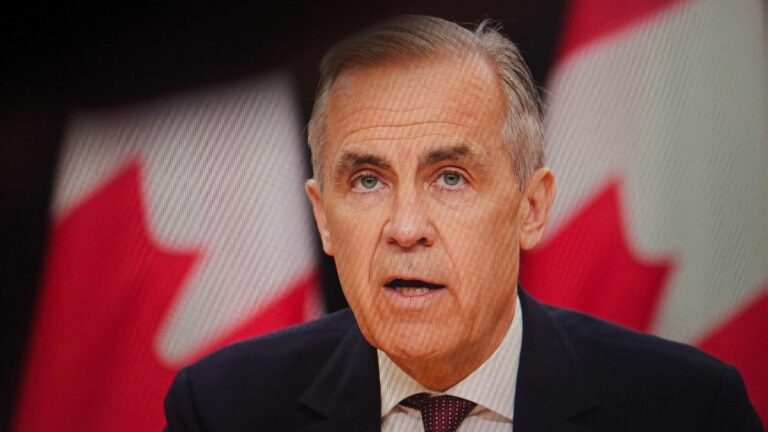
A stronger-than-expected financial outlook has given Ottawa an opportunity to reduce federal deficits, but Canada’s parliamentary budget watchdog says Prime Minister Mark Carney’s government has chosen to direct almost all that additional financial flexibility toward new commitments.
In findings released November 17, 2026, Parliamentary Budget Officer Annette Ryan identified $331.6 billion in new budget measures across three federal fiscal plans. The watchdog also found that the government’s latest budget used 96% of the additional fiscal room available since its spring economic update.
The findings raise questions about Ottawa’s spending priorities, borrowing requirements and promises to exercise fiscal restraint. While the government argues that major investments are necessary to strengthen Canada’s economy, the independent assessment suggests those ambitions are leaving relatively little room to accelerate deficit reduction.
The $331.6 Billion Figure Covers Three Federal Fiscal Plans
Carney Government Adds $331.6 Billion in Budget Measures as Watchdog Says 96% of New Fiscal Room Was Spent
- The $331.6 Billion Figure Covers Three Federal Fiscal Plans
- Ottawa Used 96% of Its Newly Available Fiscal Room
- Stronger Tax Revenues and Higher Energy Prices Created a Financial Windfall
- A $62 Billion Spending Forecast Reduction Is Raising Questions
- Most Recent Measures Still Favour Day-to-Day Government Operations
- New Funding Targets Businesses, Housing and Household Affordability
- Federal Deficits Remain Much Higher Than They Could Have Been
- Ottawa’s Fiscal Targets Are Being Met, but With Little Room for Error
- Housing and Investment Promises Face Growing Scrutiny
- Federal Borrowing Could Reach $764.7 Billion as Interest Costs Climb
The Parliamentary Budget Office’s latest assessment puts the scale of the Carney government’s fiscal commitments into perspective. According to the watchdog, new measures announced through Budget 2025, the Spring Economic Update 2026 and Budget 2026 total $331.6 billion. The calculation captures the costs of policies announced across three separate fiscal plans, rather than representing spending in a single year.
That distinction is important because government measures can include direct expenditures, tax incentives and financial commitments spread over several years. A business investment incentive, for example, can reduce government tax revenue without requiring Ottawa to issue an equivalent payment directly to a company.
The watchdog also examined the government’s fiscal decisions against an earlier baseline. Since the 2024 Fall Economic Statement, new measures have totalled $324.8 billion, nearly twice the $176.7 billion in additional fiscal room created by changing economic and financial conditions. These figures use different accounting comparisons, but both illustrate the substantial scale of Ottawa’s recent policy commitments.
Ottawa Used 96% of Its Newly Available Fiscal Room
One of the most significant findings concerns how the government handled an unexpected improvement in its financial outlook. The Parliamentary Budget Office calculated that economic developments and revised projections created $158.3 billion in additional fiscal room over five years compared with the Spring Economic Update 2026. Rather than directing most of that improvement toward reducing deficits, Ottawa introduced $151.5 billion in new measures covering 2026-27 through 2030-31.
That means approximately 96 cents of every newly available fiscal dollar was committed to new policies, leaving just $6.8 billion of the improvement to strengthen the projected budget balance. The watchdog’s calculation refers to future financial projections, not money that has already been paid out.
The government has argued that investment is necessary to strengthen economic growth, support workers and improve Canada’s competitiveness. However, the watchdog’s findings highlight the competing objective of reducing government borrowing. Even with the improved outlook, Budget 2026 projects a $62.3-billion deficit for 2026-27, only $3 billion smaller than the $65.3 billion previously forecast in the spring.
Stronger Tax Revenues and Higher Energy Prices Created a Financial Windfall
The government’s improved financial position reflects several developments that were not fully anticipated in its earlier forecasts. According to the Parliamentary Budget Office, projected federal revenues increased by $119.3 billion over the five-year planning period before accounting for new measures. Income taxes accounted for $78.3 billion of that improvement, supported by stronger preliminary financial results and expectations for corporate profits and wages.
Higher energy prices also played an important role. Budget 2026 projects nominal GDP growth of 5.6% in 2026, compared with the 4.1% forecast in the spring. Because nominal GDP measures economic activity in current dollars, higher prices can increase the government’s tax base even without a comparable improvement in underlying economic output.
That distinction creates a potential risk for Ottawa. While stronger revenues provide immediate fiscal flexibility, some gains depend on commodity prices and economic conditions that can change quickly. The watchdog warned that falling energy prices could reverse part of the improvement, potentially leaving the government with higher deficits while many of its new commitments remain in place.
A $62 Billion Spending Forecast Reduction Is Raising Questions
Another significant component of Ottawa’s improved financial outlook involves a $62-billion downward revision to projected direct program expenses over five years. The reduction follows stronger-than-expected spending results for the 2025-26 fiscal year, when direct program expenses came in $13.6 billion below the amount estimated in the spring update.
Budget 2026 effectively carries much of that lower spending projection into future years, reducing expected direct program expenses by approximately $12.4 billion annually. However, the Parliamentary Budget Office identified an important limitation: the adjustment was not tied to specific programs or identifiable reductions in previously approved funding. Instead, the government described it as a broad forecasting adjustment involving the timing and level of expenditures.
That makes the change different from an announced program cancellation or a verified permanent efficiency improvement. The watchdog indicated that it would seek additional information from the Department of Finance to better understand the revision. Despite the lower starting forecast, direct program expenses are projected to be $37 billion higher over five years than in the spring update once new measures are included.
Most Recent Measures Still Favour Day-to-Day Government Operations
Carney’s government has emphasized a strategy of reducing routine operating costs while directing more resources toward investments that strengthen Canada’s long-term economic performance. However, the Parliamentary Budget Office found that the composition of recent fiscal commitments tells a more complicated story. Of the $331.6 billion in measures announced across three fiscal plans, approximately $201.7 billion, or 61%, was classified as day-to-day operating spending.
Budget 2026 does shift more decisively toward investment. Of its $151.5 billion in new measures, $89.5 billion is classified as capital investment, while $62 billion is categorized as operating spending. The distinction matters because capital measures are intended to support productive assets, infrastructure and longer-term economic development.
The watchdog also questioned how broadly the government defines capital investment. Its framework includes some tax incentives and subsidies that would not qualify as capital formation under conventional national accounting standards. As a result, the classification can influence whether Ottawa meets its operating-balance target, even though the underlying measures still carry financial costs.
New Funding Targets Businesses, Housing and Household Affordability
The government’s latest measures cover a wide range of economic and social priorities. According to the Parliamentary Budget Office, the six largest measures in Budget 2026 account for approximately $80.7 billion. They include $36.1 billion for the Productivity Mega Deduction, $11.3 billion for workers and businesses affected by tariffs, $11.2 billion for homelessness initiatives, and $8.7 billion for clean electricity tax credits and infrastructure.
Additional commitments include $7.9 billion for housing and infrastructure in First Nations communities and $5.4 billion for Canada’s early learning and childcare system. The measures reflect Ottawa’s attempt to address immediate financial pressures while supporting longer-term economic development.
For households, the budget also proposes a temporary 50% supplement to the Canada Groceries and Essentials Benefit for the 2026-27 benefit year. However, delivering assistance remains an important challenge. The watchdog previously estimated that approximately 1.4 million potentially eligible Canadians were missing out on GST credit benefits because they had not filed tax returns. New funding may provide meaningful assistance, but its effectiveness ultimately depends on reaching the intended recipients.
Federal Deficits Remain Much Higher Than They Could Have Been
The Parliamentary Budget Office’s analysis illustrates how new spending decisions affect Ottawa’s deficit projections. Without the latest tax and spending measures, the federal deficit for 2026-27 would have fallen to an estimated $43.8 billion. Instead, Budget 2026 projects a deficit of $62.3 billion, approximately $18.5 billion higher than the scenario without additional measures.
The difference becomes more pronounced toward the end of the government’s planning period. Without new measures, the deficit was projected to decline to $20.8 billion by 2030-31. With the government’s commitments included, the projected deficit remains at $52.9 billion. That represents a difference of more than $32 billion in that year alone.
These comparisons do not establish that every proposed measure is unnecessary or that cancelling them would be practical. Investments can generate economic benefits, protect employment and strengthen public services. However, the figures demonstrate the financial trade-offs involved. Ottawa has chosen to prioritize additional programs and investment incentives rather than use most of its improved fiscal outlook to accelerate deficit reduction.
Ottawa’s Fiscal Targets Are Being Met, but With Little Room for Error
Despite concerns about spending and borrowing, the Parliamentary Budget Office acknowledged that Budget 2026 projects compliance with the government’s two principal fiscal targets. These commitments involve maintaining a declining deficit relative to GDP and balancing day-to-day operating spending with revenues by 2028-29.
The government now expects to achieve an operating surplus of $11.2 billion in 2027-28, one year ahead of its original deadline. However, the watchdog emphasized that the second target leaves very little protection against unexpected economic developments.
In 2027-28, the projected deficit-to-GDP ratio has a margin of approximately $2 billion before it would stop declining. The government’s own downside economic scenario would increase the deficit by $3.6 billion that year, enough to breach the target.
The assessment also found that, without new measures, the operating budget would have reached surplus in 2026-27. In other words, stronger revenues were already improving the outlook. Ottawa’s fiscal targets remain achievable under current projections, but meeting them depends on economic conditions developing reasonably close to expectations.
Housing and Investment Promises Face Growing Scrutiny
The budget watchdog also examined whether the government’s substantial commitments are producing measurable progress. Housing remains an important example. Budget 2025 established an ambition to double the pace of home construction, but the Parliamentary Budget Office found that cumulative housing starts from January through September 2026 were approximately 4% below the comparable period in 2025.
Budget 2026 includes roughly $14.8 billion in new housing-related funding over five years, including support for non-market housing, homelessness programs and housing affordability. Yet additional funding does not automatically translate into completed homes, particularly when construction timelines, labour shortages and project costs create practical obstacles.
Similar questions surround Ottawa’s broader investment strategy. The government has highlighted nearly $500 billion in financing commitments associated with the Canada Investment Summit as progress toward its $1-trillion capital investment objective. However, the watchdog stressed that many commitments came from financial institutions willing to provide financing for future projects, rather than investors committing funds to specific developments. The distinction matters because financing capacity alone does not establish how many projects will proceed or when their economic benefits will materialize.
Federal Borrowing Could Reach $764.7 Billion as Interest Costs Climb
Beyond the annual deficit, the Parliamentary Budget Office identified a larger financial challenge involving Ottawa’s borrowing requirements. Budget 2026 projects cumulative federal borrowing of $764.7 billion between 2026-27 and 2030-31, compared with approximately $288.7 billion in cumulative budget deficits over the same period.
The difference reflects financial transactions that do not appear as ordinary budget expenses, including loans, investments and the upfront purchase of capital assets. These transactions can create financial assets for the government, but they still require financing and expose Ottawa to borrowing costs.
Those costs are becoming increasingly significant. Federal public debt charges are projected to increase from $53.5 billion in 2025-26 to $85.5 billion by 2030-31. On a per-person basis, annual debt charges are expected to reach approximately $2,009 by the end of the projection period.
The government maintains that investments can support stronger long-term economic growth, and the watchdog’s projections do not indicate an immediate fiscal crisis. Nevertheless, rising interest expenses reduce future financial flexibility. The central question is whether Ottawa’s expanding commitments will generate sufficient economic and social benefits to justify their costs while preserving room to respond to future challenges.
This Options Discord Chat is The Real Deal
While the internet is scoured with trading chat rooms, many of which even charge upwards of thousands of dollars to join, this smaller options trading discord chatroom is the real deal and actually providing valuable trade setups, education, and community without the noise and spam of the larger more expensive rooms. With a incredibly low-cost monthly fee, Options Trading Club (click here to see their reviews) requires an application to join ensuring that every member is dedicated and serious about taking their trading to the next level. If you are looking for a change in your trading strategies, then click here to apply for a membership.