35,000+ smart investors are already getting financial news, market signals, and macro shifts in the economy that could impact their money next with our FREE weekly newsletter. Get ahead of what the crowd finds out too late. Click Here to Subscribe for FREE.
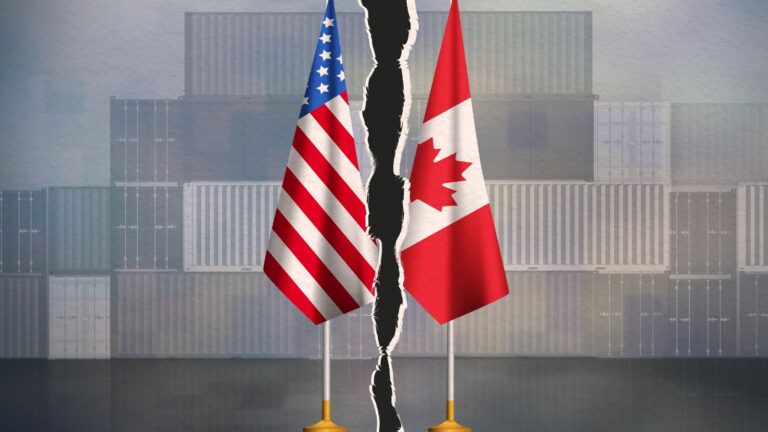
The latest signals from Washington suggest Canada and the United States may once again be approaching a trade breakthrough, but the final stretch remains anything but settled. White House economic adviser Kevin Hassett says negotiations are gathering momentum and that the two countries are “very close” to an agreement. President Donald Trump has similarly predicted that the dispute will be resolved soon.
Behind that optimism, however, a more cautious message has emerged. A U.S. official familiar with the discussions says Washington still does not believe Canada has offered enough, while Ottawa continues to insist that any agreement must protect Canadian economic interests. After a previous near-deal collapsed in August, neither government appears willing to treat progress as a guarantee of success.
Washington Is Sending Two Messages at the Same Time
Trump Official Says Canada Still Hasn’t Offered Enough as White House Claims Trade Agreement Is Close
- Washington Is Sending Two Messages at the Same Time
- Lutnick and LeBlanc Have Reopened a Critical Negotiating Channel
- The Failed August Deal Still Hangs Over Every Conversation
- Tariffs Are Already Being Rewritten Before Any Agreement Is Signed
- Autos and Steel Remain the Toughest Economic Test
- U.S. Midterm Politics Has Become Part of the Trade Calendar
- Canada Has Leverage, but Its Dependence on the U.S. Market Is Still Enormous
- A Tariff Deal Would Not End the Larger CUSMA Fight
On the surface, the latest statements coming from the Trump administration sound unusually optimistic. National Economic Council Director Kevin Hassett said on October 25 that negotiations had “picked up” and were “gathering steam,” adding that he believed the countries were very close to finally reaching an agreement. Hassett also said Commerce Secretary Howard Lutnick had been communicating with Canadian counterparts throughout the week. Trump reinforced that message while campaigning in Michigan, predicting that the tariff dispute would be settled relatively soon.
Yet the administration is simultaneously keeping pressure on Ottawa. Bloomberg reported that a U.S. official familiar with the sensitive discussions said Washington still does not believe Canada has offered enough and that the outlook remains uncertain. Trump had made the bargaining imbalance explicit two days earlier, telling reporters that Canada was working hard for an agreement while insisting that the United States had “all the cards.” Those statements are not necessarily contradictory. Negotiators can be close on the architecture of an agreement while remaining divided over the concessions required to sign it. After what happened in August, that distinction has become especially important.
Lutnick and LeBlanc Have Reopened a Critical Negotiating Channel
One reason for the increased optimism is the apparent acceleration of contact between senior officials. Hassett identified Commerce Secretary Howard Lutnick as an important participant, saying Lutnick had been speaking with Canadian counterparts through the previous week. Bloomberg also reported that discussions involving Lutnick and Dominic LeBlanc, the minister responsible for Canada-U.S. trade, had intensified in recent weeks. Ottawa said Sunday that Canada remained in constructive dialogue with Washington and was prepared to pursue a mutually beneficial trading relationship.
The political leadership has also remained engaged. Prime Minister Mark Carney said on October 21 that he had spoken with Trump and discussed trade, while reiterating that Canada was prepared to negotiate when Washington was ready. His condition was straightforward: the resulting agreement must serve Canadian interests. That language reflects the difficult position Ottawa faces. Canadian businesses want greater certainty after months of tariff changes, but accepting an agreement simply to end the immediate dispute could create longer-term problems if the terms constrain Canadian industrial or trade policy. The renewed conversations therefore represent meaningful progress, but they do not yet amount to proof that the core disagreements have been resolved.
The Failed August Deal Still Hangs Over Every Conversation
The biggest reason for caution is that Canada and the United States have already been this close before. Negotiations intensified in August and appeared to be moving toward a comprehensive arrangement. Canada says it was prepared to remove remaining retaliatory tariffs in strategic sectors if Washington substantially reduced American tariffs on Canadian products. Instead, Prime Minister Carney suspended negotiations on August 21, arguing that last-minute changes to the American proposal were unfair, uneconomic and raised questions about whether any agreement would provide the stability Canada needed.
Washington offered a very different version of the collapse. U.S. Trade Representative Jamieson Greer said Canada had declined to finalize terms that had been agreed earlier and accused Ottawa of introducing new demands and walking back commitments. Greer said the American proposal included significant tariff reductions covering steel, aluminum, automobiles and lumber, along with broader cooperation on economic security, export controls, digital trade and critical minerals. The result was not simply another negotiating delay. New 50% U.S. tariffs took effect on a broad group of Canadian products, followed by Canadian retaliation. With both governments still publicly blaming the other for that failure, negotiators now have to solve the substantive issues while also rebuilding confidence that another near-final package will not unravel at the last moment.
Tariffs Are Already Being Rewritten Before Any Agreement Is Signed
The tariff landscape is continuing to move even without a final deal. On October 23, Trump modified the list of Canadian products affected by the United States’ Section 338 tariffs. The White House said products including certain plywood sheets, paper products, machinery, refrigeration equipment and packing materials would be removed from the additional 50% duties. At the same time, other products, including certain valves, carpets and waste products, were added. The changes are scheduled to take effect October 30.
That matters because businesses are being forced to operate under rules that can change independently of the broader negotiations. The White House says the Section 338 duties apply to covered products even when those goods otherwise qualify under the United States-Mexico-Canada Agreement, and they can sit on top of separate Section 232 tariffs. Canada, meanwhile, introduced counter-tariffs on September 8 covering C$27.6 billion of U.S. imports, with rates of 15%, 25% or 50% depending on the product. The measures target areas including steel, aluminum, dairy, appliances, agricultural equipment, pulp and paper, plastics and electronics. For companies ordering machinery, packaging or raw materials months in advance, the uncertainty itself has become a cost.
Autos and Steel Remain the Toughest Economic Test
Few sectors illustrate the stakes better than automobiles. Canada’s automotive industry directly supports more than 125,000 jobs and produced more than 1.2 million vehicles in 2025. Federal data indicate that more than 90% of Canadian-made vehicles and roughly 60% of Canadian-made auto parts are exported to the United States. The industry is deeply integrated rather than neatly divided by the border: Carney has said parts used in an average vehicle can cross the Canada-U.S. border as many as eight times before a finished product reaches a customer.
That integration is why tariffs can hurt manufacturers on both sides simultaneously. Carney said in October that Canadian auto exports to the United States had declined by more than 10%, while American automotive exports to Canada had fallen by more than 20%. Ottawa and Ontario responded on October 21 with an $8.7-billion package aimed at industries exposed to tariffs, including major funding for steel production and automotive investment. Steel presents a similar challenge because it feeds construction, machinery, defence and vehicle manufacturing. Any credible trade settlement therefore has to do more than remove duties from a few politically sensitive products. Canadian officials have repeatedly identified automobiles, steel, aluminum and lumber as strategic sectors where meaningful tariff relief is required for a durable agreement.
U.S. Midterm Politics Has Become Part of the Trade Calendar
The negotiations are also unfolding days before the November 3 U.S. midterm elections, placing Canada policy directly inside several closely contested American races. The clearest example is Maine. Republican Senator Susan Collins had pressed the Trump administration for relief from Canadian tariffs affecting businesses and farmers in her state. Trump’s October 23 changes subsequently removed 50% duties from several products important to Maine industries, including certain plywood, paper, packaging, refrigeration and agricultural products. Collins publicly welcomed the decision while facing a competitive re-election campaign.
Michigan provides another example. Trump travelled to Port Huron on October 25 to campaign for Republican candidates in a state whose auto industry is intimately connected to Canadian production. At the rally, he said the dispute with Canada would be settled soon. Republican Senate candidate Mike Rogers has supported parts of Trump’s manufacturing agenda while acknowledging that the automotive component of the Canadian tariff policy worries him. That tension captures the political problem facing lawmakers in border states: tariffs can be presented as protection for domestic industry, but they can also increase costs for manufacturers whose supply chains depend on Canadian inputs. The closer election day gets, the stronger the incentive becomes to show tangible progress.
Canada Has Leverage, but Its Dependence on the U.S. Market Is Still Enormous
Trump’s argument that Washington holds the stronger negotiating position is rooted partly in the scale of Canada’s dependence on the American market. Statistics Canada reported that 71.7% of Canadian merchandise exports went to the United States in 2025. That was down significantly from 75.9% a year earlier, reflecting Canada’s growing push toward other markets, but it still means that disruptions in U.S. access quickly reach Canadian factories, farms, resource companies and transportation networks.
Dependence, however, runs in both directions. The Office of the U.S. Trade Representative estimates that American goods and services trade with Canada totalled about US$872.3 billion in 2025. U.S. goods exports to Canada alone were approximately US$333.6 billion, making the Canadian market enormously important for American producers. Canadian government figures put total cross-border goods and services flows at roughly C$3.5 billion every day in 2025. That scale explains why seemingly narrow disputes over plywood, farm equipment or automotive content can quickly become political issues hundreds of kilometres away from the border. Canada may have less bargaining power because of its heavier reliance on the U.S. market, but a prolonged trade confrontation also creates costs for American states, businesses and workers that depend on Canadian customers and suppliers.
A Tariff Deal Would Not End the Larger CUSMA Fight
Even if negotiators produce a bilateral tariff agreement, a much larger North American trade question will remain unresolved. During the formal July 1 review of the United States-Mexico-Canada Agreement, Washington declined to extend the pact in its current form. Canada supported renewal, but U.S. Trade Representative Jamieson Greer said the Trump administration wanted shortcomings in the agreement and American trade deficits addressed before supporting an extension.
That decision did not terminate CUSMA. The agreement remains in force and is scheduled to continue until 2036 unless a country separately exercises its withdrawal rights. Because all three governments did not agree to extend it during the 2026 review, the agreement now moves into annual joint reviews until the countries approve another 16-year extension or the existing term expires. USTR has already begun the consultation process ahead of the 2027 review. That makes the agreement currently being discussed with Canada best understood as a potential near-term settlement to the tariff confrontation rather than a final resolution of North American trade policy. A successful deal could lower immediate tensions and give businesses greater certainty. The harder debate over automobiles, rules of origin, economic security and the future structure of CUSMA would still be waiting.
This Options Discord Chat is The Real Deal
While the internet is scoured with trading chat rooms, many of which even charge upwards of thousands of dollars to join, this smaller options trading discord chatroom is the real deal and actually providing valuable trade setups, education, and community without the noise and spam of the larger more expensive rooms. With a incredibly low-cost monthly fee, Options Trading Club (click here to see their reviews) requires an application to join ensuring that every member is dedicated and serious about taking their trading to the next level. If you are looking for a change in your trading strategies, then click here to apply for a membership.