35,000+ smart investors are already getting financial news, market signals, and macro shifts in the economy that could impact their money next with our FREE weekly newsletter. Get ahead of what the crowd finds out too late. Click Here to Subscribe for FREE.
A threat against one of Canada’s best-known aircraft manufacturers has taken an unexpected turn in the American heartland. On October 19, President Donald Trump signalled he would help Bombardier, the Montreal-based aerospace company he had previously threatened to shut out of the United States. The apparent change came after Republican Senator Roger Marshall raised concerns about the company’s American workforce, including approximately 1,500 jobs in Wichita, Kansas.
The development exposes a difficult reality behind the Canada–U.S. trade dispute. Bombardier may be headquartered in Quebec, but its aircraft depend on thousands of American workers, suppliers and customers. Trump’s latest remarks suggest those connections have influenced his thinking. However, no formal policy reversal was announced, and the original sales ban had never been implemented. For employees on both sides of the border, the episode illustrates how quickly political threats can create uncertainty around deeply interconnected industries.
Trump Changes His Tone During a Kansas Campaign Rally
Trump Backs Away From Bombardier Threat After Republican Senator Raises 1,500 Kansas Jobs
- Trump Changes His Tone During a Kansas Campaign Rally
- The Original Threat Put Bombardier’s American Business at Risk
- Senator Roger Marshall Makes Kansas Jobs a Political Priority
- Another Republican Senator Also Pressed Washington to Reconsider
- Wichita Is Much More Than a Small Bombardier Outpost
- A New $50 Million Investment Strengthens Bombardier’s Kansas Argument
- Bombardier’s Supply Chain Reaches Across 47 American States
- Defence Contracts Make the Dispute More Complicated
- Canada’s Retaliatory Tariffs Helped Trigger the Confrontation
- The Threat Created Uncertainty Even Without a Formal Ban
- A Tight Senate Race Adds Pressure to Protect Local Employment
- The Next Test Is Whether Washington Follows Through
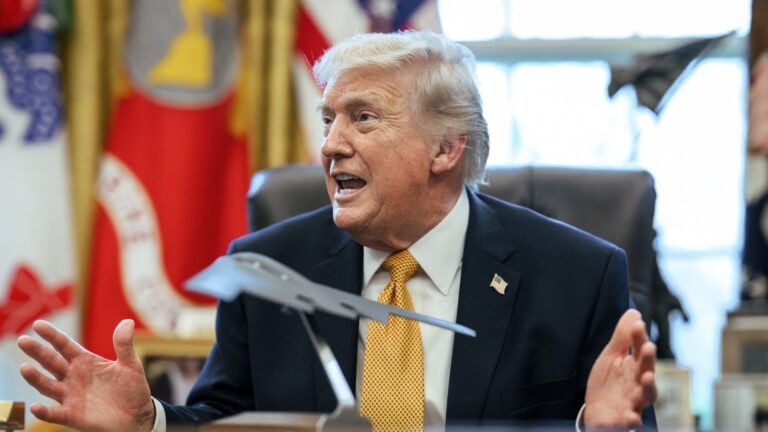
Speaking at a Republican campaign rally in Park City, Kansas, on October 19, Trump appeared to soften his earlier position against Bombardier. The president told supporters that Senator Roger Marshall had contacted him about an aviation company operating in the state. Trump said he intended to help the company, explaining that he had initially viewed it primarily as a Canadian business before learning more about its American operations. Although he did not identify Bombardier by name, the context clearly pointed to the Montreal-based aircraft manufacturer.
The shift was significant because Trump had previously demanded that Bombardier stop selling aircraft in the United States unless it increased American manufacturing. During the rally, he instead indicated that the company’s Kansas presence deserved protection. His remarks suggested a willingness to reconsider the threat rather than pursue an immediate confrontation. Nevertheless, Trump did not outline a new trade arrangement, announce a regulatory decision or establish specific protections for Bombardier. The change was verbal, leaving questions about how Washington would treat the company going forward.
The Original Threat Put Bombardier’s American Business at Risk
The controversy began on September 7, when Trump used Truth Social to declare that Bombardier should no longer sell aircraft in the United States. He criticized the Canadian company’s products and argued that manufacturers benefiting from American customers should build more of their planes on American soil. The message reflected his broader effort to use access to the U.S. market as leverage in disputes over trade and domestic manufacturing. It was particularly consequential for Bombardier because American customers account for roughly half its sales.
The proposed restrictions immediately raised concerns among employees, business leaders and aviation specialists. Bombardier’s commercial operations depend on customers being able to purchase, operate and maintain expensive aircraft across international borders. A sudden loss of access to the United States could disrupt future orders and affect the broader supplier network. Yet the distinction between a presidential threat and an enforceable restriction remained important. Trump did not explain the legal mechanism for barring sales, and the administration had not implemented a formal ban when he made his latest remarks in Kansas.
Senator Roger Marshall Makes Kansas Jobs a Political Priority
Marshall, a Republican seeking another Senate term in November, quickly found himself defending jobs at a company targeted by a president from his own party. On September 8, he publicly promised to protect Bombardier’s workforce in Kansas and said he had already raised the matter inside the Oval Office. His statement referred to more than 1,200 local jobs, while subsequent company and state government figures placed Bombardier’s Wichita workforce at approximately 1,500 employees.
Marshall did not simply reject Trump’s broader manufacturing objective. Instead, he argued that Bombardier should expand production and employment in Wichita, pointing to the city’s long history of aircraft manufacturing. He recalled a period when Learjet, later part of Bombardier, employed more than 3,000 people locally. His preferred outcome was therefore to preserve existing employment while attracting additional manufacturing work. Trump’s October 19 remarks explicitly acknowledged Marshall’s phone call, giving the senator an opportunity to demonstrate influence with the White House. Whether that intervention ultimately produces lasting policy certainty remains unresolved.
Another Republican Senator Also Pressed Washington to Reconsider
Marshall was not the only Kansas Republican concerned about the potential consequences. Senator Jerry Moran contacted the Trump administration shortly after the September announcement, emphasizing Bombardier’s contribution to the state’s aerospace and defence industries. Moran’s September 7 statement highlighted the importance of the company’s workforce and its connections to local suppliers. He subsequently reported discussions involving Bombardier officials, the White House, the U.S. commerce secretary and the American trade representative.
Moran’s argument extended beyond protecting a single employer. Wichita’s aviation sector depends on interconnected manufacturers, specialized contractors, maintenance providers and experienced technical workers. When a major company faces uncertainty, the consequences can spread through businesses that provide components, equipment and services. Moran called for Canada and the United States to resolve their disagreements while recognizing their shared economic interests. His intervention also showed that concern about the Bombardier threat was not limited to one politician facing re-election. It reflected a broader recognition among Kansas leaders that American manufacturing jobs can depend on companies headquartered outside the country.
Wichita Is Much More Than a Small Bombardier Outpost
Bombardier’s presence in Wichita is substantial. The city identifies the company among its major employers, alongside aviation giants such as Spirit AeroSystems and Textron Aviation. Bombardier’s local facilities support aircraft testing, maintenance, engineering and specialized modifications. Wichita also serves as the company’s United States headquarters and the principal home of Bombardier Defense, which works on aircraft configured for military and government missions. These operations require experienced mechanics, engineers, technicians and other aviation professionals whose skills cannot easily be replaced.
The relationship also carries considerable history. Learjet produced aircraft in Wichita for approximately six decades before Bombardier delivered the final Learjet 75 in March 2022. Rather than abandoning the city afterward, Bombardier redirected operations toward flight testing, aircraft servicing and defence programs. Those activities helped preserve Wichita’s importance within the company’s international business. For employees who lived through the end of Learjet production, uncertainty surrounding another potential disruption carries particular significance. Their jobs represent years of training and specialized experience, not merely numbers in an international trade dispute.
A New $50 Million Investment Strengthens Bombardier’s Kansas Argument
Just four days before Trump’s October 19 rally, Bombardier announced approximately $50 million in investments at its Wichita facilities. The October 15 announcement coincided with the inauguration of the company’s North American Learning Center, a new facility designed to train aircraft mechanics and maintenance technicians. Kansas Governor Laura Kelly and Lieutenant Governor David Toland attended the opening alongside Bombardier executives. The investment also includes an expanded wheel-and-tire operation and additional planned capabilities intended to strengthen the company’s American service network.
The training centre provides a particularly tangible example of Bombardier’s commitment to U.S. employment. Aviation International News reported that approximately 250 newly hired technicians are expected to complete training there during its first year. The facility includes a retired Global 5000 fuselage that allows employees to practise maintenance procedures on real aircraft equipment. These developments complicate any suggestion that Bombardier merely sells Canadian products to American customers without investing locally. They also give Kansas officials concrete evidence when arguing that protecting the company’s operations supports American jobs, technical training and long-term industrial growth.
Bombardier’s Supply Chain Reaches Across 47 American States
Bombardier’s American economic footprint extends far beyond Kansas. In its September response to Trump’s original threat, the company reported purchasing more than $2.5 billion in goods and services annually from American suppliers. Its supply network includes approximately 2,800 companies operating across 47 states. Bombardier also employs roughly 3,500 people directly in the United States, with operations involving manufacturing, maintenance, engineering and customer support.
Some of the components produced in America are essential to Bombardier’s most advanced aircraft. Wings for its Global 8000 business jet are manufactured in Red Oak, Texas, while important flight-control components are produced near Los Angeles, California. American companies also provide engines, avionics and other major systems. This illustrates the complexity of modern aerospace manufacturing: aircraft may undergo final assembly in Canada while depending heavily on components and expertise developed in the United States. Restricting sales of those aircraft could therefore affect American suppliers as well as Canadian factories. Bombardier’s supply chain demonstrates why national manufacturing interests cannot always be separated neatly by the location of a corporate headquarters.
Defence Contracts Make the Dispute More Complicated
Bombardier’s aircraft are not used exclusively by private executives and wealthy travellers. The company’s Defense division supplies platforms for specialized military and government operations, including surveillance, communications and intelligence missions. Its Wichita employees have performed engineering and modification work on Global aircraft used in defence programs. In 2022, Bombardier announced the delivery of a Global aircraft configured for the U.S. Air Force’s Battlefield Airborne Communications Node program, which supports military communications.
The same Wichita facilities have supported international defence customers. Bombardier’s work on Germany’s PEGASUS surveillance-aircraft program involves modifications to Global 6000 jets before specialized equipment is integrated by European partners. These projects demonstrate how the company’s American operations support activities extending beyond commercial aviation. They also make the economic consequences of a potential sales restriction more complicated. A disruption affecting Bombardier could influence businesses involved in maintaining and modifying aircraft used by government customers. That does not mean defence contracts automatically protect the manufacturer from trade measures, but it provides another reason for Washington to consider the implications carefully.
Canada’s Retaliatory Tariffs Helped Trigger the Confrontation
The Bombardier dispute developed during a particularly difficult period in Canada–U.S. trade relations. On August 21, Prime Minister Mark Carney announced that Canada was suspending trade negotiations after rejecting proposed American terms. The United States subsequently imposed 50% tariffs affecting approximately C$27.6 billion worth of Canadian products. Ottawa responded with counter-tariffs targeting an equivalent value of American goods, which took effect on September 8, the day after Trump’s Bombardier announcement.
Canada’s measures included tariffs of 15%, 25% and 50% on selected American imports, including products in sectors such as steel, aluminum, dairy, appliances and agricultural equipment. The dispute created additional uncertainty for manufacturers already operating across the border. Bombardier became a particularly visible target because of its Canadian headquarters and substantial American customer base. However, Trump’s proposed aircraft sales ban was separate from the broader tariffs already imposed on other goods. His apparent retreat on Bombardier should not be confused with a resolution of the wider trade conflict, which continues to affect businesses and workers in both countries.
The Threat Created Uncertainty Even Without a Formal Ban
One important aspect of the controversy is that the proposed Bombardier restrictions were never formally implemented. Aviation lawyers consulted by Reuters in September questioned how the administration could prevent deliveries of aircraft that had already received the necessary U.S. aviation approvals. Federal Aviation Administration certification is fundamentally connected to aircraft design and safety. The agency’s published rules permit airworthiness certificates to be revoked under specified conditions involving approved design or safe operation, rather than simply because of a political trade disagreement.
Trump had previously threatened Bombardier in January 2026, when he discussed decertifying Canadian aircraft and imposing a 50% tariff over Canada’s certification process for American-made Gulfstream jets. Those threats also raised questions about regulatory authority. Although the September sales-ban proposal was not enacted, it still affected market confidence. Reuters reported that Bombardier shares fell approximately 3.6% following the announcement. The episode illustrates how uncertainty can influence investor sentiment and business planning even when a threatened government measure never becomes an enforceable policy.
A Tight Senate Race Adds Pressure to Protect Local Employment
The political timing is difficult to ignore. Marshall faces Democrat Adam Hamilton in the November 3 midterm elections, with Kansas emerging as a more competitive Senate contest than Republicans had initially expected. Trump carried the state by approximately 16 percentage points in the 2024 presidential election, but Marshall’s re-election campaign has faced growing scrutiny. Hamilton criticized the Bombardier threat, arguing that it endangered well-paying Kansas jobs and demonstrated the economic consequences of Washington’s trade policies.
During Trump’s October 19 appearance, the president repeatedly urged Kansas voters to support Marshall. His acknowledgement of the senator’s intervention on Bombardier offered a concrete example of Marshall advocating for a major local employer. However, both parties can point to the same episode for different reasons. Republicans can highlight the apparent reversal as evidence that their representatives have influence in Washington, while Democrats can argue that the original threat created unnecessary uncertainty. For Bombardier employees, the immediate concern is considerably less partisan: they want stable operations, secure employment and confidence that political disputes will not jeopardize their livelihoods.
The Next Test Is Whether Washington Follows Through
Trump’s October 19 comments represent a meaningful change in tone, but the longer-term outcome remains uncertain. The president indicated that Bombardier’s American presence deserved protection after learning more about its Kansas workforce. Still, he did not announce a written exemption, formally withdraw a regulatory measure or outline an agreement with the Canadian manufacturer. Since the proposed sales ban had not taken effect, the immediate development is best understood as a retreat from a threat rather than the cancellation of an operating restriction.
For Canada, the episode offers a revealing example of the economic leverage created by shared North American supply chains. Bombardier’s Canadian headquarters and manufacturing operations are closely connected to American jobs, technology and customers. Its Wichita expansion demonstrates that protecting Canadian aerospace activity can also support investment in the United States. Whether this recognition produces greater stability will depend on future decisions in Washington and the broader direction of Canada–U.S. trade relations. For now, the strongest message from Kansas is that a trade confrontation aimed at a Canadian company can quickly become a fight to protect American workers.
This Options Discord Chat is The Real Deal
While the internet is scoured with trading chat rooms, many of which even charge upwards of thousands of dollars to join, this smaller options trading discord chatroom is the real deal and actually providing valuable trade setups, education, and community without the noise and spam of the larger more expensive rooms. With a incredibly low-cost monthly fee, Options Trading Club (click here to see their reviews) requires an application to join ensuring that every member is dedicated and serious about taking their trading to the next level. If you are looking for a change in your trading strategies, then click here to apply for a membership.