35,000+ smart investors are already getting financial news, market signals, and macro shifts in the economy that could impact their money next with our FREE weekly newsletter. Get ahead of what the crowd finds out too late. Click Here to Subscribe for FREE.
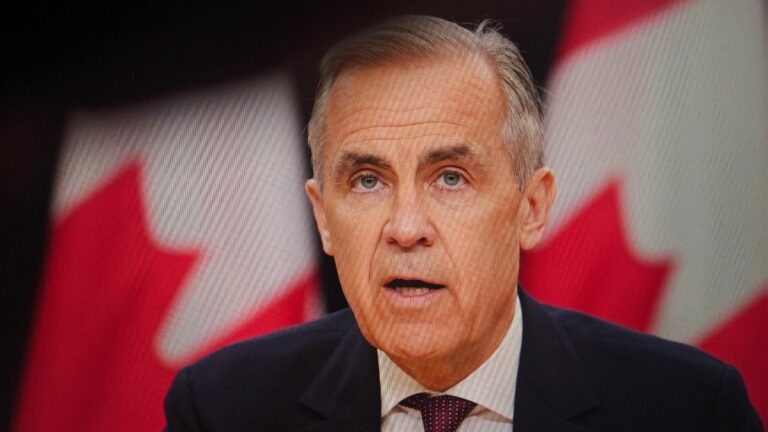
Prime Minister Mark Carney delivered an urgent warning in Edmonton as Alberta prepared for one of the most consequential votes in its history. Despite polls showing substantial support for remaining in Canada, Carney cautioned that Monday’s referendum should not be treated as a guaranteed victory for national unity.
Speaking at a packed pro-Canada rally on October 16, 2026, Carney urged Albertans to participate while pointing to growing tensions with U.S. President Donald Trump. He argued that American trade pressure and threats to Canadian sovereignty make internal divisions particularly dangerous.
The October 19 referendum will not immediately determine whether Alberta becomes independent. Instead, voters will decide whether the province should remain in Confederation or begin the legal process toward a future binding separation vote.
Edmonton Becomes the Centre of a Final Push for Canadian Unity
Carney Warns Alberta Vote Is No Sure Thing as Trump Tensions Dominate Final Edmonton Rally
- Edmonton Becomes the Centre of a Final Push for Canadian Unity
- Monday’s Referendum Is About Starting a Separation Process
- Trump’s Trade War Adds a New Dimension to Alberta’s Independence Debate
- Carney and Danielle Smith Find Common Ground Despite Their Differences
- A New Pacific Oil Pipeline Becomes Part of Carney’s Economic Argument
- Nine Other Referendum Questions Expose Continuing Political Divisions
- Some Albertans See the Vote as a Way to Pressure Ottawa
- Polling Favours Staying in Canada, but Turnout Remains Critical
- The Edmonton Rally Also Raises Questions About Election Rules
- Whatever Happens Monday, Alberta’s Constitutional Debate Could Continue
Thousands of supporters gathered at Edmonton’s Expo Centre on Friday evening as Carney wrapped up a two-day campaign encouraging Albertans to remain in Canada. The event was organized with the Forever Canadian movement, which has been mobilizing opposition to provincial independence. Canadian flags, cheering crowds and appeals to national solidarity dominated the gathering. However, the prime minister’s central message was less celebratory than the atmosphere might have suggested. He warned that the referendum’s outcome depended on actual participation, regardless of how strongly opinion polls appeared to favour continued membership in Canada.
Carney specifically cautioned supporters against assuming the result had already been decided. His warning that turnout would determine the outcome reflected a concern familiar to political organizers: widespread support does not necessarily translate into votes. The prime minister also described pursuing separation as a dangerous gamble that could create prolonged uncertainty for Alberta and the country. Speaking in the city where he grew up gave those remarks additional personal significance. His appeal was directed not only at committed federalists but also at Albertans who may oppose independence without feeling particularly enthusiastic about Ottawa or the Liberal government.
Monday’s Referendum Is About Starting a Separation Process
Albertans will face ten referendum questions on October 19, but the most consequential concerns the province’s future within Canada. Official Elections Alberta documents identify it as Question 10, although it will be presented to voters first. The ballot offers two choices: Alberta should remain a Canadian province, or the provincial government should begin the legal process required to hold a future binding referendum on separation. The distinction is critical because voting for the second option would not immediately establish an independent Alberta or dissolve existing constitutional arrangements.
The results of the October 19 referendum are legally non-binding, meaning additional political and constitutional steps would be necessary regardless of the outcome. Premier Danielle Smith has indicated that she would respect a result favouring the separation process and move toward another vote. Elections Alberta will count ballots by hand, beginning with the question concerning Alberta’s place in Canada. Unofficial results are expected within 48 hours after voting closes. For families, employers and investors watching the outcome, the immediate issue is whether a lengthy constitutional debate could begin, rather than whether Alberta will suddenly cease to be part of Canada.
Trump’s Trade War Adds a New Dimension to Alberta’s Independence Debate
Carney’s Edmonton speech repeatedly returned to the increasingly difficult relationship between Canada and the United States. Trump has imposed substantial tariffs on Canadian industries and repeatedly suggested that Canada could become America’s 51st state. Against that backdrop, Carney warned that forces outside Canada’s borders were seeking to divide the country for their own advantage. The prime minister did not explicitly name Trump in that warning, but the American president’s trade policies and territorial rhetoric formed an unmistakable part of the political context surrounding the speech.
The strongest applause at the Edmonton rally, according to Associated Press reporting, came when Carney discussed reducing Canada’s economic dependence on the United States. He presented national unity as particularly important when Canada is attempting to diversify trade and strengthen its economic position. Earlier in the week, he had also said that foreign governments, including Washington, should refrain from interfering in Alberta’s referendum. His statements reflected concerns about potential outside influence, although the rally remarks themselves did not establish that a foreign government had interfered with the vote. The broader argument was that Canada’s internal disagreements are unfolding during an unusually difficult period in its relationship with its largest trading partner.
Carney and Danielle Smith Find Common Ground Despite Their Differences
Earlier Friday, Carney made a stop in Red Deer alongside Alberta Premier Danielle Smith, creating an unusual political alliance ahead of the referendum. Smith, who leads the province’s United Conservative government, has frequently challenged federal Liberal policies on energy development, regulation and provincial authority. Nevertheless, both leaders publicly endorsed Option 1 on the separation question, supporting Alberta’s continued place in Canada. Smith had already confirmed that she voted to remain in Confederation during advance polling. Their joint appearance demonstrated that the independence debate has created areas of agreement between politicians who otherwise compete over major policy questions.
Smith acknowledged that relations with Ottawa have changed significantly under Carney. She said the federal government had substantially addressed seven of nine federal laws Alberta previously opposed and pointed to recent cooperation on energy infrastructure. Carney, meanwhile, acknowledged the province’s longstanding frustrations with federal policy. Their temporary alignment extended beyond the two governments. Federal Conservative Leader Pierre Poilievre also urged Albertans to remain in Canada, despite being Carney’s principal political opponent. The shared position does not eliminate disagreements over immigration, constitutional reform or energy regulation. It does, however, demonstrate that opposition to independence crosses several of Canada’s major political divisions.
A New Pacific Oil Pipeline Becomes Part of Carney’s Economic Argument
Energy development featured prominently in Carney’s campaign because disputes over Alberta’s oil and gas sector have long contributed to tensions with Ottawa. The federal government formally designated the proposed Pacific Link oil pipeline as a project of national interest on October 1, following months of negotiations with Alberta. The proposed pipeline would carry an additional one million barrels of Canadian oil per day toward Pacific export markets, particularly in Asia. Ottawa argues that the project could reduce dependence on American buyers, giving Canadian producers additional customers and improving the country’s ability to withstand international trade disruptions.
The federal government estimates that Pacific Link could support approximately 140,000 jobs and generate more than $20 billion annually in additional economic activity. Those are government projections rather than completed economic benefits. The plan includes equal federal and provincial ownership, with Indigenous communities offered a minimum 10% ownership interest. Regulatory consultations and substantial development work remain ahead. Carney has portrayed the project as evidence that Alberta can achieve important economic objectives through cooperation within Canada. Independence advocates, however, remain skeptical that such arrangements will permanently resolve the province’s grievances. The pipeline has therefore become both a significant infrastructure proposal and a symbol of competing visions for Alberta’s economic future.
Nine Other Referendum Questions Expose Continuing Political Divisions
Although Carney and Smith agree on Alberta’s continued membership in Canada, they remain divided on the other nine referendum questions. Five concern immigration, access to publicly funded services and eligibility requirements. They include proposals to give Alberta greater influence over immigration decisions, restrict certain provincial programs according to immigration status, establish residency requirements for some temporary residents and require proof of Canadian citizenship when voting in provincial elections. These questions address issues Smith has identified as major concerns about provincial finances, public services and Alberta’s relationship with Ottawa.
The remaining four questions concern changes to Canada’s constitutional arrangements. They ask whether Alberta should pursue reforms involving judicial appointments, abolition of the Senate, greater freedom to opt out of federal programs and priority for provincial legislation in certain jurisdictional disputes. Smith wants voters to support all nine proposals, while Carney has urged opposition. None of these questions would automatically change federal law or amend the Constitution if approved; they seek non-binding expressions of public support. The disagreements illustrate the complicated nature of Monday’s referendum. Albertans could favour remaining in Canada while simultaneously endorsing significant changes to how the federation operates.
Some Albertans See the Vote as a Way to Pressure Ottawa
Supporters of greater Alberta independence argue that the province has not received fair treatment within Confederation. Their complaints frequently centre on federal energy regulations, the distribution of tax revenues, equalization and what they perceive as insufficient provincial control over economic decisions. Some believe Alberta could become more prosperous as an independent country, while others view the possibility of separation primarily as a negotiating tool. Independence advocate Tanya Clemens dismissed recent agreements between Carney and Smith as insufficiently reliable, arguing that government commitments remain dependent on conditions that could change.
That distinction between actual independence and political leverage has become particularly important. An October 16 Angus Reid Institute survey found that 60% of respondents supporting Option 2 were primarily motivated by sending a message to Ottawa, while 37% identified separation as their main motivation. At Carney’s Red Deer appearance, resident Kelsie Petersen offered a similar perspective. She indicated that she would prefer Alberta not to separate but planned to support another referendum to secure a better deal for the province. Such attitudes help explain why Carney has focused on the risks of treating the ballot as a protest vote rather than a decision with potentially lasting consequences.
Polling Favours Staying in Canada, but Turnout Remains Critical
Opinion polls provide a substantial advantage to supporters of Canadian unity. A September Ipsos survey found that 70% of Albertans intended to vote for the province to remain in Canada, compared with 20% who supported starting the process toward a binding separation referendum. Another 10% were undecided. More recent research from the Angus Reid Institute, released October 16, found 66% support for remaining in Canada and 34% for beginning the separation process. The Angus Reid survey collected responses from 1,010 Alberta adults between October 13 and 15.
Those findings explain why the prime minister has emphasized participation rather than celebrating a presumed victory. Polls measure reported preferences, while actual results depend on who casts a ballot and whether opinions shift. Angus Reid also found that 78% of respondents had made up their minds before the campaign, suggesting many positions were already entrenched. Another 62% believed the separatist movement would never disappear entirely, regardless of Monday’s outcome. For provincial leaders, that presents a longer-term challenge. A decisive result could provide temporary political stability, but it would not necessarily resolve the grievances that have sustained demands for greater autonomy.
The Edmonton Rally Also Raises Questions About Election Rules
The location of Carney’s final major rally produced a separate controversy shortly before voting day. Edmonton’s Expo Centre was hosting advance polling at the same time the Forever Canadian campaign planned its Friday evening gathering. Some independence supporters questioned whether a partisan referendum event should take place in a building where people were actively voting. The concern reflected broader tensions surrounding the campaign, with both sides competing to mobilize supporters while maintaining public confidence in the voting process.
Elections Alberta clarified that restrictions on campaign advertising applied to the designated voting area rather than the entire large convention facility. Advance polling took place in Hall H, while the rally was organized elsewhere in the Expo Centre. Officials also included a nearby parking area within the restricted voting space. Rally organizers advised attendees to keep campaign materials concealed near polling areas and avoid discussing voting intentions with electors. The controversy did not establish that the rally violated election law, but it illustrated the sensitivity surrounding the referendum. With the province’s constitutional future dominating political discussion, questions about campaign boundaries and electoral neutrality have attracted heightened attention.
Whatever Happens Monday, Alberta’s Constitutional Debate Could Continue
Even if voters support beginning the separation process, Alberta would remain part of Canada while additional legal steps unfold. The Supreme Court of Canada’s 1998 Secession Reference established that a province cannot lawfully leave Confederation unilaterally. The federal Clarity Act subsequently created requirements concerning a clear referendum question and a clear majority before negotiations on actual secession could begin. Constitutional changes would require extensive negotiations involving federal and provincial governments. Indigenous treaty rights would also have to be addressed, particularly because First Nations treaties predate Alberta’s creation as a province.
The economic implications are similarly complex. Research commissioned from the University of Calgary’s School of Public Policy examined scenarios in which establishing an independent Alberta could involve costs of approximately $50 billion to $170 billion during the first five years. Those estimates depend on assumptions about negotiations, government services and the transition to independent institutions. Monday’s polls are scheduled to operate from 9 a.m. to 8 p.m., with unofficial results expected within 48 hours and official results scheduled for October 29. The vote will provide an important measure of Alberta’s political direction, but the province’s relationship with Ottawa, energy development and constitutional authority will remain significant issues regardless of the outcome.
This Options Discord Chat is The Real Deal
While the internet is scoured with trading chat rooms, many of which even charge upwards of thousands of dollars to join, this smaller options trading discord chatroom is the real deal and actually providing valuable trade setups, education, and community without the noise and spam of the larger more expensive rooms. With a incredibly low-cost monthly fee, Options Trading Club (click here to see their reviews) requires an application to join ensuring that every member is dedicated and serious about taking their trading to the next level. If you are looking for a change in your trading strategies, then click here to apply for a membership.