35,000+ smart investors are already getting financial news, market signals, and macro shifts in the economy that could impact their money next with our FREE weekly newsletter. Get ahead of what the crowd finds out too late. Click Here to Subscribe for FREE.
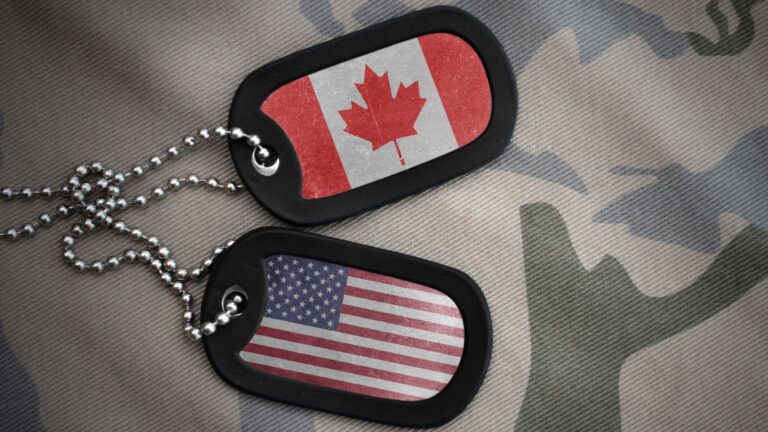
For decades, Canadian and American military commanders have worked together to defend the same continent. Now, Canada’s military has reportedly examined a scenario that would have seemed almost unimaginable: an invasion by the United States.
The revelation has surprised retired U.S. General Glen VanHerck, who commanded NORAD and U.S. Northern Command from 2020 to 2024. In an October 17 interview with the National Post, VanHerck questioned why Canada’s closest defence partner would be considered a potential aggressor, while acknowledging that responsible military planners must prepare for unlikely emergencies.
His larger concern is not an imminent American attack. It is that political disputes, trade tensions and increasingly confrontational rhetoric could weaken the confidence underpinning North American security. Although military cooperation remains strong, VanHerck warns that the political relationship supporting it is becoming less predictable.
Canadian Military Planners Examined a Scenario Few Expected
Canada’s U.S. Invasion War Game Surprised Former NORAD Chief, Who Warns Political Feud Is Eroding Trust
- Canadian Military Planners Examined a Scenario Few Expected
- Former NORAD Commander Says the Revelation Caught Him Off Guard
- Political Disputes Are Creating Doubts About Long-Term Security Commitments
- NORAD Remains One of the World’s Closest Military Partnerships
- Canada’s Arctic Geography Gives It a Military Advantage Washington Cannot Replace
- Hypersonic Missiles Present a More Immediate Defence Challenge
- Carney’s Government Has Increased Defence Spending, but Questions Remain
- Reducing Dependence on American Military Suppliers Creates Another Dilemma
- History Shows That Planning for an Invasion Does Not Mean One Is Coming
- Rebuilding Political Trust May Matter More Than Preparing for Conflict
The controversy began with reports that Canadian military officials had examined how the country might respond to a hypothetical American invasion. In January 2026, The Globe and Mail reported, citing two unnamed senior government officials, that the Canadian Armed Forces had developed a theoretical model of such an attack. The modelling reportedly assumed that American forces could overwhelm Canadian conventional positions relatively quickly, potentially within days, forcing Canada to consider how resistance might continue under dramatically unequal military conditions.
The distinction between military modelling and an actual operational plan is essential. The reported exercise was a conceptual assessment, not an approved set of orders to mobilize troops against the United States. Prime Minister Mark Carney subsequently acknowledged studying the possibility of American military action during a September interview with The New York Times. He described it as an “extreme tail risk,” meaning a highly unlikely outcome with potentially enormous consequences. Carney stressed that preparing for remote possibilities is part of responsible risk management, not a prediction that Washington intends to invade.
Former NORAD Commander Says the Revelation Caught Him Off Guard
VanHerck spent more than three years overseeing the military organization responsible for helping protect Canadian and American airspace. During that period, he worked closely with military personnel from both countries on issues involving surveillance, aerospace threats and continental defence. That experience made the invasion scenario particularly surprising. He told the National Post that he had seen no meaningful indications of American military preparations for an attack against Canada, apart from political rhetoric that he did not interpret as evidence of an approaching military operation.
Nevertheless, VanHerck did not criticize the principle of considering difficult scenarios. Military commanders routinely examine potential threats that may never occur, partly to identify vulnerabilities before an emergency develops. During his own leadership, he had encountered planning involving American military aircraft and personnel operating in Canada, but those scenarios involved assisting Canadian forces against external threats, particularly from Russia. He said he had never encountered anything comparable to an American plan to attack Canada during his tenure. His surprise reflects the extraordinary nature of the hypothetical conflict, rather than opposition to contingency planning itself.
Political Disputes Are Creating Doubts About Long-Term Security Commitments
The broader backdrop is a Canada–U.S. relationship strained by tariffs, disputes over sovereignty and President Donald Trump’s repeated comments about Canada becoming America’s 51st state. Trump has previously said military force against Canada was highly unlikely, instead emphasizing economic pressure. However, his rhetoric has contributed to concerns about how far disagreements between the two governments might go. The BBC reported in October that military experts continued to regard an invasion as extremely unlikely, despite the deterioration in political relations.
VanHerck believes the more immediate danger is that political hostility could undermine strategic stability. His argument is that adversaries may begin questioning whether Canada and the United States would reliably support each other during a genuine international crisis. He has also criticized political decision-making on both sides of the border, suggesting that emotionally charged disagreements can overshadow shared national-security interests. Importantly, he distinguishes those political tensions from the professional relationships between military commanders. The disagreement is not evidence that NORAD personnel have stopped cooperating, but it raises questions about how governments will sustain that cooperation over time.
NORAD Remains One of the World’s Closest Military Partnerships
Established in 1958, the North American Aerospace Defense Command represents an unusually integrated defence arrangement between two sovereign countries. Its responsibilities include aerospace warning, aerospace control and maritime warning. The commander is responsible to both the Canadian and American governments, while Canadian and American personnel jointly monitor potential threats. NORAD operates through three regional commands covering Alaska, Canada and the continental United States, with the Canadian region headquartered in Winnipeg.
The organization also differs from U.S. Northern Command, which operates under American national authority. VanHerck commanded both institutions, giving him direct experience with their separate responsibilities. During the 2023 Chinese surveillance balloon incident, for example, personnel from both countries helped track the object through NORAD, while the eventual shootdown was carried out under U.S. Northern Command authority with Canadian government support. Such arrangements illustrate why shared defence does not eliminate national sovereignty. They also demonstrate how much coordination is required whenever a threat crosses the continent’s airspace, making the political relationship supporting NORAD especially important.
Canada’s Arctic Geography Gives It a Military Advantage Washington Cannot Replace
One of VanHerck’s strongest arguments concerns Canada’s geographic importance. The country occupies much of North America’s northern approaches, making its territory essential to detecting potential threats travelling across the Arctic. Although American forces possess substantially greater military resources, they cannot reproduce Canada’s location. Northern surveillance facilities, airfields and military installations create opportunities for both countries to identify and respond to aircraft, missiles and other threats approaching from outside the continent.
That geography is reflected in Canada’s existing defence infrastructure. The North Warning System includes radar installations extending from Alaska toward Labrador, while facilities at Inuvik, Yellowknife, Iqaluit and Goose Bay support northern military operations. Canada is investing in upgrades to these locations and other Arctic infrastructure. The work also involves cooperation with Indigenous and northern communities, whose local knowledge and logistical expertise matter in remote conditions. VanHerck’s warning is that physical equipment can be purchased or replaced, but an established relationship with a sovereign neighbour cannot be recreated as easily. Losing that cooperation would make continental defence considerably more complicated.
Hypersonic Missiles Present a More Immediate Defence Challenge
While political leaders debate hypothetical conflicts between neighbours, military planners face increasingly sophisticated weapons that could threaten both countries. VanHerck has repeatedly warned about hypersonic missiles, which can travel at extremely high speeds while manoeuvring in ways that complicate traditional tracking. In his October interview, he said Canada remained exposed to shortcomings in its ability to detect and track these weapons. He identified space-based surveillance, including satellites in low-Earth orbit, as an important part of closing the gap.
The United States is investing in such technology through the Space Development Agency’s missile-tracking programs. In July 2026, the U.S. Space Force announced approximately US$1.75 billion in awards for 36 additional missile-warning and missile-defence tracking satellites. Canada is pursuing its own surveillance improvements, including Arctic Over-the-Horizon Radar. The Department of National Defence expects the radar project to achieve an initial operational capability by the end of 2029. These investments remain works in progress. The broader concern is that missile technology is advancing while both governments must still build, integrate and operate the systems needed to detect emerging threats reliably.
Carney’s Government Has Increased Defence Spending, but Questions Remain
Canada has announced a substantial increase in military spending under Carney’s government. In March 2026, Ottawa reported that it had reached NATO’s defence-spending benchmark of 2% of gross domestic product for the 2025–26 fiscal year, with more than C$63 billion in qualifying expenditures across defence and other government departments. The federal government has also committed to NATO’s newer target of 5% of GDP by 2035, comprising 3.5% for core defence capabilities and another 1.5% for defence- and security-related investments.
VanHerck acknowledged that Carney had strengthened Canada’s commitment to military modernization. However, he questioned whether spending targets expressed as percentages of GDP are the best way to assess preparedness. From an operational perspective, the important questions involve which threats need to be addressed, what equipment is necessary and whether personnel have the resources to complete their missions. Canada has already committed C$38.6 billion on an accrual basis over 20 years to NORAD modernization, originally announced in 2022. The challenge is converting long-term financial commitments into functioning capabilities, especially when major surveillance and infrastructure projects require years to complete.
Reducing Dependence on American Military Suppliers Creates Another Dilemma
Canada’s government is also attempting to strengthen its domestic defence industry and diversify equipment suppliers. Carney introduced a Defence Industrial Strategy in February 2026 that prioritizes Canadian production, partnerships with trusted allies and greater control over critical military technologies. The policy reflects concern that dependence on foreign suppliers can become a vulnerability during international disputes. Canada has also been reviewing its planned F-35 fighter acquisition, initially announced as an 88-aircraft purchase in 2023, while maintaining plans for its initial aircraft deliveries.
A separate example emerged in September, when Ottawa signed a non-binding term sheet with Sweden’s Saab to advance negotiations over its GlobalEye airborne early-warning aircraft. The GlobalEye discussions involve surveillance aircraft, not a completed purchase of Saab fighter jets. VanHerck recognizes Canada’s interest in greater independence but cautions against allowing political frustration to determine equipment choices. Modern defence cooperation depends on compatible communications, maintenance systems, spare parts and operational procedures. Aircraft from different countries may provide excellent capabilities individually, yet require careful integration to operate effectively together. Greater sovereignty and continued interoperability must therefore be considered together.
History Shows That Planning for an Invasion Does Not Mean One Is Coming
The idea of Canadian and American military planners imagining conflict with each other is not entirely new. In 1921, Canadian military officials developed Defence Scheme No. 1, which examined how Canada might respond to a war involving the United States. American planners subsequently produced War Plan Red, completed in 1930, which considered operations against Canada in the event of war with Britain. Those historical plans were never carried out, and the two countries eventually developed the extraordinary military partnership that exists today.
The current situation is fundamentally different from the interwar period, when North American defence arrangements had not yet evolved into NORAD. Still, history illustrates that military planners sometimes investigate scenarios considered politically unlikely. The reported 2026 model included assumptions about conventional American superiority and possible unconventional Canadian resistance, but such modelling should not be treated as a reliable forecast of what would happen in an actual conflict. Analysts interviewed by the BBC emphasized the extensive military and economic ties that make an American invasion highly improbable. Canada’s preparedness debate is therefore better understood as a response to strategic uncertainty than evidence of an approaching war.
Rebuilding Political Trust May Matter More Than Preparing for Conflict
Despite the unsettling headlines, VanHerck’s assessment of military cooperation remains reassuring. Based on his conversations with senior officers in both countries, he says professional trust and mutual respect remain strong. Canadian and American military personnel continue carrying out their NORAD responsibilities together, even as elected leaders confront disagreements over trade, sovereignty and defence spending. His concern is that sustained political hostility could eventually complicate decisions about equipment, resources and cooperation, undermining a partnership that has helped protect both countries for generations.
VanHerck is participating in the Second Century Commission, a binational initiative examining the future of Canada–U.S. relations. Supported by McGill University, Johns Hopkins University and the Centre for International Governance Innovation, the commission is co-chaired by former Canadian cabinet minister Lisa Raitt and former U.S. congresswoman Jane Harman. It plans to publish recommendations by the end of 2027 on trade, security, technology and other shared priorities. The initiative reflects a larger reality: Canada can strengthen its independence while maintaining cooperation with its most important neighbour. The immediate challenge is not preparing Canadians for an expected invasion, but preventing today’s political disagreements from damaging tomorrow’s security.
This Options Discord Chat is The Real Deal
While the internet is scoured with trading chat rooms, many of which even charge upwards of thousands of dollars to join, this smaller options trading discord chatroom is the real deal and actually providing valuable trade setups, education, and community without the noise and spam of the larger more expensive rooms. With a incredibly low-cost monthly fee, Options Trading Club (click here to see their reviews) requires an application to join ensuring that every member is dedicated and serious about taking their trading to the next level. If you are looking for a change in your trading strategies, then click here to apply for a membership.