35,000+ smart investors are already getting financial news, market signals, and macro shifts in the economy that could impact their money next with our FREE weekly newsletter. Get ahead of what the crowd finds out too late. Click Here to Subscribe for FREE.
Canada’s economic relationship with the United States has long been one of its greatest strengths. Former deputy prime minister Chrystia Freeland now warns that the same relationship could become a serious national security vulnerability.
Speaking at the Council on Foreign Relations in New York on October 15, 2026, Freeland argued that Canada must reduce its economic dependence on a country whose president has repeatedly raised the possibility of making Canada America’s 51st state.
Her warning comes as Donald Trump’s tariffs strain Canadian industries, negotiations over North America’s trade agreement remain unresolved, and Prime Minister Mark Carney pursues new international partnerships.
Freeland’s message is not that Canada should abandon American trade. It is that the country needs enough economic independence to protect its sovereignty when its closest trading partner becomes unpredictable.
Freeland Delivers a Blunt Warning About Canada’s Sovereignty
Freeland Warns U.S. Wants to ‘Take Over’ Canada, Says Reducing American Trade Dependence Is a National Security Issue
- Freeland Delivers a Blunt Warning About Canada’s Sovereignty
- Trump’s Repeated 51st-State Remarks Give the Warning New Urgency
- More Than 70% of Canada’s Merchandise Exports Still Go to America
- Canadian Steel, Aluminum and Auto Workers Are Already Feeling the Pressure
- Trump’s Refusal to Extend CUSMA Has Added Another Layer of Uncertainty
- Freeland Helped Negotiate the Agreement She Now Warns Canada Against Relying On
- Carney Wants to Double Canada’s Exports Beyond the United States
- Europe Is Becoming a More Important Alternative Trading Partner
- India and Southeast Asia Offer Opportunities, but New Dependence Carries Risks
- Building Real Economic Independence Will Take More Than New Trade Agreements
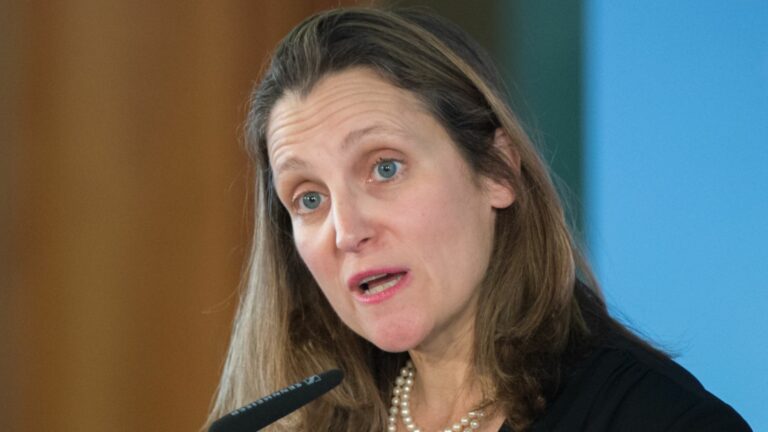
Chrystia Freeland delivered her warning during an October 15 discussion at the Council on Foreign Relations in New York, where she appeared with journalist Ali Velshi. The former finance minister and deputy prime minister said Canada must diversify its trading relationships for national security reasons. She argued that maintaining or expanding economic dependence becomes dangerous when a partner openly discusses taking over another country. Her remarks represented a striking assessment from someone who previously helped negotiate one of North America’s most important trade agreements.
Freeland’s comments were especially significant because they framed trade diversification as a matter of national security rather than simply economic growth. She acknowledged that dependence on any single trading partner would be unwise, even if the United States were led by a president who supported free trade. Her position therefore extends beyond her disagreements with Trump. It reflects a broader concern that Canadian governments and businesses need alternatives when political decisions in Washington threaten their interests. For manufacturers, exporters and workers whose livelihoods depend on American customers, that warning raises difficult questions about the country’s economic future.
Trump’s Repeated 51st-State Remarks Give the Warning New Urgency
Trump’s statements about making Canada part of the United States have repeatedly unsettled the relationship between the neighbouring countries. During a January 7, 2025, press conference at Mar-a-Lago, Trump was asked whether he would consider military force to acquire Canada. He rejected that option but explicitly mentioned using economic pressure. He also described the Canada–U.S. border as artificially drawn and suggested that eliminating it could benefit American national security. The remarks drew immediate condemnation from Canadian political leaders, including then-prime minister Justin Trudeau and Conservative Leader Pierre Poilievre.
The rhetoric has continued during Trump’s second presidency. In August 2026, following the collapse of bilateral trade negotiations, Trump again suggested that Canada wanted the benefits of American statehood without actually becoming a state. Although these comments do not establish that Washington has a formal annexation plan, they have contributed to concerns about Canadian sovereignty. Freeland’s warning is rooted in the possibility that economic dependence gives a larger country leverage over a smaller neighbour. Her argument is that even without military threats, control over market access, tariffs and commercial relationships can become a powerful instrument of political pressure.
More Than 70% of Canada’s Merchandise Exports Still Go to America
The scale of Canada’s dependence becomes clear in the country’s trade statistics. Statistics Canada reported that 71.7% of Canadian merchandise exports went to the United States in 2025, down from 75.9% the previous year. Although that represents a meaningful decline, America remains by far Canada’s largest destination for exported goods. Canada also recorded an $81.6-billion merchandise trade surplus with the United States during 2025. The figures show why decisions made in Washington can influence Canadian manufacturing, energy production, agriculture and employment.
The relationship is broader when services are included. Global Affairs Canada’s 2026 State of Trade report valued Canadian goods and services exports to the United States at $683.3 billion in 2025, approximately 67% of total exports. Trade with other countries increased, but the American market remains exceptionally difficult to replace because of geographic proximity, established transportation routes and decades of integrated production. An Ontario auto-parts manufacturer, for example, cannot necessarily redirect specialized components to Europe without finding different customers and meeting new technical requirements. Freeland’s argument highlights that vulnerability: a large export market can generate prosperity while simultaneously limiting the options available when political relationships deteriorate.
Canadian Steel, Aluminum and Auto Workers Are Already Feeling the Pressure
The consequences of America’s trade restrictions have been particularly visible in Canadian manufacturing. The Bank of Canada’s April 2026 Monetary Policy Report found that steel exports to the United States had fallen by approximately half after tariffs were imposed. Aluminum shipments initially dropped sharply as well, although some recovered as American inventories declined. Both industries face substantial American duties, with core steel and aluminum tariffs reaching 50%. These measures have placed pressure on Canadian producers whose largest customers are located just across the border.
The automotive industry faces similarly difficult conditions. In August 2026, Trump threatened to raise tariffs on Canadian vehicles and automotive parts to 50% beginning in January 2027, adding uncertainty to an industry built around North American supply chains. The impact extends beyond large factories to smaller businesses supplying equipment, transportation and maintenance services. Reuters reported on October 16 that Canadian steelmakers were responding to reduced American sales by pursuing domestic customers in sectors including mining, energy and infrastructure. Such adjustments demonstrate that diversification can happen, but it often requires changes in production, investment and workforce planning. For affected communities, economic resilience is not an abstract national objective; it directly influences job security and future opportunities.
Trump’s Refusal to Extend CUSMA Has Added Another Layer of Uncertainty
The future of the Canada–United States–Mexico Agreement has become another source of concern. On July 1, 2026, American trade representative Jamieson Greer announced that Washington would not extend the agreement in its existing form following the scheduled six-year review. The administration argued that unresolved trade deficits and provisions affecting American manufacturers needed further negotiation. This was particularly significant because CUSMA was negotiated during Trump’s first presidency and entered into force in July 2020, replacing the original North American Free Trade Agreement.
The decision does not mean CUSMA has immediately expired. Under Article 34.7, the agreement remains in force until July 2036 unless the participating governments agree to extend its duration or other termination provisions come into play. The countries must now conduct annual reviews while pursuing a possible extension. An October 5 American Federal Register notice confirmed that the next review process was already being organized. For Canadian businesses, the immediate problem is uncertainty rather than the disappearance of existing trade rules. Companies considering factories, long-term supply arrangements or major equipment purchases must weigh the possibility of future changes. Freeland’s concern is that relying overwhelmingly on one market makes such uncertainty especially costly.
Freeland Helped Negotiate the Agreement She Now Warns Canada Against Relying On
Freeland brings considerable personal experience to the debate. As Canada’s foreign affairs minister, she played a leading role in renegotiating NAFTA during Trump’s first presidency, helping secure the agreement that eventually became CUSMA. She later served as deputy prime minister and finance minister before leaving Justin Trudeau’s cabinet in December 2024. After an unsuccessful Liberal leadership campaign in 2025, she departed Parliament in early 2026. Her new book, Unreliable Boyfriend, released October 13, recounts her experiences dealing with American political power and the challenges facing democratic allies.
In an October 14 interview with Reuters, Freeland argued that Canada should resist unfair American tariffs rather than make concessions simply to begin negotiations. She supported dollar-for-dollar retaliation and praised Carney’s decision to reject the trade arrangement proposed by Washington in August. Her criticism also extends to excessive dependence on China, which she considers another security vulnerability. That distinction is important because Freeland is not advocating replacing American dependence with another dominant foreign partner. Her position is that democratic countries need stronger relationships with multiple trustworthy economies. Although she is no longer setting Canadian government policy, her experience provides a perspective on the risks of negotiating from a position of excessive dependence.
Carney Wants to Double Canada’s Exports Beyond the United States
Freeland’s argument closely resembles the trade diversification strategy being pursued by Prime Minister Mark Carney. His government has set a target of doubling Canadian exports to markets outside the United States over the next decade, an ambition Ottawa describes as representing roughly $300 billion in additional orders. The strategy emphasizes new trade agreements, infrastructure development, critical minerals, energy exports and advanced technologies. Some progress is already visible. Global Affairs Canada reported that Canadian goods and services exports to non-American markets increased 11.1% in 2025, reaching 32.8% of total exports.
However, those gains should not be mistaken for proof that Canada has already achieved its long-term objectives. Global Affairs Canada’s report noted that some of the increase reflected exceptional gold shipments and higher energy exports, rather than a broad expansion of customers across every industry. Carney’s government has also proposed major improvements to ports and transportation corridors to make overseas trade more practical. Canada’s services sector presents another opportunity: only 53% of services exports went to the United States in 2025, compared with more than 70% of merchandise exports. Software, professional services and other digitally delivered products may be easier to sell internationally than physical goods that require expensive transportation infrastructure.
Europe Is Becoming a More Important Alternative Trading Partner
Europe represents one of Canada’s strongest opportunities for reducing dependence on the American market. The Canada–European Union Comprehensive Economic and Trade Agreement, provisionally in force since September 2017, eliminated tariffs on approximately 98% of EU tariff lines when it began operating. In 2025, Canadian exports of goods and services to the European Union reached $67.7 billion, an increase of 16.4% from the previous year. Total two-way Canada–EU trade was valued at approximately $178.6 billion, making the European bloc Canada’s second-largest trading partner for goods and services.
The relationship is expanding beyond traditional merchandise trade. In March 2026, Canadian and European officials launched negotiations toward a digital trade agreement, while Canada also gained a special route into the EU’s Security Action for Europe defence procurement initiative. These developments could create opportunities for Canadian technology, engineering and manufacturing businesses. Still, Europe’s market is not an immediate substitute for the United States, which purchased more than ten times the value of Canadian exports going to the EU in 2025. Geographic distance, different regulatory requirements and shipping costs remain significant obstacles. Diversification through Europe will require sustained investment and customer relationships, rather than relying on trade agreements alone.
India and Southeast Asia Offer Opportunities, but New Dependence Carries Risks
Canada is also accelerating efforts to build stronger economic relationships across Asia. During an October 14 interview with Reuters, Foreign Affairs Minister Anita Anand said Ottawa was aiming to conclude a comprehensive economic partnership agreement with India before the end of 2026. Canadian officials believe an agreement could help increase annual bilateral goods and services trade to $70 billion by 2030, compared with $30.4 billion in 2025. The two countries are also strengthening commercial ties in energy, financial services and critical minerals, including a $2.6-billion uranium supply agreement involving Canadian producer Cameco.
Southeast Asia presents another opportunity. Canada signed a comprehensive economic partnership agreement with Indonesia in September 2025, and Parliament approved implementing legislation in May 2026. Negotiations involving the Association of Southeast Asian Nations and the Philippines have also advanced. Yet Freeland’s comments raise an important caution about diversification. She has warned that becoming too economically dependent on China would create another national security vulnerability. Expanding Canadian trade cannot simply mean replacing American dependence with dependence on a different major power. The objective is to develop a wider network of reliable customers and suppliers so that no single government can exercise disproportionate influence over Canada’s economic decisions.
Building Real Economic Independence Will Take More Than New Trade Agreements
Reducing dependence on the United States also requires changes inside Canada. In June 2025, Parliament passed the One Canadian Economy Act, establishing a framework for removing federal internal trade barriers and accelerating major infrastructure projects. The government has emphasized transportation corridors, energy infrastructure, ports and labour mobility as priorities for improving national competitiveness. On October 1, 2026, Carney designated the proposed Pacific Link oil pipeline as a project of national interest. The project is designed to create capacity for an additional one million barrels of Canadian oil per day to reach overseas markets, although it remains subject to development, regulatory requirements and consultation.
The economic transition will not be painless. Bank of Canada Governor Tiff Macklem warned in February 2026 that shifting supply chains, developing new customers and adapting industries would take time. The central bank has also cautioned that businesses may face higher transportation and input costs during restructuring. Meanwhile, Washington maintains that its trade policies are intended to strengthen American manufacturing and address trade imbalances. Those competing priorities underline the challenge facing Canada. American customers remain essential, and maintaining a productive relationship with Washington continues to serve both countries’ interests. Freeland’s warning is ultimately about ensuring that Canada’s economic future does not depend entirely on decisions made by one foreign government. Diversification will be meaningful when Canadian businesses have genuine alternatives and Ottawa can make important national decisions without fearing that its largest export market could suddenly disappear.
This Options Discord Chat is The Real Deal
While the internet is scoured with trading chat rooms, many of which even charge upwards of thousands of dollars to join, this smaller options trading discord chatroom is the real deal and actually providing valuable trade setups, education, and community without the noise and spam of the larger more expensive rooms. With a incredibly low-cost monthly fee, Options Trading Club (click here to see their reviews) requires an application to join ensuring that every member is dedicated and serious about taking their trading to the next level. If you are looking for a change in your trading strategies, then click here to apply for a membership.