35,000+ smart investors are already getting financial news, market signals, and macro shifts in the economy that could impact their money next with our FREE weekly newsletter. Get ahead of what the crowd finds out too late. Click Here to Subscribe for FREE.
Europe’s race to rebuild its militaries is creating an unexpected opening for Canadian defence companies. France, one of the strongest advocates of buying European-made weapons, says that ambition need not shut Ottawa out. In an interview published October 12, French Ambassador Hélène Farnaud-Defromont welcomed closer procurement cooperation with Canada while insisting Europe must develop more of its own industrial capacity.
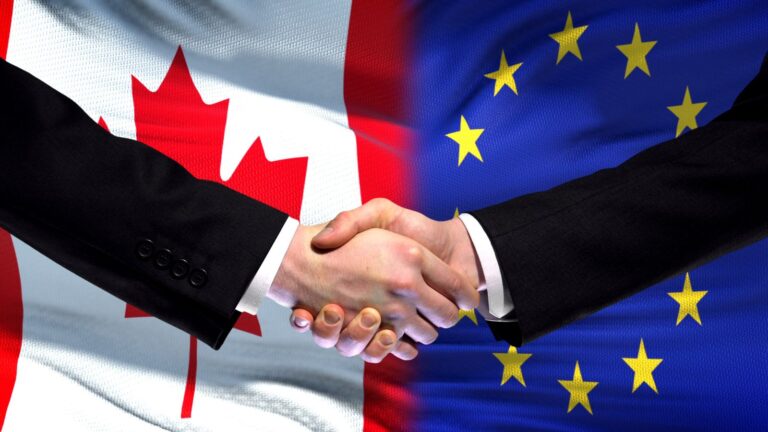
Her remarks arrive as Canada becomes the first non-European participant in the European Union’s SAFE procurement framework. The opportunity is substantial, but it is not a guaranteed windfall: European governments still decide what to buy, sourcing rules apply, and Canada has so far recorded just one publicly announced contract under the initiative. The larger story is about how old allies are trying to build more choices into their security relationships without dismantling NATO.
France Opens the Door Without Abandoning Its European Preference
France Signals Canada Can Join European Defence Deals as Allies Reduce Dependence on U.S. Weapons
- France Opens the Door Without Abandoning Its European Preference
- Canada Already Has a Place at Europe’s SAFE Table
- Europe’s Dependence on American Weapons Remains Enormous
- The Canadian Exception Changes Europe’s Content Rules
- American Ownership Creates an Eligibility Puzzle
- A Montréal Radio Contract Provides the First Test
- France and Canada Have Already Solved One Security Hurdle
- France’s Independence Strategy Predates Trump
- A Stronger European NATO Poses Questions for Ottawa
- Europe Is Funding Drones, Missiles and Seabed Defences
- Canada Is Rethinking Its Own Foreign Weapons Purchases
- The Real Measure Will Be Canadian Jobs and Delivered Equipment
France is sending Ottawa a balanced message: cooperation is welcome, but European production remains the priority. In an interview with The Canadian Press, Hélène Farnaud-Defromont, France’s ambassador to Canada, defended a European preference for strategic purchases. She said the ideal would be equipment made entirely with European content, while acknowledging that reaching such a goal would take time. This matters to Canadian firms wondering whether Europe’s drive for independence will create opportunities or erect new barriers.
The ambassador also offered to share France’s industrial experience with Canada, describing the country as unusually capable of producing a broad range of military technologies. Her remarks signal openness, not a newly awarded French contract or a promise that Canadian suppliers will win tenders. For manufacturers considering new partnerships, that is still meaningful. A government seeking European-made systems can recognize that trusted overseas partners provide expertise, components and production capacity Europe cannot reproduce alone.
Canada Already Has a Place at Europe’s SAFE Table
Canada’s access did not begin with the ambassador’s remarks. Ottawa and Brussels signed their SAFE participation agreement on February 14, 2026, in Munich. The European Union formally concluded it in June, and the agreement entered into force on August 1. Canada became the first country outside Europe with this special arrangement, following a Canada–EU security partnership signed in 2025. Those steps turned diplomatic interest into a legal route for Canadian manufacturers to compete.
SAFE, short for Security Action for Europe, offers up to €150 billion in EU-backed loans for defence purchasing. The borrowers are EU member states, not the Canadian government or individual Canadian companies. Participating governments use the financing to acquire equipment, often through joint purchases designed to increase production and reduce costs. Canada has gained access to an important new European market, but it certainly has not received a €150-billion funding allocation or automatic approval for its products.
Europe’s Dependence on American Weapons Remains Enormous
Europe wants more control over its military supplies, yet the numbers show how difficult the transition will be. According to SIPRI, the United States supplied 58% of major arms imported by European NATO members during 2021–2025. European countries’ imports of major weapons grew 210% compared with the preceding five-year period, driven partly by Russia’s invasion of Ukraine and the effort to replenish military inventories. Much of that demand flowed to American factories.
SIPRI estimates that the United States accounted for 42% of worldwide major arms exports in the same period, while France ranked second with 9.8%. As of the end of 2025, European customers had ordered or provisionally selected hundreds of American F-35 fighters. These are long-term commitments, not purchases easily switched overnight. European autonomy is therefore less about abruptly cutting off Washington than about gradually adding production lines, alternative suppliers and the freedom to maintain equipment during a crisis.
The Canadian Exception Changes Europe’s Content Rules
SAFE’s details offer Canada a striking advantage. The program normally limits components originating outside the EU, eligible European Economic Area countries and Ukraine to 35% of an end product’s component costs. Canada negotiated special treatment that can permit up to 80% Canadian content, provided other requirements are satisfied. At least 20% must still originate in the EU, eligible European partners or Ukraine. Unrestricted access, however, is not part of the bargain.
The exception carries a price. Ottawa agreed to an initial €10-million contribution, including a €7.5-million advance against future participation charges. Under specified contracts with European content at or below 65%, the participation fee is calculated at 15% of Canadian content value. Canada says the contribution supports Ukraine’s defence industry. For bidders, the practical challenge is not just building a competitive product; it is tracing where components originate, demonstrating eligibility and accounting for costs before a government places an order.
American Ownership Creates an Eligibility Puzzle
Canada’s defence industry has a complication: many businesses operating on Canadian soil are subsidiaries of American corporations. The French ambassador acknowledged that reality but would not predict its effect on participation. A Canadian address alone does not settle the issue. SAFE’s bilateral agreement examines where a company is established, where its managers are based and whether a company outside the eligible countries exercises control over it.
Importantly, the rules do not automatically disqualify every Canadian firm with American ownership. A foreign-controlled company may participate if a participating EU state verifies safeguards protecting European security interests and classified information. Certain advanced systems face further tests over whether their designs can be changed without restrictions imposed from abroad. The calculation is more demanding than a Made in Canada label. Firms may need to demonstrate control over technology, reliable access to components and the ability to deliver even if international relationships become strained.
A Montréal Radio Contract Provides the First Test
One Canadian company has shown what a SAFE-linked opportunity looks like. In June, Prime Minister Mark Carney announced that Montréal-based Marconi Technologies had secured a contract worth more than $10 million to provide Canadian-made ORION tactical radios to Poland’s Cyber Command. The project involves Polish partner Enamor International, with deliveries expected to begin in 2026 and continue through 2030. Ottawa described it as the first contract awarded to a Canadian company under SAFE.
The significance reaches beyond the equipment. According to the Prime Minister’s Office, Marconi planned to draw on nearly 100 Canadian companies, from skilled trades to advanced engineering, for the work. Radios lack the profile of fighters or submarines, but secure communications help allied forces operate together. As of October 12, The Canadian Press reported that only one Canadian contract had emerged publicly from the program. The breakthrough is real; a broad wave of orders remains an aspiration.
France and Canada Have Already Solved One Security Hurdle
Defence partnerships are not ordinary shopping arrangements. Engineers often need access to restricted technical drawings, classified requirements and information about how military equipment will be used. On June 12, 2026, Canada announced a General Security of Information Agreement with France, protecting classified material shared between the governments and approved participants. That groundwork could make some cross-border research and procurement projects easier to pursue.
Ottawa identified aerospace, space systems, cybersecurity, secure communications, artificial intelligence and maritime technologies among the areas that could benefit. The arrangement matters when Canadian subcontractors work with French contractors on sensitive components. It is not, by itself, a supply agreement or an authorization to access every secret. Businesses still have to meet security-clearance, procurement and export requirements. Nevertheless, the agreement also addresses a practical obstacle often overlooked in debates about defence independence: trusted partners need rules for sharing information before they can safely build complex systems together.
France’s Independence Strategy Predates Trump
France’s strategic autonomy is not a sudden reaction to Washington. In 1966, President Charles de Gaulle withdrew the country from NATO’s integrated military command to preserve control over French forces, although France remained a member of the alliance. Paris returned to the integrated command in 2009. The approach combines allied cooperation with independent decision-making over military capabilities and sensitive technologies.
France also possesses an unusually broad defence industry. SIPRI ranks it as the world’s second-largest exporter of major arms for 2021–2025, supplying customers in 63 countries. Nearly four-fifths of those exports went outside Europe, illustrating the business behind French industrial independence. Farnaud-Defromont’s argument for stronger European sourcing fits that history. It also exposes a tension: French manufacturers benefit from selling worldwide, even as Paris encourages Europeans to buy closer to home. Canada hopes to occupy the space between those two priorities as a trusted partner rather than an excluded competitor.
A Stronger European NATO Poses Questions for Ottawa
Canada’s stake in European security goes beyond selling weapons. It leads NATO’s multinational brigade in Latvia through Operation REASSURANCE, its largest overseas military mission. In July 2026, Ottawa extended the operation through 2031 and assumed further leadership responsibilities on NATO’s eastern flank. Canada also joined allies in committing to defence and security investment equivalent to 5% of GDP by 2035, including at least 3.5% for core military requirements.
Yet European independence raises a delicate diplomatic question: who makes decisions if EU defence structures grow stronger? Former Canadian ambassador to NATO Kerry Buck has warned that Ottawa historically feared being sidelined by a more autonomous European pillar. The concern is not an argument against European capabilities; it is about keeping the Atlantic alliance politically connected. Canada’s new EU defence partnership explicitly treats NATO as the foundation of collective defence. Ideally, greater European production strengthens NATO without excluding Canada from strategic conversations.
Europe Is Funding Drones, Missiles and Seabed Defences
The opportunity extends beyond tanks and aircraft. On September 28, the EU approved its first five European Defence Projects of Common Interest, covering drones and counter-drone systems, maritime and seabed protection, space, integrated air and missile defence, and security along Europe’s eastern flank. The Commission earmarked €325 million for these projects under its €1.5-billion European Defence Industry Programme. Their priorities reflect the importance of satellites, cables and digital systems in modern warfare.
There is an important distinction for Canadian companies: the European Defence Industry Programme is not the same funding mechanism as SAFE. Canada’s special SAFE agreement does not automatically confer eligibility for every EU-funded research or weapons initiative. Nonetheless, the new projects point toward capabilities European governments are likely to seek. Canadian specialists in sensors, robotics, satellites, communications and naval technology can seek permitted partnerships. The opportunity depends on tenders and partnerships, not merely the size of spending announcements.
Canada Is Rethinking Its Own Foreign Weapons Purchases
Ottawa’s European outreach reflects changing military equipment sourcing. Its February 2026 Defence Industrial Strategy adopted a build-partner-buy approach, favouring domestic production first and joint development with trusted allies where appropriate. Canada is still reviewing its planned purchase of 88 American F-35 fighters, while committed to 16. The tension became visible on September 23, when Canada’s first F-35 completed its maiden flight in Texas even as Ottawa’s review remained unfinished.
A major submarine decision offers another illustration. In July, the government selected Germany’s Thyssenkrupp Marine Systems as the preferred supplier for negotiations to acquire up to 12 submarines, based on a design shared with Norway. Ottawa said final contracting was expected by the end of 2027, so the selection was not yet a completed purchase. Neither procurement is a SAFE contract. Together, however, they show why defence sourcing has become inseparable from questions about industrial jobs, sovereignty and long-term allied relationships.
The Real Measure Will Be Canadian Jobs and Delivered Equipment
The economic stakes remain large, though forecasts are not contracts. Ottawa’s Defence Industrial Strategy identifies $180 billion in possible defence procurement and $290 billion in defence-related capital investment opportunities over a decade. It aims to raise the share of defence acquisitions awarded to Canadian firms to 70%, increase defence exports by 50% and create 125,000 jobs. Those ambitious goals depend on sustained execution, investment and demand.
European orders could help Canadian manufacturers expand beyond a familiar North American customer base. But the test will be practical: how many eligible firms win contracts, how much manufacturing and intellectual property remain in Canada, and whether equipment reaches allied forces on time. The Montréal radio deal offers an example; the ambassador’s comments offer encouragement. Neither guarantees an industrial transformation. Both countries have legal frameworks and shared security interests. Whether they turn those advantages into repeat orders will determine how significant this opening becomes.
This Options Discord Chat is The Real Deal
While the internet is scoured with trading chat rooms, many of which even charge upwards of thousands of dollars to join, this smaller options trading discord chatroom is the real deal and actually providing valuable trade setups, education, and community without the noise and spam of the larger more expensive rooms. With a incredibly low-cost monthly fee, Options Trading Club (click here to see their reviews) requires an application to join ensuring that every member is dedicated and serious about taking their trading to the next level. If you are looking for a change in your trading strategies, then click here to apply for a membership.