35,000+ smart investors are already getting financial news, market signals, and macro shifts in the economy that could impact their money next with our FREE weekly newsletter. Get ahead of what the crowd finds out too late. Click Here to Subscribe for FREE.
With Alberta preparing for one of the most consequential votes in its modern political history, Canada’s two leading federal political figures are turning their attention toward the province.
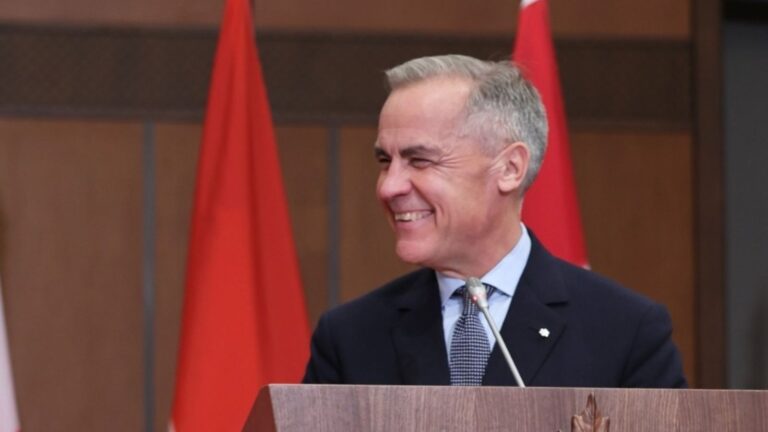
Prime Minister Mark Carney is expected to visit Alberta in the coming week, while Conservative Leader Pierre Poilievre has confirmed plans to deliver another speech promoting Canadian unity ahead of the October 19, 2026, referendum.
The political activity comes as Premier Danielle Smith faces competing demands from separatist supporters and Albertans determined to remain in Confederation.
Although the upcoming vote cannot immediately separate Alberta from Canada, its outcome could influence the province’s political direction for years. New federal energy commitments, growing concerns about foreign influence, and shifting separatist politics in Quebec have made the approaching referendum a national issue extending far beyond Alberta’s borders.
Carney’s Expected Alberta Visit Comes at a Critical Moment
Carney Expected in Alberta as Poilievre Prepares His Own Unity Push Before Separation Referendum
- Carney’s Expected Alberta Visit Comes at a Critical Moment
- Poilievre Announces His Own Campaign for Canadian Unity
- October 19 Will Not Be a Direct Vote to Leave Canada
- Danielle Smith Is Trying to Satisfy Both Sides of the Debate
- Competing Petitions Show How Deeply Albertans Are Divided
- Pacific Link Has Become Carney’s Biggest Economic Argument for Unity
- Polling Suggests Most Albertans Still Prefer Remaining in Canada
- Alberta’s Referendum Also Raises Major Immigration and Constitutional Questions
- First Nations Treaty Rights Remain a Major Legal Obstacle
- Foreign Influence Concerns Add Another Complication
- Quebec’s Separatist Victory Makes Alberta’s Vote a National Issue
- What Happens After October 19 Could Matter Just as Much
Prime Minister Mark Carney is expected to travel to Alberta during the week leading up to the October 19 referendum, according to reporting published by CBC News on October 11. The anticipated visit would come just days before Albertans decide whether their provincial government should begin the legal process toward a future binding referendum on separation. Specific stops and the timing of Carney’s appearances had not been publicly confirmed in that reporting. Nevertheless, the prospect of another visit underscores the federal government’s growing attention to Alberta’s political uncertainty.
Carney was already in Fort McMurray on October 1, appearing alongside Premier Danielle Smith to announce federal support for the proposed Pacific Link oil pipeline. The appearance offered a visible example of two governments cooperating despite longstanding disagreements over energy policy. His challenge now is to convince Albertans that remaining within Canada can deliver meaningful economic opportunities. That message must reach residents who believe previous federal governments overlooked the province’s interests, particularly those connected to oil, gas, and resource development.
Poilievre Announces His Own Campaign for Canadian Unity
Conservative Leader Pierre Poilievre has also committed to a renewed campaign against Alberta separation. Speaking at a news conference in Burlington, Ontario, on October 9, Poilievre announced that he would travel to Alberta the following week to deliver a speech on national unity. He also promised additional campaigning across the province. Although he did not disclose the exact location or date of his planned address, the announcement placed the federal Conservative leader directly into the final stages of the referendum campaign.
Poilievre’s position reflects a delicate political balancing act. During a June 8 speech in Calgary, he argued that Alberta’s frustrations could be addressed through changes to federal policies rather than independence. He called for expanded resource development, greater provincial autonomy, and fewer federal restrictions on economic activity. His central argument was that Albertans need different priorities from Ottawa, not a different country. That approach allows him to acknowledge complaints about federal decision-making while rejecting the separatist movement’s proposed solution. It also reflects the challenge facing Conservatives whose supporters hold different views on Alberta’s future.
October 19 Will Not Be a Direct Vote to Leave Canada
Despite the political attention surrounding the referendum, Albertans will not be voting directly to establish an independent country on October 19. Elections Alberta confirms that the separation-related question offers two choices: remain a province of Canada or have the provincial government commence the legal process required to hold a future binding referendum on separation. The result is explicitly non-binding, meaning neither option immediately changes Alberta’s constitutional status. Even a majority supporting the second option would not authorize Alberta to leave Confederation.
The separation question is officially numbered Question 10, although Elections Alberta will present it first to voters. Nine additional questions address immigration policies and proposed constitutional changes. Each question appears on a separate ballot, creating an unusually extensive voting process. Advance voting is scheduled for October 13 through October 17, followed by referendum day on October 19. The distinction between supporting independence and supporting another referendum matters because voters may want to express dissatisfaction with Ottawa without necessarily believing Alberta should become a sovereign nation.
Danielle Smith Is Trying to Satisfy Both Sides of the Debate
Premier Danielle Smith has repeatedly said she supports Alberta remaining within Canada. During her May 21 address announcing the separation-related vote, she described staying in Confederation as both her personal position and that of her government. Nevertheless, she defended holding the referendum, arguing that hundreds of thousands of Albertans had participated in competing citizen initiatives and deserved an opportunity to express their views. Smith has also maintained that recognizing regional grievances is necessary to reduce political resentment.
Her position has attracted criticism from different directions. Opponents of separation argue that placing the question on the ballot gives unnecessary legitimacy to a movement that lacks majority support. Separatist organizers, meanwhile, have criticized the government for stopping short of asking voters to approve immediate independence. In an October 9 interview with CBC News, Smith said she would not hold another separation referendum during her premiership if voters chose to remain in Canada. That promise adds considerable significance to the result. For Smith, the vote is an opportunity to settle a divisive political issue, although there is no guarantee the debate will disappear afterward.
Competing Petitions Show How Deeply Albertans Are Divided
The referendum emerged after substantial petition campaigns demonstrated public engagement on both sides of the independence question. Elections Alberta reported that the Alberta Forever Canada initiative, organized by former provincial cabinet minister Thomas Lukaszuk, obtained 404,293 verified signatures. The petition supported Alberta remaining within Canada. Separately, an independence-related initiative promoted by Mitch Sylvestre successfully met its signature threshold, with Elections Alberta reporting an estimated 222,597 verified signatures in July 2026.
The figures reveal meaningful political mobilization but require careful interpretation. Signing a petition does not necessarily predict how an individual will vote in a provincewide referendum, and the two initiatives were conducted under different procedural requirements. The independence petition also encountered legal obstacles, leaving further steps suspended pending court proceedings. Nevertheless, the participation demonstrates why provincial leaders cannot simply dismiss the issue as an insignificant dispute. For Albertans who have spent years debating the province’s relationship with Ottawa, the petitions gave competing political movements measurable public support. The October vote will provide a different test: whether those campaigns can persuade a broad electorate rather than only motivated petition supporters.
Pacific Link Has Become Carney’s Biggest Economic Argument for Unity
One of the most significant developments preceding the referendum came on October 1, when Carney’s government designated the proposed Pacific Link oil pipeline as a project of national interest. The planned infrastructure would transport approximately one million barrels of crude oil daily from Alberta to Canada’s West Coast, allowing producers to reach Asian and other international markets. The federal government presented the project as a way to diversify Canada’s energy exports and reduce dependence on the United States.
The proposal also represents a substantial shift in relations between Ottawa and Alberta. Under the announced framework, the two governments would share ownership equally, while Indigenous communities would be offered a minimum 10% ownership interest. Federal officials said more than 130 Indigenous communities had been consulted during the project’s assessment. However, national-interest status does not mean the pipeline has been built or that every outstanding concern has been resolved. Regulatory conditions, financing, environmental protections, and Indigenous participation still require further work. Ottawa is targeting September 2027 for a federal conditions document. For Alberta residents, the project’s credibility will ultimately depend on whether the governments deliver practical progress beyond the referendum campaign.
Polling Suggests Most Albertans Still Prefer Remaining in Canada
Public opinion research has consistently indicated that a majority of Albertans oppose separation, although results differ depending on how pollsters phrase the question. An Angus Reid Institute survey conducted August 10 through August 13 found that 61% preferred remaining in Canada, compared with 33% who favoured beginning the process toward another referendum. When respondents were instead asked a simplified question about actually leaving Canada, 65% chose to remain and 30% supported independence.
More recently, political analyst Éric Grenier’s referendum polling tracker, updated October 9, reported an average of approximately 70% favouring remaining in Canada and 22% supporting the process toward another separation referendum, with undecided voters included. These findings suggest the pro-Canada side enters the final campaign period with a substantial advantage. However, turnout remains an important uncertainty. Angus Reid also found that 41% of respondents favouring actual separation described their motivation primarily as sending a message to Ottawa. That distinction helps explain why a referendum about the possibility of another referendum can produce different responses from a direct question about independence.
Alberta’s Referendum Also Raises Major Immigration and Constitutional Questions
The separation question has dominated political coverage, but it represents only one part of the October 19 ballot. Five questions concern immigration-related policies, including increased provincial control over immigration, eligibility for publicly funded services, waiting periods for certain temporary residents, and proof-of-citizenship requirements for provincial elections. Four additional questions seek public views on constitutional changes involving judicial appointments, the federal Senate, provincial control over social programs, and the division of federal and provincial powers.
These questions reflect a broader provincial autonomy agenda extending well beyond the independence movement. Supporters argue that Alberta needs greater authority to manage public services, respond to population growth, and protect provincial decision-making. Critics question whether some proposals could create legal uncertainty or conflict with existing federal responsibilities and constitutional protections. Importantly, the results of these questions do not automatically amend Canada’s Constitution or enact new provincial laws. They are separate expressions of public opinion that provincial leaders may use to guide future policy discussions. For voters, understanding those distinctions is essential because supporting one proposal does not require agreement with the others.
First Nations Treaty Rights Remain a Major Legal Obstacle
The independence debate has also produced significant legal challenges involving Indigenous rights. In May 2026, Alberta’s Court of King’s Bench quashed the approval of the citizen-led separatist petition after legal action brought by the Athabasca Chipewyan First Nation and members of the Blackfoot Confederacy. The court determined that Alberta had failed to meet consultation obligations concerning potential effects on treaty rights. The ruling was appealed, and a subsequent court order permitted petition signatures to be verified while leaving further procedural steps on hold.
First Nations leaders have emphasized that their treaty relationships are not simply arrangements with the provincial government. Treaties 7 and 8, which cover substantial areas of Alberta, involve enduring relationships and obligations connected to the Crown. The Blackfoot Confederacy has argued that decisions affecting the province’s constitutional future must account for those rights and the interests of treaty nations. These questions cannot be settled through a provincial campaign slogan or a simple ballot majority. Even if Alberta eventually pursued a binding independence referendum, Indigenous rights and constitutional obligations would remain central to determining what lawful separation could involve.
Foreign Influence Concerns Add Another Complication
Concerns about outside involvement have intensified as the referendum approaches. Canada’s Foreign Influence Transparency Commissioner, Anton Boegman, issued a statement on September 22 acknowledging concerns about foreign influence activities directed at the Alberta vote. His office contacted individuals and organizations potentially subject to registration requirements under federal transparency legislation. The law requires qualifying arrangements with foreign principals intended to influence Canadian political processes to be disclosed. However, being contacted about registration obligations does not itself establish wrongdoing.
The issue attracted renewed attention after reports concerning contacts between Alberta separatist figures and American political operatives. Premier Danielle Smith’s office said she was unaware of the reported meetings and reiterated her opposition to separation. Elon Musk also entered the controversy by publicly expressing support for separatism in Alberta, Saskatchewan, and Quebec. Carney rejected the suggestion that outsiders should determine Canada’s future, while Poilievre dismissed Musk’s social media comments as a distraction from domestic priorities. The distinction between foreign commentary, political contacts, and unlawful interference remains important. Nevertheless, the controversy has made the protection of Canada’s democratic decision-making an increasingly prominent part of the debate.
Quebec’s Separatist Victory Makes Alberta’s Vote a National Issue
Alberta’s referendum is unfolding immediately after a major political change in Quebec. On October 5, the sovereigntist Parti Québécois, led by Paul St-Pierre Plamondon, won 59 seats in Quebec’s 127-seat National Assembly, placing it in a position to form a minority government. The party secured approximately 28% of the popular vote, meaning its electoral victory should not be interpreted as majority public support for independence. Nevertheless, the result returned a party committed to Quebec sovereignty to the centre of provincial government.
The development has encouraged some Alberta separatist leaders, who regard Quebec’s renewed independence debate as an opportunity to challenge the existing federation. However, St-Pierre Plamondon has said another Quebec independence referendum would not be pursued while Donald Trump remains U.S. president. The broader political environment is complicated by American tariffs and Canada’s efforts to diversify trade. Carney faces the unusual task of defending national unity in two provinces with very different political histories and economic priorities. Both situations demonstrate how debates over federal authority can intensify even when polling does not show majority support for separation.
What Happens After October 19 Could Matter Just as Much
The referendum’s immediate consequences will depend on the choices Albertans make and how Premier Smith’s government interprets the result. If voters favour remaining in Canada, Smith has indicated she intends to respect that decision and move beyond the separation debate during her premiership. If voters support commencing the process toward another referendum, the province would face additional legal and political decisions. Canada’s constitutional framework does not allow a province to declare independence unilaterally. The Supreme Court’s 1998 Quebec Secession Reference and the federal Clarity Act establish requirements concerning clear democratic support, constitutional negotiations, and the rights of affected parties.
Elections Alberta will count ballots by hand, beginning with the separation-related question, and publish unofficial results as counts are received. With ten questions on the ballot, the process may take longer than an ordinary election-night count. Regardless of the result, the economic and constitutional questions driving Alberta’s dissatisfaction will remain. Carney and Poilievre are approaching the campaign from different political directions, but both argue that Alberta should remain part of Canada. The referendum will test whether their competing visions of a stronger federation resonate with voters—and whether practical cooperation can succeed where political promises have struggled.
This Options Discord Chat is The Real Deal
While the internet is scoured with trading chat rooms, many of which even charge upwards of thousands of dollars to join, this smaller options trading discord chatroom is the real deal and actually providing valuable trade setups, education, and community without the noise and spam of the larger more expensive rooms. With a incredibly low-cost monthly fee, Options Trading Club (click here to see their reviews) requires an application to join ensuring that every member is dedicated and serious about taking their trading to the next level. If you are looking for a change in your trading strategies, then click here to apply for a membership.