35,000+ smart investors are already getting financial news, market signals, and macro shifts in the economy that could impact their money next with our FREE weekly newsletter. Get ahead of what the crowd finds out too late. Click Here to Subscribe for FREE.
President Donald Trump has renewed his attacks on Canada, dismissing Canadian automobiles, hockey sticks, and even the country’s national anthem during a campaign rally in Tennessee.
Speaking in Clarksville on October 10, 2026, Trump declared that Americans do not need Canadian-made cars or other products. He also said he liked Canada’s national anthem, “O Canada,” but did not really need to listen to it.
The remarks come during one of the most contentious periods in modern Canada-U.S. trade relations, with Washington already imposing 50% tariffs on hundreds of Canadian products and threatening further restrictions on automobiles.
However, Trump’s suggestion that America can easily do without Canadian goods contrasts with extensive economic ties between the countries. From vehicle components and crude oil to agricultural supplies, Canadian products remain important to American manufacturing, consumers, and businesses.
Trump Takes Aim at Canada During Tennessee Rally
Trump Says U.S. Doesn’t Need Canadian Cars or Hockey Sticks, Questions Why Americans Need ‘O Canada’
- Trump Takes Aim at Canada During Tennessee Rally
- His Comments About ‘O Canada’ Bring National Identity Into the Dispute
- Hockey Sticks Were Already Targeted by Trump’s 50% Tariffs
- Canada’s Hockey-Stick Industry Is Smaller Than Many Americans Realize
- Canadian Cars Remain a Major Part of America’s Automotive Market
- American Workers Also Benefit From Canadian Auto Production
- Trump’s Proposed 50% Auto Tariff Raises the Stakes Further
- Major Automakers Are Still Manufacturing Vehicles in Canada
- The United States Still Relies Heavily on Canadian Energy and Materials
- The Latest Trade Figures Show How Closely the Countries Remain Connected
- The Anthem Dispute Revives Memories of Canada’s Hockey Protests
- Canada’s Government Has Responded With Its Own Tariffs
- The Future of Canada-U.S. Trade Remains Unresolved
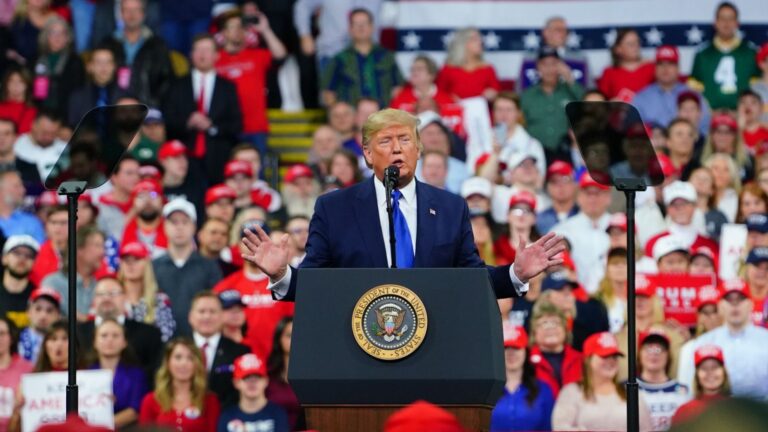
Trump delivered his latest comments at an October 10 campaign rally in Clarksville, Tennessee, where thousands of supporters gathered ahead of the American midterm elections. Speaking about trade and Canada’s relationship with the United States, he argued that Canadians had grown accustomed to receiving favourable treatment from Washington. According to a White House press-pool report filed by Washington Post correspondent Katherine Doyle, Trump said Canada was not entitled to special treatment and insisted that American businesses did not need Canadian products.
He specifically mentioned cars, hockey sticks, and face masks, while also turning his attention to Canada’s national anthem. Trump acknowledged that he liked “O Canada” but questioned the necessity of hearing it. The comments were delivered as part of a broader speech emphasizing American manufacturing, tariffs, and his administration’s economic policies. Importantly, there was no reported announcement of a formal policy targeting the anthem. The remarks instead reflected Trump’s longstanding argument that the United States holds greater economic leverage over Canada and should use that advantage in negotiations.
His Comments About ‘O Canada’ Bring National Identity Into the Dispute
Trump’s reference to Canada’s anthem introduced a cultural dimension into an already difficult economic relationship. “O Canada” was first performed in Quebec City on June 24, 1880, during Saint-Jean-Baptiste Day celebrations. It officially became Canada’s national anthem on July 1, 1980, under the National Anthem Act. Its music was composed by Calixa Lavallée, while the original French lyrics were written by Adolphe-Basile Routhier. Over generations, the song has become an established symbol of Canadian sovereignty and national identity.
The anthem also occupies a familiar place in North American sports, particularly when Canadian and American teams compete. At hockey games involving teams from both countries, the national anthems are traditionally performed before play begins. Trump did not explicitly demand an end to that custom during his Tennessee remarks. Nevertheless, his dismissal of the need to hear the song arrives after repeated statements about Canada’s relationship with the United States, including earlier suggestions that Canada should become America’s 51st state. Against that backdrop, a remark that might otherwise appear casual carries greater political sensitivity.
Hockey Sticks Were Already Targeted by Trump’s 50% Tariffs
Hockey sticks were not an entirely new subject in Trump’s trade dispute with Canada. On July 20, 2026, the White House announced additional tariffs of 50% on selected Canadian imports, using Section 338 of the Tariff Act of 1930. The affected products included sporting equipment, alcoholic beverages, construction materials, and hundreds of other categories. The measures took effect in August, with the Associated Press reporting that more than 550 Canadian product categories were covered. Hockey sticks became one of the most recognizable examples because of their association with Canadian sporting culture.
The tariffs were expected to affect approximately US$20 billion in Canadian exports, representing about 5% of the goods Canada sent to the United States during 2025. Although that share is relatively small compared with total bilateral trade, a 50% duty can be significant for an individual business. Import tariffs are paid by American importers, which may absorb the expense or pass some of it to customers. Consequently, a Canadian hockey-equipment supplier can lose price competitiveness even when American customers remain interested in its products. Trump’s latest comments reinforce the political symbolism attached to those restrictions.
Canada’s Hockey-Stick Industry Is Smaller Than Many Americans Realize
Despite hockey’s importance to Canada’s sporting identity, relatively few modern hockey sticks are manufactured domestically. Reuters reported in July that Roustan Hockey in Ontario was Canada’s last major producer of traditional wooden hockey sticks. The company manufactures approximately 400,000 wooden sticks annually, with around 100,000 exported to the United States. Modern professional players generally prefer lightweight composite sticks, many of which are manufactured outside Canada.
That distinction makes Trump’s focus on hockey sticks economically unusual. Tariffs on Canadian-made wooden sticks affect a relatively narrow manufacturing segment rather than the entire international hockey-equipment market. However, smaller Canadian businesses can still experience meaningful consequences. CityNews reported that Guelph-based Taggs Hockey sells roughly 1,000 sticks annually, with American buyers accounting for as much as one-fifth of its business. For a small manufacturer, losing even a portion of those customers can matter. The situation illustrates a broader problem with highly targeted trade measures: a product category may appear minor in national statistics while remaining essential to the livelihoods of individual manufacturers and retailers.
Canadian Cars Remain a Major Part of America’s Automotive Market
Trump’s dismissal of Canadian automobiles carries far greater economic implications than his comments about hockey sticks. Canada’s automotive sector is deeply connected to American consumers and manufacturers. According to the federal government’s 2026 automotive strategy, Canada produced more than 1.2 million passenger vehicles during 2025. More than 90% of Canadian-built vehicles and approximately 60% of Canadian-produced auto parts are exported to the United States. The industry directly supports roughly 125,000 Canadian jobs, while a much larger workforce depends on related activities.
Those figures demonstrate why American market access is so important to Canadian manufacturing communities. However, the dependence does not operate in only one direction. American automakers and their suppliers also participate in Canadian production. A pickup truck or sport utility vehicle assembled in Ontario may contain engines, electronic systems, or other components manufactured by American workers. Statistics Canada estimated that 76.4% of Canadian automobile assembly employment in 2024 was attributable to American demand, representing approximately 27,000 jobs. The figures show Canada’s exposure to American trade policy while also highlighting the long-established commercial links supporting manufacturers in both countries.
American Workers Also Benefit From Canadian Auto Production
North America’s automotive industry does not operate as a collection of completely separate national manufacturing systems. Production has been integrated across Canada, the United States, and Mexico for decades. Vehicle components can cross international borders repeatedly before reaching final assembly. Canadian government information has indicated that some components may cross the Canada-U.S. border as many as six times during production. This arrangement allows manufacturers to specialize in particular parts, share production capacity, and maintain established supplier networks.
The integration also means that a Canadian-built vehicle can contain substantial American economic value. Federal briefing materials have estimated that Canadian vehicles contain approximately 50% American content by value on average. In 2024, Canada imported nearly C$30 billion worth of automotive parts from the United States. Those purchases support American manufacturing activity even when the finished vehicle is assembled in Canada. New tariffs can therefore affect workers on both sides of the border. An American supplier could lose orders if Canadian production slows, while an American assembly plant could face higher costs for Canadian components. Trump’s preference for domestic production reflects his economic priorities, but replacing established supply chains is considerably more complicated than changing the location of final assembly.
Trump’s Proposed 50% Auto Tariff Raises the Stakes Further
Canadian automakers are already operating under substantial American trade restrictions. Since April 2025, Canadian-built vehicles have faced a 25% U.S. tariff on their non-American content, with qualifying U.S.-origin content exempt under the relevant CUSMA rules. These measures have forced manufacturers to reassess production costs, vehicle pricing, and investment decisions. Automobiles are particularly sensitive to trade restrictions because they require expensive facilities, specialized equipment, and complicated supplier relationships.
The situation could become more difficult in 2027. On August 24, Trump threatened to increase American tariffs on Canadian cars, trucks, and automotive parts to 50%, with the higher rate scheduled to begin January 1, 2027. The proposal followed the collapse of trade negotiations between Washington and Ottawa. However, the announced 2027 increase must be distinguished from tariffs already in effect: it remained a threatened future escalation at the time of Trump’s October 10 remarks. For Canadian manufacturers, uncertainty itself can be damaging. Companies planning future vehicle programs need to estimate manufacturing costs several years in advance, and unpredictable trade conditions can make long-term investment commitments harder to justify.
Major Automakers Are Still Manufacturing Vehicles in Canada
Trump has repeatedly argued that his tariff policies are encouraging automotive manufacturers to shift production toward the United States. Some Canadian operations have experienced layoffs, production adjustments, and postponed investments. However, major vehicle manufacturers continue operating substantial facilities in Ontario. Toyota Motor Manufacturing Canada began producing the sixth-generation RAV4 in Woodstock in January 2026, supported by an investment exceeding C$1.1 billion. Toyota assembled more than 535,000 vehicles in Canada during 2025 and employs over 8,500 workers across its Ontario operations.
Honda also continues assembling Civic and CR-V models in Alliston, Ontario. In May 2026, the company confirmed that its existing employment and production levels would remain unchanged despite indefinitely suspending a separate Canadian electric-vehicle supply-chain project. General Motors presents a more difficult picture. Its Oshawa assembly plant reduced production to two shifts in February, affecting approximately 500 employees, while maintaining preparations for next-generation full-size pickup production. These developments illustrate an industry experiencing genuine pressure rather than a complete departure from Canada. Manufacturers are making different decisions based on individual vehicle programs, market demand, investment costs, and their exposure to changing tariffs.
The United States Still Relies Heavily on Canadian Energy and Materials
Trump’s assertion that America does not need Canadian products extends beyond the automotive sector. However, Canada’s importance to American energy and manufacturing is well documented. The Associated Press reported in August that approximately four million barrels of Canadian crude oil flow into the United States daily. According to the U.S. Energy Information Administration figures cited in that reporting, those shipments are equivalent to nearly 20% of total American petroleum consumption. Much of the crude is processed by Midwest refineries designed to handle Canadian heavy oil.
Canada also supplies aluminum for American manufacturing and potash used by agricultural producers. More than 80% of American potash imports come from Canada, according to the Associated Press. That fertilizer is important for major U.S. crops, including corn and soybeans. The economic relationship contains some notable contradictions. Trump has previously acknowledged that American manufacturers need Canadian aluminum even while imposing tariffs on the metal. His ambassador to Canada, Pete Hoekstra, has similarly recognized American dependence on Canadian potash. These facts do not mean the United States could never develop alternative suppliers, but changing established energy and agricultural supply chains would involve substantial costs and investment.
The Latest Trade Figures Show How Closely the Countries Remain Connected
The scale of Canada-U.S. commerce provides another perspective on Trump’s remarks. According to the Associated Press, the countries exchanged approximately US$872 billion in goods and services during 2025. That trade encompasses automobiles, petroleum, agricultural products, industrial equipment, and many other goods. The United States frequently records a merchandise trade deficit with Canada, but the imbalance reflects purchases of valuable products rather than a direct financial subsidy from the American government.
Canada’s latest merchandise trade figures also demonstrate how quickly businesses respond to changing tariff policies. Statistics Canada reported on October 6 that Canadian exports to the United States increased 8.1% in August 2026. Canada’s bilateral merchandise trade surplus rose from C$6.1 billion in July to C$11.2 billion in August. However, Statistics Canada cautioned that companies may have accelerated shipments before new American tariffs took effect. The increase therefore cannot automatically be interpreted as permanently stronger demand. The broader economic lesson is that Canada and the United States remain important customers and suppliers for one another, even as political leaders disagree over whether the trading relationship is fair.
The Anthem Dispute Revives Memories of Canada’s Hockey Protests
Trump’s latest comments may be especially sensitive because hockey and national anthems have already become symbols of disagreement between the countries. During the February 2025 Four Nations Face-Off championship in Boston, Canadian singer Chantal Kreviazuk deliberately altered a line of “O Canada” before the championship game against the United States. She changed the words to emphasize Canadian ownership of the country, explaining that the decision was a response to Trump’s repeated suggestions that Canada should become America’s 51st state.
The performance attracted international attention and demonstrated how a sporting ceremony could become an expression of political identity. Canada subsequently defeated the United States 3-2 in overtime, giving the event additional significance for many Canadian supporters. At other games during the tournament, some spectators booed opposing national anthems, prompting debate over whether political disputes should intrude on international sports. Trump’s October 10 statement does not establish that he intends to change how anthems are performed at hockey games. Nevertheless, invoking both “O Canada” and hockey sticks during another trade-related attack recalls a period when national pride, sporting rivalry, and diplomatic tensions became unusually intertwined.
Canada’s Government Has Responded With Its Own Tariffs
Ottawa has already introduced substantial countermeasures in response to American trade restrictions. After Washington imposed additional 50% tariffs on selected Canadian products in August 2026, Prime Minister Mark Carney’s government announced retaliatory duties covering approximately C$27.6 billion in American imports. The measures took effect September 8, with selected products facing tariff rates of 15%, 25%, or 50%. The affected categories include steel, dairy products, household appliances, agricultural equipment, pulp and paper, and electronics.
Canada also announced C$7.5 billion in new and enhanced assistance measures for businesses and workers affected by the dispute. The federal government’s stated approach combines trade retaliation with efforts to strengthen domestic industries and reduce dependence on a single export market. However, retaliation creates its own economic complications. Canadian companies purchasing American materials may encounter higher costs, while businesses exporting to the United States remain exposed to Washington’s tariffs. The disagreement has therefore become more than a diplomatic confrontation between national leaders. It increasingly affects commercial contracts, investment planning, manufacturing employment, and the prices households may eventually pay for imported goods.
The Future of Canada-U.S. Trade Remains Unresolved
The dispute is unfolding as North America’s trade framework faces another period of uncertainty. During the July 1, 2026, joint review of the United States-Mexico-Canada Agreement, Washington declined to renew the agreement in its existing form. However, the U.S. Trade Representative confirmed that the agreement remains legally in force while negotiations continue. On October 2, American officials opened a public consultation process ahead of the 2027 joint review, with comments due January 12, 2027.
For Canadian businesses, the consequences of those negotiations could extend far beyond Trump’s latest remarks. Automakers must decide where to invest in future production, energy companies need reliable export markets, and manufacturers must evaluate the cost of selling across the border. The relationship remains important to American businesses as well, particularly those relying on Canadian components, energy, fertilizer, and customers. Trump’s Tennessee comments highlight the political distance between the countries, but their economic connections are much harder to separate. The central question is whether both governments can negotiate a more predictable trading relationship before prolonged uncertainty begins reshaping industries that have operated together for generations.
This Options Discord Chat is The Real Deal
While the internet is scoured with trading chat rooms, many of which even charge upwards of thousands of dollars to join, this smaller options trading discord chatroom is the real deal and actually providing valuable trade setups, education, and community without the noise and spam of the larger more expensive rooms. With a incredibly low-cost monthly fee, Options Trading Club (click here to see their reviews) requires an application to join ensuring that every member is dedicated and serious about taking their trading to the next level. If you are looking for a change in your trading strategies, then click here to apply for a membership.