35,000+ smart investors are already getting financial news, market signals, and macro shifts in the economy that could impact their money next with our FREE weekly newsletter. Get ahead of what the crowd finds out too late. Click Here to Subscribe for FREE.
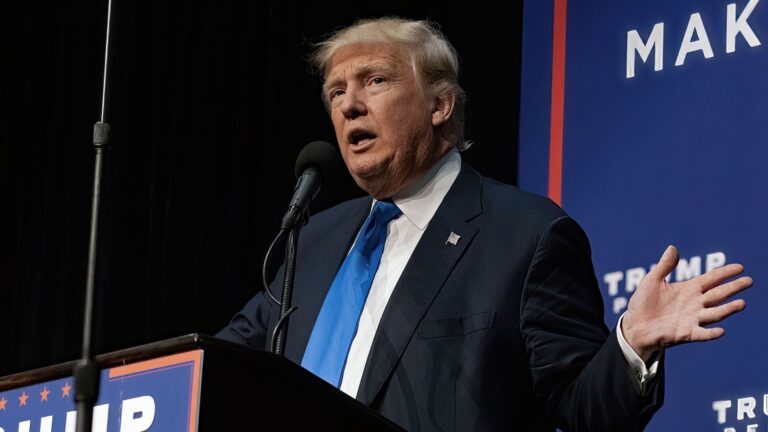
President Donald Trump is once again challenging familiar geographic names, this time suggesting that either the Atlantic or Pacific Ocean could receive a distinctly American identity. Speaking at a campaign rally in Clarksville, Tennessee, on October 10, 2026, Trump floated names including “Trump Ocean” and “Ocean of the Americas,” drawing laughter and applause from supporters.
His latest remarks follow a controversial August executive order directing American federal agencies to refer to Lake Ontario as “Lake America,” despite objections from Canadian leaders. Trump also previously changed the Gulf of Mexico’s official designation within the U.S. government to the Gulf of America.
While the ocean proposal has not become official policy, it has revived questions about presidential authority, international borders, diplomatic relationships, and the significance of geographic names shared by generations.
Trump Suggests Naming the Atlantic or Pacific Ocean After Himself
Trump Floats Renaming an Ocean After Touting His Controversial Lake Ontario Name Change
- Trump Suggests Naming the Atlantic or Pacific Ocean After Himself
- Lake Ontario Was Already Renamed Lake America by Executive Order
- Canada’s Leaders Reject the Lake America Designation
- Lake Ontario’s Indigenous Name Has Survived for Centuries
- The Gulf of America Decision Established an Earlier Precedent
- Google Maps and Apple Have Already Changed What Americans See
- Renaming an Entire Ocean Would Be a Much Bigger Challenge
- The Great Lakes Remain Shared Waters Regardless of Their Names
- U.S. Lawmakers Are Trying to Reverse the Lake Ontario Decision
- Canadians Are Turning Lake Ontario’s Name Into a Symbol of Pride
- The U.S.–Canada Trade Dispute Gives the Naming Fight Added Significance
- Trump Also Floats River Changes as Questions Grow About What Comes Next
Trump introduced the possibility of another major geographic name change during his Saturday rally in Clarksville, Tennessee. Addressing supporters ahead of the November midterm elections, the president reflected on his administration’s previous renaming decisions before suggesting that the United States should claim an ocean name as well. He floated two possibilities: “Trump Ocean” and “Ocean of the Americas.” The comments drew laughter and applause, indicating that the proposal was delivered at least partly in a humorous tone. However, his earlier remarks about Lake Ontario eventually resulted in an executive order, making the latest suggestion more than an ordinary political joke to some observers.
The president did not specify whether he preferred the Atlantic or Pacific Ocean, nor did he announce an executive order, implementation timeline, or formal review. His remarks also included the possibility of renaming a major river before leaving office. For Canadians, the ocean proposal carries additional significance because the same president recently changed the American government’s official terminology for a lake shared with Ontario. What might sound like entertaining campaign rhetoric can become a diplomatic issue when it involves geographic features extending beyond one country’s borders.
Lake Ontario Was Already Renamed Lake America by Executive Order
The latest ocean proposal follows a controversial decision made just six weeks earlier. On August 27, 2026, Trump signed Executive Order 14422, officially directing the United States government to replace the name Lake Ontario with Lake America. The order instructed the secretary of the interior to coordinate with the U.S. Board on Geographic Names and update the Geographic Names Information System within the prescribed administrative process. It also required federal departments and agencies to adopt the new designation in official maps, contracts, communications, and other documents, consistent with applicable law.
The order was published in the Federal Register on September 2, formalizing the administration’s instructions for federal usage. However, the decision did not give Washington the authority to dictate what Canada calls the lake. Lake Ontario remains the name used by the Canadian government, and New York State officials have also opposed the change. This creates an unusual situation in which American federal documents can identify the body of water differently from Canadian maps and provincial records. The lake itself, its international boundary, and the communities relying on it remain unchanged.
Canada’s Leaders Reject the Lake America Designation
Canadian Prime Minister Mark Carney responded to Trump’s August executive order by emphasizing the lake’s historical significance and Indigenous origins. Carney argued that the name Lake Ontario predates both Canadian Confederation in 1867 and the American Declaration of Independence in 1776. His response framed the controversy as more than a disagreement over words, pointing instead to the importance of historical continuity and Canada’s ability to determine its own geographic names. The prime minister made clear that Canada would continue using Lake Ontario, regardless of the terminology adopted by the American federal government.
Ontario Premier Doug Ford delivered an equally visible response on August 29 by unveiling a large lakeside sign at Fifty Point Conservation Area. The sign displayed the name Lake Ontario alongside the words “Now and Always,” reinforcing the province’s refusal to recognize Trump’s change. Opposition also emerged south of the border. New York Governor Kathy Hochul rejected the new designation, while Vermont’s Republican Governor Phil Scott described the decision as petty and disappointing. Their reactions demonstrated that disagreement extended beyond Canadian politicians or a single political party.
Lake Ontario’s Indigenous Name Has Survived for Centuries
Lake Ontario’s name carries a history considerably older than the modern border separating Canada and the United States. Natural Resources Canada traces the name Ontario to the Iroquoian word kanadario, associated with sparkling water, and records its use as early as 1641. Other historical and linguistic interpretations connect the name with Wendat words describing a beautiful or great lake. Although translations and spellings differ among sources, they share an important characteristic: the name is rooted in Indigenous languages rather than modern national politics.
The geographic name eventually became closely associated with the surrounding region. When Ontario became a Canadian province in 1867, it adopted a name already established through centuries of Indigenous and European usage. For communities along the lake, the name connects local history, geography, and identity. Those connections help explain why Trump’s executive order generated such a strong response. Changing the terminology in a federal database may be administratively straightforward, but replacing a name embedded in cultural traditions is considerably more complicated. The controversy has also renewed public attention to the Indigenous origins of familiar Canadian place names.
The Gulf of America Decision Established an Earlier Precedent
Trump’s attempt to rename Lake Ontario was not his administration’s first geographic rebranding campaign. On January 20, 2025, he signed Executive Order 14172, directing federal authorities to adopt the name Gulf of America for a defined area previously known as the Gulf of Mexico. The administration described the decision as an effort to recognize America’s historical and economic relationship with the waterway. Trump later proclaimed February 9, 2025, Gulf of America Day, turning the name change into a recurring symbol of his administration’s national identity messaging.
The response illustrated how differently countries can treat the same geographic feature. Mexico’s government continued to recognize the Gulf of Mexico and challenged the idea that an American executive order could determine terminology for waters associated with multiple countries. President Claudia Sheinbaum also criticized Google’s implementation of the change, arguing that American naming decisions should not extend into areas under Mexican jurisdiction. The precedent matters because it shows the difference between changing American government records and securing international acceptance. Trump’s latest ocean suggestion would confront that distinction on an even larger geographic scale.
Google Maps and Apple Have Already Changed What Americans See
The Lake Ontario controversy has produced an unexpected consequence for ordinary technology users. After Trump’s executive order, Google Maps began displaying Lake America for users in the United States. Canadian users continued seeing Lake Ontario, while users outside the two countries could encounter both names. Google explained that its mapping policy follows official geographic naming information supplied by government authorities. Apple also adopted the new terminology in its mapping service, according to an Associated Press report published October 8. The result is that people in different countries can open digital maps and encounter different names for the same lake.
The changes have also affected Canadian websites that rely on American mapping services. The Canadian Press reported that map elements on websites associated with Hydro One, GO Transit, and the LCBO displayed Lake America after the Google update, despite Canada’s unchanged naming policy. Some users began exploring alternative mapping platforms, including MapQuest and OpenStreetMap-based services. The episode illustrates how national government decisions can spread through international technology systems, occasionally producing results that local organizations never intended. A simple map label has become a surprisingly visible expression of competing national positions.
Renaming an Entire Ocean Would Be a Much Bigger Challenge
A presidential order affecting American government terminology is one thing; securing worldwide acceptance for the name of an ocean is another. The National Oceanic and Atmospheric Administration recognizes five major ocean regions: the Pacific, Atlantic, Indian, Arctic, and Southern oceans. Together, the world’s interconnected ocean waters cover approximately 71% of Earth’s surface. Their names appear in international navigation systems, scientific research, educational materials, and government records. Changing the internationally recognized name of the Atlantic or Pacific would therefore involve far more institutions and countries than the renaming of a single lake.
The United Nations does not serve as a worldwide naming authority, but its Group of Experts on Geographical Names promotes consistency and cooperation between national naming organizations. The International Hydrographic Organization also provides standards used by countries preparing marine charts. American authorities can establish terminology for U.S. federal purposes, but that does not compel other governments or international organizations to adopt it. Under maritime law, territorial seas generally extend up to 12 nautical miles from a country’s coastal baselines, while exclusive economic zones may extend up to 200 nautical miles for specified resource rights. Neither arrangement grants ownership of an entire ocean.
Lake Ontario’s international significance extends well beyond political symbolism. The lake forms part of the boundary between Ontario and New York and belongs to a freshwater system managed through longstanding Canadian-American cooperation. The Boundary Waters Treaty of 1909 established principles for resolving disputes over shared waters and created the International Joint Commission. Under the treaty, both countries have responsibilities concerning activities that could affect water levels, flows, and pollution across the international boundary. These obligations continue regardless of the different geographic names appearing in federal documents.
The countries also cooperate through the Great Lakes Water Quality Agreement, originally signed in 1972 and most recently updated in 2012. That agreement provides a framework for protecting water quality, restoring damaged ecosystems, and addressing environmental threats. For residents, businesses, and municipalities surrounding Lake Ontario, these responsibilities are considerably more immediate than a political dispute over terminology. Drinking water, shipping, fisheries, recreation, and environmental protection all depend on cooperation between jurisdictions. Changing a name in an American database does not alter the international boundary or remove either country’s treaty obligations. It does, however, introduce an additional difference into how the two governments describe a resource they must continue managing together.
U.S. Lawmakers Are Trying to Reverse the Lake Ontario Decision
Opposition to the Lake America designation has also reached the United States Congress. On August 31, Democratic Representative Debbie Dingell of Michigan, working with lawmakers including Tim Kennedy and Joe Morelle of New York, introduced the Hands Off Our Great Lakes Act. The legislation seeks to prevent federal officials from unilaterally renaming any of the five Great Lakes. It specifically targets Executive Order 14422, which established Lake America as the federal government’s new designation. Supporters of the legislation argue that the names of major shared waterways should not become instruments of political disputes.
Senator Kirsten Gillibrand of New York introduced corresponding legislation in the Senate on September 14. The proposed measures would nullify Trump’s lake-renaming order and prevent federal funds from being used to implement a substantially similar directive. However, introducing legislation is not the same as passing it. As of October 10, the bills remained proposals rather than enacted federal law, and Trump’s executive order continued to govern federal usage. Their introduction nevertheless demonstrates the opposition within American political institutions. The dispute now concerns not only which name should appear on maps, but also how much authority a president should exercise over longstanding geographic designations.
Canadians Are Turning Lake Ontario’s Name Into a Symbol of Pride
The disagreement has produced an unexpected response among Canadian businesses. Rather than relying entirely on political statements, several companies have introduced products celebrating the familiar Lake Ontario name. Nova Scotia-based Peace by Chocolate developed a 92-gram milk chocolate and maple cream bar packaged with Canadian imagery and information about the lake’s Indigenous origins. Founder Tareq Hadhad, whose family arrived in Canada as Syrian refugees in 2016, said the company wanted to respond constructively to the controversy. The product quickly became one of its five bestselling chocolate bars.
Other businesses have experienced similar interest. Ontario leather goods manufacturer Hides in Hand began producing coin purses embroidered with the lake’s name and outline. Toronto apparel company Province of Canada introduced a Lake Ontario sweatshirt that attracted enough demand for additional production runs. The company committed 15% of each sweatshirt purchase to Indspire, a charity supporting Indigenous education. These products are modest compared with the diplomatic and legal questions surrounding the controversy, but they demonstrate how strongly geographic names can connect with consumers. What began as an American executive order has unexpectedly become a marketing opportunity and a source of cultural expression for Canadian companies.
The U.S.–Canada Trade Dispute Gives the Naming Fight Added Significance
Trump’s Lake Ontario decision emerged during one of the most difficult periods in recent Canadian-American trade relations. Negotiations between Ottawa and Washington broke down on August 21, 2026, following disagreements over proposed trade arrangements. Just four days later, Trump publicly suggested changing Lake Ontario’s name, linking his proposal to deteriorating commercial relations with the Canadian province. The subsequent executive order arrived as both countries were imposing tariffs and debating the future of important cross-border industries. Although the lake’s name has no direct effect on tariff rates, the timing gave the decision an unmistakable diplomatic dimension.
Prime Minister Carney subsequently called for more serious negotiations, arguing that Canada remained willing to pursue a mutually beneficial agreement that respected its economic sovereignty. American officials disputed Canada’s explanation for the failed negotiations, maintaining that Washington had offered acceptable terms. The differences extend across manufacturing, agriculture, and the highly integrated automotive sector. For Canadian businesses whose operations depend on American customers, unresolved trade disagreements create far more immediate financial concerns than the renaming of a lake. Nevertheless, the naming controversy has become another public expression of the strained relationship between the two countries.
Trump Also Floats River Changes as Questions Grow About What Comes Next
The president’s latest remarks suggest that his interest in renaming geographic landmarks may not be finished. During the October 10 rally, Trump discussed the possibility of finding a major river to rename but indicated that he would leave the Hudson and Mississippi rivers alone. He expressed appreciation for the Hudson River’s historical namesake and spoke favourably about Mississippi. The comments followed his September suggestion that New Mexico might be renamed New America. That earlier proposal also generated opposition, including from New Mexico Governor Michelle Lujan Grisham, who defended the state’s longstanding name and history.
These proposals have important differences in legal status. The Gulf of America and Lake America designations were implemented through executive orders affecting U.S. federal usage. By contrast, New America’s designation remains only a suggestion, and a state name change cannot be accomplished through presidential instruction alone. Likewise, Trump’s October 10 comments did not establish a formal new name for either major ocean. For now, the Atlantic and Pacific retain their internationally recognized identities, while Lake Ontario continues to be called by its historical name in Canada. Whether Washington pursues another executive order remains uncertain, but the dispute has already demonstrated how a few words on a map can become a much larger political and cultural debate.
This Options Discord Chat is The Real Deal
While the internet is scoured with trading chat rooms, many of which even charge upwards of thousands of dollars to join, this smaller options trading discord chatroom is the real deal and actually providing valuable trade setups, education, and community without the noise and spam of the larger more expensive rooms. With a incredibly low-cost monthly fee, Options Trading Club (click here to see their reviews) requires an application to join ensuring that every member is dedicated and serious about taking their trading to the next level. If you are looking for a change in your trading strategies, then click here to apply for a membership.