35,000+ smart investors are already getting financial news, market signals, and macro shifts in the economy that could impact their money next with our FREE weekly newsletter. Get ahead of what the crowd finds out too late. Click Here to Subscribe for FREE.
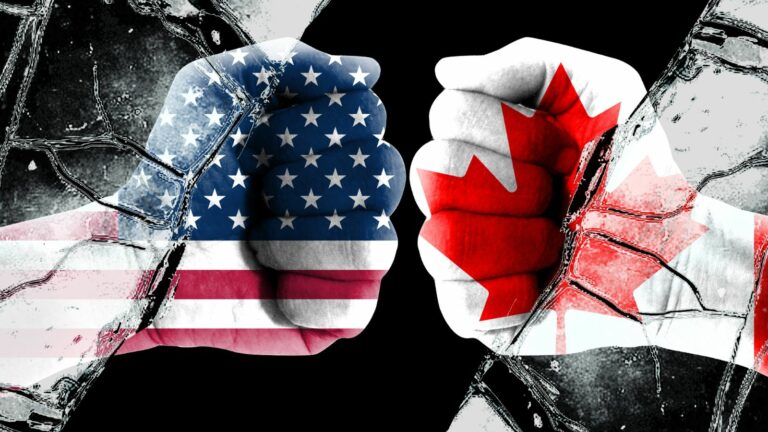
A tariff fight that began as a global trade policy has turned into a major domestic legal challenge inside the United States. A coalition of 25 states is asking the U.S. Court of International Trade to strike down the Trump administration’s latest Section 301 tariffs, arguing that the government stretched a targeted trade law into another near-global tariff system. Canada is directly caught in the dispute: covered Canadian goods face a 10% additional tariff, although important exemptions protect USMCA-compliant trade.
The case arrives after two earlier battles over different tariff authorities and amid a much wider deterioration in Canada-U.S. trade relations. Following a closely watched September 30 hearing, the judges are now considering whether the administration lawfully used forced-labour concerns to justify duties covering 60 trading partners.
A Domestic Revolt Against a Global Tariff Regime
25 U.S. States Challenge Trump Tariffs That Also Hit Canadian Exports
- A Domestic Revolt Against a Global Tariff Regime
- The Coalition Really Does Include 25 States
- Canada Is Directly Inside the Challenged Tariff System
- USMCA Compliance Shields a Large Share of Canadian Trade
- Forced Labour Is the Administration’s Stated Justification
- Canada Already Had a Forced-Labour Import Ban
- Ottawa Was Already Trying to Strengthen Enforcement
- Section 301 Gives USTR Genuine Tariff Authority
- The Fight Is Really About How That Power Was Used
- The States Say the Investigation Moved Unusually Fast
- USTR Says the Process Was Far From Superficial
- The Rate Structure Is Strikingly Broad
- Exemptions Make the Policy More Complicated Than a Flat Tariff
- Timing Is Central to the States’ “Pretext” Argument
- The Supreme Court Had Already Closed the IEEPA Door
- Section 122 Became the Administration’s Second Route
- The Government Says Section 301 Is Legally Different
- States Say the Tariffs Are Hitting Their Own Budgets
- Research Suggests Americans Absorb Most Tariff Costs
- Canada’s Exposure to the U.S. Market Remains Enormous
- Rules of Origin Have Become a Financial Decision
- The Case Extends Far Beyond Canada
- Small U.S. Businesses Are Fighting Alongside the States
- The Court Could Strike Down the Tariffs—or Order a Do-Over
- For Canada, This Is Only One Front in a Bigger Trade Rupture
The challenge is notable because the plaintiffs are not foreign governments trying to escape American trade restrictions. They are U.S. states arguing that Washington’s tariff policy is inflicting costs at home while exceeding the authority Congress granted under Section 301 of the Trade Act of 1974. The coalition filed its complaint in the U.S. Court of International Trade on August 3, asking judges to set aside the new duties and block their continued enforcement.
The tariffs being challenged took effect in late July and cover goods from 60 economies that together account for virtually all U.S. imports. The states characterize the policy as the administration’s third attempt to preserve a broad tariff structure after previous approaches encountered court defeats. The administration rejects that interpretation and says the latest tariffs are a legitimate response to the failure of trading partners to adequately police goods made with forced labour. That disagreement now sits at the heart of the case.
The Coalition Really Does Include 25 States
The lawsuit brings together Oregon, Arizona, California, Colorado, Connecticut, Delaware, Hawaii, Illinois, Kentucky, Maine, Maryland, Massachusetts, Michigan, Minnesota, Nevada, New Jersey, New Mexico, New York, North Carolina, Pennsylvania, Rhode Island, Vermont, Virginia, Washington and Wisconsin. Most are represented by their attorneys general, while Kentucky Governor Andy Beshear and Pennsylvania Governor Josh Shapiro joined in their official capacities.
California, Arizona and Oregon have played leading roles in the litigation, but the unusually large coalition gives the challenge considerably more institutional weight than a dispute brought only by individual importers. The states contend that tariffs affect them in several capacities: as governments purchasing equipment and supplies, as customers buying goods containing imported components, and as public entities attempting to budget when trade policy can suddenly alter procurement costs. Their involvement also turns what might otherwise look like an international trade dispute into a question about how federal tariff decisions affect state finances across much of the country.
Canada Is Directly Inside the Challenged Tariff System
Canada is one of the economies specifically targeted by the Section 301 forced-labour action. The U.S. Trade Representative placed Canadian goods in the 10% tariff category rather than the 12.5% category applied to many other economies. The distinction reflects Washington’s acknowledgment that Canada already has a prohibition on importing products made with forced labour, even though USTR concluded that Canada was not enforcing its system effectively enough.
That makes the Canadian situation unusual. The tariff is not based on a U.S. finding that Canadian factories broadly use forced labour. Rather, Washington’s concern is that countries such as Canada may allow goods produced with forced labour elsewhere to enter their own markets, potentially affecting international commerce and American competitors. For Canadian exporters, however, the practical issue is simpler: when a product falls within the tariff’s coverage and does not qualify for an exemption, the importer bringing that Canadian product into the United States faces an additional 10% duty.
The headline 10% rate does not mean every Canadian product entering the United States suddenly became 10% more expensive at the border. Canada’s government says goods qualifying for preferential treatment under the Canada-United States-Mexico Agreement remain exempt from these Section 301 duties. That carve-out is enormously important because the vast majority of bilateral commerce is capable of qualifying for USMCA treatment when the applicable origin requirements and certification rules are satisfied.
For exporters, however, “Canadian” and “USMCA-compliant” are not automatically the same thing. Goods must meet the agreement’s rules of origin, and the importer normally must make the appropriate preferential tariff claim. A Canadian business using substantial non-North-American components can therefore face a different result from a nearby competitor making a similar product with qualifying inputs. The legal challenge matters most directly to Canadian products that remain exposed after those rules and exemptions are applied, while other tariff authorities can still hit USMCA-compliant products separately.
Forced Labour Is the Administration’s Stated Justification
The Trump administration presents the tariffs as part of an effort to remove goods made with forced labour from global supply chains. USTR launched investigations covering 60 economies and concluded in June that their acts, policies or practices concerning forced-labour imports were unreasonable and burdened or restricted U.S. commerce. Economies with an existing prohibition or relevant commitments generally received the lower 10% rate, while many others received 12.5%.
Administration officials argue that the United States has enforced a prohibition against forced-labour imports for generations and should not be expected to compete with products that can move through jurisdictions with weaker enforcement. USTR has also held consultations and training sessions with foreign governments to encourage stronger import controls. That policy objective is not the central point of disagreement in court: the state plaintiffs also condemn forced labour. The dispute is whether Section 301 legally permits this particular remedy, implemented on this scale and through the process USTR used.
Canada Already Had a Forced-Labour Import Ban
One reason the Canadian portion of the dispute is more complicated than the headline suggests is that Canada already prohibits goods produced wholly or partly through forced labour. The prohibition entered Canadian law in 2020 through amendments to the Customs Tariff, implementing a commitment made under the USMCA. The Canada Border Services Agency is responsible for border enforcement, with assistance from other federal departments and agencies.
Canada added another layer in 2024 when its Fighting Against Forced Labour and Child Labour in Supply Chains Act came into force. That measure focuses largely on transparency, requiring covered businesses and federal institutions to report on steps taken to identify and reduce forced- and child-labour risks in their supply chains. U.S. officials nevertheless concluded that simply having a legal prohibition was insufficient. Their Section 301 finding focused heavily on whether countries were effectively enforcing such bans. The distinction between having legislation and demonstrating enforcement became the basis for placing Canada in the 10% category.
Ottawa Was Already Trying to Strengthen Enforcement
Canada was not standing still when the American tariff decision arrived. In June 2026, Ottawa introduced legislation designed to replace the existing Customs Tariff prohibition with a more comprehensive standalone forced-labour import framework. The government described the proposal as an effort to strengthen enforcement and make it harder for goods tied to forced labour to enter the Canadian market.
That timing gives the dispute another layer. Canada shares Washington’s stated goal of excluding forced-labour goods, and Canadian officials pointed directly to the new legislation when responding to the U.S. tariffs. Yet USTR still concluded that additional pressure was warranted. That creates a policy question alongside the legal one: whether imposing tariffs on a country already building tougher enforcement mechanisms encourages faster reform or instead penalizes legitimate exporters unrelated to the offending supply chains. The states challenging the duties emphasize the latter risk, while the administration argues that economic pressure has already pushed numerous governments toward stronger forced-labour restrictions.
Section 301 Gives USTR Genuine Tariff Authority
The administration enters this case with one important advantage it did not have in the Supreme Court fight over emergency powers: Section 301 expressly contemplates import duties. The statute authorizes the U.S. Trade Representative to respond when foreign acts, policies or practices are found to be unreasonable or discriminatory and to burden or restrict U.S. commerce. Available responses can include imposing duties or other import restrictions.
The law can also reach products that were not themselves involved in the underlying foreign practice, giving USTR substantial flexibility. That is why the current dispute cannot be reduced to the argument that presidents simply lack tariff authority. Congress has delegated considerable trade-remedy power through Section 301. The harder question is whether the statutory conditions were actually met here. The challengers argue USTR must still identify the relevant practice, establish its burden on American commerce and choose an appropriate response directed at eliminating that practice. The administration says its investigation satisfied those requirements.
The Fight Is Really About How That Power Was Used
The 25 states are not arguing that Section 301 can never support a tariff. Instead, they contend that a law designed to respond to identified foreign trade practices was stretched into a mechanism for keeping broadly applicable tariffs on almost the entire world. Their complaint describes the July action as arbitrary, capricious and beyond the authority Congress delegated to USTR.
One of their central objections involves tailoring. If the identified problem is weak enforcement against imported goods made with forced labour, the states argue, USTR should be able to demonstrate how the tariff imposed on each economy is connected to that economy’s conduct and how the duty is expected to change it. The government counters that Section 301 contains substantial discretion and does not require the mathematical precision the challengers demand. That difference matters because the court is not being asked to decide whether forced labour is a legitimate concern. It is deciding whether the administrative record legally supports this particular response.
The States Say the Investigation Moved Unusually Fast
Speed is one of the plaintiffs’ most prominent pieces of evidence. USTR launched the forced-labour investigations on March 12 and published its principal findings on June 2, roughly two and a half months later. The exercise covered 59 countries plus the European Union simultaneously. The state complaint contrasts that pace with earlier Section 301 investigations that spent many months examining the actions of a single trading partner.
The states point, for example, to the first Trump administration’s investigation of Chinese technology-transfer and intellectual-property practices, which developed over many months before tariffs were proposed. They also cite a more recent Brazil investigation that lasted about a year. The challengers argue that analyzing dozens of economies in a fraction of that time made detailed country-specific findings unrealistic. Speed alone does not necessarily make an investigation illegal, however. The administration maintains that the relevant question is whether USTR assembled an adequate factual and administrative record, not whether it followed the timetable of earlier cases.
USTR Says the Process Was Far From Superficial
The administration has its own numbers to demonstrate that the investigation involved extensive public participation. USTR says the overall process included two rounds of public hearings and more than 2,100 comments. After it proposed responsive action in June, the agency says it reviewed more than 1,600 written submissions and heard testimony from more than 100 witnesses during hearings held from July 7 through July 9.
USTR also says it consulted with more than 45 governments covered by the investigations. Those figures form an important part of the government’s answer to allegations that it predetermined the result. The challengers respond that the existence of hearings and comments does not prove the agency meaningfully addressed objections raised during them. That is a familiar administrative-law distinction: agencies are generally free to reject comments, but significant concerns cannot simply be ignored when the agency explains a major decision. The judges must ultimately assess the quality of the reasoning, not merely the volume of material collected.
The Rate Structure Is Strikingly Broad
Rather than establishing dozens of sharply differentiated tariff rates, USTR grouped countries into a small number of categories. Canada joined Argentina, Bangladesh, Cambodia, Ecuador, El Salvador, Guatemala, Honduras, India, Indonesia, Jordan, Malaysia, Mexico, Pakistan, Sri Lanka, Trinidad and Tobago and the United Kingdom in the 10% category. Other economies generally face 12.5%, with special most-favoured-nation calculations applying to the European Union, Taiwan, Japan, Korea and Switzerland.
The challengers say that narrow spread is evidence the policy was not sufficiently tailored to the conditions discovered in each country. The states note that economies with vastly different legal systems, enforcement records and levels of development ended up facing almost identical rates. USTR sees the structure differently. Its framework rewards jurisdictions that already impose a forced-labour ban, have committed to one, or possess a partial enforcement regime, while placing a higher rate on economies without comparable measures. Whether that classification is sufficiently reasoned is now for the court to judge.
Exemptions Make the Policy More Complicated Than a Flat Tariff
Even outside the USMCA carve-out affecting Canada and Mexico, the Section 301 action contains numerous exclusions. USTR exempted goods already subject to certain Section 232 measures and created exclusions for products such as raw materials whose taxation could leave the United States without adequate supply. Other exemptions cover goods capable of causing economy-wide disruption or products that cannot be produced domestically in sufficient quantities or at reasonable prices.
This matters economically because two Canadian exporters selling equally valuable products can have completely different exposure depending on tariff classification, origin and other trade rules. It also matters legally. The government can point to exemptions as evidence that officials considered domestic economic consequences rather than blindly taxing everything. Opponents can counter that selective exclusions highlight the sweeping nature of the remaining duties. For businesses, meanwhile, the immediate challenge is less philosophical: customs classification, origin documentation and applicable exclusions can now determine whether a shipment carries a substantial additional cost.
Timing Is Central to the States’ “Pretext” Argument
The chronology may become one of the most important parts of the case. The new Section 301 duties were announced immediately before the temporary global tariffs imposed under Section 122 were scheduled to expire. The forced-labour tariffs then took effect at 12:01 a.m. on July 24, allowing much of the broader tariff structure to continue without a prolonged gap.
The states argue that this continuity reveals the real purpose of the investigation. In their view, forced labour supplied a new statutory justification for a tariff regime the administration already wanted to preserve after its earlier legal strategies ran into trouble. Administration officials reject the suggestion that the investigation was a sham and maintain that USTR genuinely examined foreign forced-labour policies. Both propositions can matter simultaneously: policymakers can favour a broad tariff strategy while also caring about forced labour. The legal question is whether the administrative decision was actually grounded in the statutory findings Section 301 requires rather than a predetermined desire to maintain global tariffs.
The Supreme Court Had Already Closed the IEEPA Door
The litigation cannot be understood without the Supreme Court’s February 20 decision in Learning Resources v. Trump. The administration had relied on the International Emergency Economic Powers Act, or IEEPA, to support sweeping tariffs. In a 6-3 ruling, the Supreme Court held that IEEPA does not authorize the president to impose tariffs, eliminating the statutory foundation for some of the administration’s broadest trade measures.
That ruling did not say presidents can never impose tariffs. Congress has enacted several statutes that explicitly delegate tariff authority under particular circumstances. Instead, the Court concluded that IEEPA was not one of them. That distinction explains why the current Section 301 fight is more legally complex. Unlike IEEPA, Section 301 explicitly discusses duties. The administration therefore starts from stronger textual ground. But the Supreme Court decision also reinforced the larger constitutional backdrop: tariff authority originates with Congress, and executive action must stay within the boundaries Congress actually established when it delegated part of that power.
Section 122 Became the Administration’s Second Route
On the same day the Supreme Court rejected the IEEPA tariffs, the administration turned to Section 122 of the Trade Act of 1974 and announced a temporary global surcharge. A coalition of states challenged that approach as well. In May, the U.S. Court of International Trade ruled that the Section 122 action was unlawful, although the Federal Circuit subsequently stayed that judgment while the litigation continued.
That sequence is why opponents repeatedly describe the current policy as “attempt number three.” From their perspective, IEEPA failed, Section 122 ran into another adverse ruling, and Section 301 was then employed to produce a broadly similar practical result. The government sees the sequence differently. Each statute has its own language and legal requirements, meaning a court defeat under one authority does not automatically invalidate tariffs imposed under another. The Section 301 case therefore cannot be decided solely by observing that earlier tariffs lost in court; judges must examine whether this third statutory framework independently authorizes what USTR did.
The Government Says Section 301 Is Legally Different
The Justice Department’s central response is straightforward: this time the administration is using a statute that explicitly empowers USTR to impose duties after investigating unfair foreign trade practices. At the September hearing, government lawyers argued that USTR conducted genuine investigations into the failure of foreign economies to prevent forced-labour goods from moving through their markets and reasonably concluded that the shortcomings burden U.S. commerce.
The government also disputes the challengers’ insistence on highly granular proof. Its position is that Section 301 does not require USTR to establish with absolute certainty the precise dollar burden generated by forced-labour goods before it can act. That argument is important because plaintiffs have emphasized the lack of detailed country-by-country links between the identified conduct and the tariff rates. If judges accept a broad reading of the agency’s discretion, the policy could survive. If they conclude that USTR’s findings were too generalized for a remedy covering nearly all imports, the administration could face another major tariff setback.
States Say the Tariffs Are Hitting Their Own Budgets
The coalition claims more than an abstract interest in federal trade policy. Its complaint says state governments buy imported equipment, supplies, replacement parts and other goods that can be subject to the challenged tariffs. Even when a state does not import an item directly, vendors can incorporate tariff costs into the prices charged under government contracts.
There is another layer when American-made products contain tariffed imported components. A piece of equipment can be assembled in the United States yet still become more expensive because one or several intermediate inputs crossed the border under an additional duty. The states say those changes create direct financial harm and make budgeting and auditing vendor price adjustments more difficult. The argument humanizes what otherwise sounds like a distant fight over presidential power. A customs duty collected at a port can eventually show up in the price of machinery, technology or supplies purchased by a state agency hundreds of kilometres inland.
Research Suggests Americans Absorb Most Tariff Costs
A substantial body of recent economic research supports the proposition that tariffs are primarily paid inside the importing country rather than by foreign governments. Researchers at the Federal Reserve Bank of New York estimated that nearly 90% of the economic burden of the 2025 U.S. tariffs fell on American firms and consumers. A Kiel Institute analysis using millions of shipment records estimated an even higher U.S. share, at roughly 96%.
Consumer-price effects are more complicated because businesses do not necessarily pass every dollar of additional import cost immediately to shoppers. A 2026 NBER study estimated that roughly 26% of tariff increases passed through to consumer prices, with some indirect effects emerging as domestic producers faced more expensive inputs and less competition. That distinction matters for Canadian trade. A Canadian exporter can lose sales because its product becomes less competitive, but the customs bill itself is generally paid by the U.S. importer, which then decides how much of that expense can be absorbed or passed downstream.
Canada’s Exposure to the U.S. Market Remains Enormous
Even after a difficult year for cross-border commerce, the United States remained overwhelmingly Canada’s largest export market in 2025. Global Affairs Canada reports that Canadian merchandise exports to the United States totalled approximately C$564.6 billion on a customs basis. The U.S. represented 72.5% of Canadian merchandise exports, although that share had fallen significantly from the previous year and reached its lowest level since the early 1980s.
That concentration explains why seemingly technical American tariff decisions attract enormous attention in Canada. A 10% duty affecting only a minority of shipments can still matter when the underlying trade relationship is measured in hundreds of billions of dollars. Exporters can try to shift sales elsewhere, and Canadian trade with non-U.S. markets has been expanding, but replacing the proximity and scale of the American market is difficult. For sectors built around integrated North American production, changing destination may require redesigning logistics, product specifications, supplier relationships and distribution networks rather than simply finding another customer.
Rules of Origin Have Become a Financial Decision
Before the current tariff battles, some Canadian companies had little incentive to formally claim USMCA preference. If a product already entered the United States with a very low or zero normal tariff, completing the additional origin documentation could offer minimal financial benefit. That calculation has changed. Canada’s Trade Commissioner Service says qualifying goods remain exempt from the Section 301 forced-labour tariffs, creating a stronger incentive to satisfy and document USMCA origin requirements.
The service estimates that more than 98% of tariff lines and over 99.9% of bilateral Canada-U.S. trade can potentially avoid certain U.S. tariffs through proper USMCA compliance. But eligibility depends on the individual product. Companies need to understand where materials originated, how much processing occurred within North America and whether the importer has the required certification. In practical terms, trade compliance has moved from a back-office formality to a potentially important profit-margin decision for Canadian companies selling into the United States.
The Case Extends Far Beyond Canada
Canada is only one piece of an extraordinarily broad policy. USTR’s action covers 60 economies, ranging from close U.S. allies to major strategic competitors. The European Union, China, Japan, Korea, Mexico, the United Kingdom, India and dozens of smaller economies are all caught within the same forced-labour initiative, although tariff rates and exemptions vary.
That breadth helps explain why the court’s eventual decision could have consequences far beyond Canada-U.S. relations. A ruling validating the administration’s approach could establish Section 301 as a powerful tool for addressing trade practices across groups of countries simultaneously. A ruling against it could push USTR toward slower, more individualized investigations with clearer links between each country’s conduct and the remedy imposed. The outcome could therefore shape future American trade actions involving issues other than forced labour. USTR is already using or considering Section 301 investigations in areas such as industrial overcapacity, digital trade and other alleged market distortions, making the legal boundaries of the statute increasingly consequential.
Small U.S. Businesses Are Fighting Alongside the States
The state coalition is not alone. Private companies also challenged the July tariffs, and those cases have been coordinated before the Court of International Trade. Among the plaintiffs are Burlap & Barrel, a U.S. business importing single-origin spices from overseas producers, and Collective Horology, a California company working with independent watchmakers. Other litigation involves Learning Resources and companies connected to the flooring business.
Their participation puts recognizable businesses behind the legal arguments. An importer of specialty spices cannot simply replace every overseas farmer with an American supplier, just as an independent-watch retailer cannot domestically manufacture the foreign watches it was created to distribute. The companies argue that broad tariffs punish legitimate importers without establishing that their particular goods have anything to do with forced labour. The administration responds that Section 301 can lawfully target a broad range of goods as leverage against foreign practices. That tension—between trade leverage and collateral business costs—is one of the case’s most tangible economic questions.
The Court Could Strike Down the Tariffs—or Order a Do-Over
During the September 30 hearing, a three-judge panel questioned lawyers for both sides about how much evidence Section 301 requires and whether USTR adequately explained the relationship between forced-labour enforcement abroad and the duties it imposed. The judges pressed challengers on whether they were effectively demanding more paperwork, while also questioning the government about whether broader statutory language could substitute for more specific requirements dealing with foreign practices.
The outcome is not necessarily all-or-nothing. The plaintiffs want the tariffs set aside, which could produce another major disruption to the administration’s trade program and potentially raise refund questions for duties already collected. But the court could choose a narrower remedy. Reuters reported after the hearing that judges could require USTR to redo portions of its investigation or provide more detailed findings rather than permanently foreclose Section 301 tariffs addressing forced labour. As of October 4, a written ruling had not yet been issued.
For Canada, This Is Only One Front in a Bigger Trade Rupture
Even a Canadian victory flowing from this litigation would not restore the old cross-border trade environment. The Section 301 forced-labour duty is only one layer of a much larger tariff conflict. Canada is also dealing with separate U.S. measures under Section 232 and Section 338. Ottawa says Section 338 tariffs of 50% were imposed on a range of Canadian products in August, while later U.S. changes added restrictions and import bans affecting selected Canadian goods.
Canada has retaliated as well. Countertariffs of 15%, 25% and 50% were introduced on C$27.6 billion in U.S. products, adding another round of costs and uncertainty for companies on both sides of the border. Meanwhile, the 2026 USMCA review remains unresolved after Washington declined to renew the agreement in its current form, although the pact remains in force. The 25-state lawsuit could remove one important tariff mechanism. It cannot, by itself, settle the increasingly complicated struggle over the future of North American trade.
This Options Discord Chat is The Real Deal
While the internet is scoured with trading chat rooms, many of which even charge upwards of thousands of dollars to join, this smaller options trading discord chatroom is the real deal and actually providing valuable trade setups, education, and community without the noise and spam of the larger more expensive rooms. With a incredibly low-cost monthly fee, Options Trading Club (click here to see their reviews) requires an application to join ensuring that every member is dedicated and serious about taking their trading to the next level. If you are looking for a change in your trading strategies, then click here to apply for a membership.