35,000+ smart investors are already getting financial news, market signals, and macro shifts in the economy that could impact their money next with our FREE weekly newsletter. Get ahead of what the crowd finds out too late. Click Here to Subscribe for FREE.
Tariffs are supposed to change where goods are made. In Maine’s woods, they are also changing what it costs to keep the machinery running.
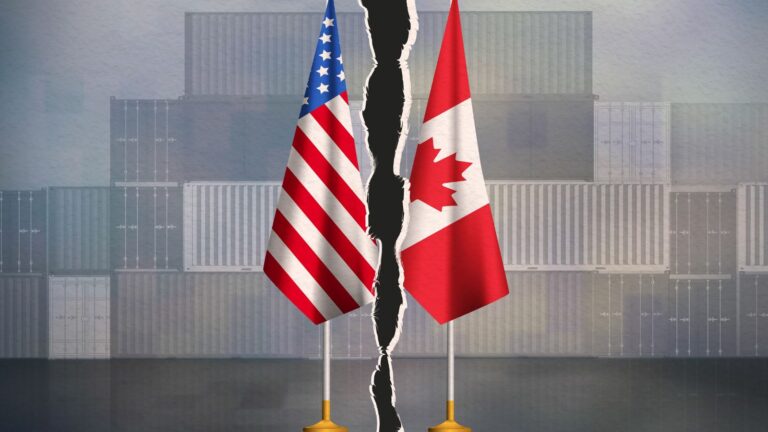
The latest U.S.-Canada trade dispute has placed duties as high as 50% on selected goods, while Canada has answered with tariffs of 15%, 25% and 50% on billions of dollars of U.S. products. For Maine logging contractors, the concern is unusually direct because industry representatives say many heavy trucks and specialized machines are sourced from Canada or other foreign manufacturers. Equipment costs were already 20% to 25% higher since January 2025, according to the Professional Logging Contractors of the Northeast. Current evidence does not establish that logging-equipment prices broadly increased 30% to 50%, but the combination of rising machinery prices, tariffs and weak timber markets is putting significant pressure on contractors.
The New Tariff Fight Reaches Deep Into Maine’s Woods
Trump’s Canada Trade War Is Hitting Maine Loggers With Equipment Costs Up 30% to 50%
- The New Tariff Fight Reaches Deep Into Maine’s Woods
- Modern Logging Machines Can Already Cost More Than a House
- Maine and Canada Operate More Like One Regional Economy
- Loggers Have Less Ability to Pass Higher Costs Along
- Tariffs Can Help One Maine Mill While Hurting Another
- The Stakes Extend Far Beyond Individual Logging Crews
- Contractors Are Looking for Ways to Survive the Cost Squeeze
The latest escalation became harder for Maine businesses to ignore in August. The Trump administration imposed additional tariffs of up to 50% on selected Canadian products, with the measures taking effect August 22 after a brief three-day delay. Canada responded by matching the U.S. measures with tariffs of 15%, 25% and 50% on C$27.6 billion worth of American imports beginning September 8. The Canadian measures cover sectors including steel, agricultural equipment, pulp and paper, appliances and electronics, expanding the consequences well beyond companies that sell finished consumer goods across the border.
Maine’s logging contractors are particularly exposed because their businesses depend on expensive machinery, replacement parts and cross-border supply chains. Dana Doran, executive director of the Professional Logging Contractors of the Northeast, has said tariffs on machinery are likely to be among the most serious effects for loggers. Many contractors obtain heavy trucks and forestry equipment from Canada. That means a trade measure intended to pressure Canadian producers can also increase the cost structure of an American contractor working miles inside Maine.
Modern Logging Machines Can Already Cost More Than a House
Mechanized logging bears little resemblance to the chainsaw-and-skidder operations associated with earlier generations. Modern crews can depend on feller bunchers, processors, forwarders and cut-to-length harvesters worth hundreds of thousands of dollars each. Maine legislative testimony in 2025 put the price of a single harvesting processor at roughly $750,000. Other industry research has placed sophisticated cut-to-length equipment in a similarly expensive range, making even relatively small percentage increases meaningful for a family-owned logging company.
One Maine Monitor investigation illustrated the tariff problem with a specialized processor that previously cost a forestry-equipment dealer roughly $525,000 to import from Europe. Duties on the machine had once been around $3,000. After tariff changes, the dealer said the duty burden rose to about $90,000, pushing the total import cost to approximately $600,000. The dealer said the company had essentially stopped bringing in those machines because loggers were unlikely to absorb the higher price. Separately, Doran said in January that equipment costs had increased approximately 20% to 25% since the beginning of 2025.
Maine and Canada Operate More Like One Regional Economy
Geography helps explain why trade barriers can produce unusually large side effects in Maine. Canada is not simply another overseas market for the state. It is Maine’s largest trade and investment partner, with companies, mills, transportation networks and natural-resource industries operating across a border that has historically been highly integrated. Maine International Trade Center reported that the state exported about $1.3 billion in goods to Canada in 2025, representing approximately 40% of all Maine merchandise exports.
Forest products demonstrate that integration especially clearly. Maine has historically exported roughly 2 million tons of wood products annually while importing about 2.3 million tons, much of it from Canada. Mills close to Quebec and New Brunswick can draw raw material from both sides of the border because their economic supply areas do not stop neatly at the international boundary. Maine state economic data showed Canada accounting for nearly 69% of Maine imports and about 35% of exports in December 2025. When tariffs interfere with that circulation, the result can be higher costs on one side of the border and weaker markets on the other.
Loggers Have Less Ability to Pass Higher Costs Along
A retailer facing higher wholesale costs can sometimes increase the price on a shelf. Independent logging contractors often operate differently. Industry representatives have repeatedly described loggers as “price takers” rather than price setters because mills and timber markets largely determine what contractors receive for harvested wood. If the price of a processor, tire, replacement hydraulic component or truck rises sharply, a logger cannot automatically add the difference to the next load of pulpwood.
That makes tariffs potentially more painful for capital-intensive industries with narrow margins. Economic research into earlier U.S. tariff rounds also found that tariffs were largely passed through into the prices paid by American importers rather than being absorbed entirely by foreign suppliers. Federal Reserve researchers found rapid and substantial pass-through from the 2018-19 tariffs, while academic work published by the American Economic Association similarly concluded that U.S. importers and consumers bore much of the cost. For a logging company financing several machines simultaneously, higher purchase prices can therefore translate into larger loans, greater interest expense and pressure to keep older equipment operating longer.
Tariffs Can Help One Maine Mill While Hurting Another
The effects are not uniformly negative across Maine’s forest sector. Pleasant River Lumber, for example, has argued that protection from lower-priced Canadian lumber has improved its competitive position. The company had invested more than $100 million in its Enfield operation since 2020 and added another manufacturing shift in early 2026. Its owners told The Maine Monitor that tariffs on Canadian lumber helped give the company enough confidence to expand. The Enfield operation and related facilities also provide an important market for Maine-grown softwood.
The situation looks different for businesses that rely on foreign customers or imported machinery. Hardwood manufacturers have faced weaker demand and retaliatory tariffs in export markets. One Maine hardwood company reported paying more than $1,000 in additional duties on individual loads shipped to a longtime Quebec customer during an earlier round of Canadian retaliation. Sawmills also need specialized foreign equipment of their own. The result is an uneven landscape: import protection can improve pricing power for a domestic softwood producer while higher equipment costs and retaliatory duties squeeze loggers, pulp suppliers and export-oriented manufacturers elsewhere in the same supply chain.
The Stakes Extend Far Beyond Individual Logging Crews
Maine’s forests remain one of the state’s largest economic resources. A University of Maine analysis of 2024 data estimated that the forest-products sector generated nearly $4.9 billion in direct economic output. When indirect activity and household spending supported by the industry were included, the total contribution reached approximately $8.3 billion. The sector supported an estimated 29,637 direct, indirect and induced jobs and generated more than $2 billion in labor income.
Those figures also reveal why the current strain matters. Between 2019 and 2024, inflation-adjusted total output supported by the forest-products sector declined about 14%, while employment declined roughly 7%. Paper-manufacturing losses accounted for a significant portion of the decline, but logging has also contracted. A logging crew disappearing from the market does not affect only the workers running harvesters in the woods. Sawmills need reliable timber supply. Landowners need contractors capable of conducting harvests. Truckers need loads. Equipment dealers, repair shops, fuel suppliers and rural communities depend on the same economic network. Losing harvesting capacity can therefore become a bottleneck for the entire industry.
Contractors Are Looking for Ways to Survive the Cost Squeeze
Some contractors are responding by delaying purchases, maintaining equipment longer or looking outside traditional logging for additional revenue. Doran has said contractors are considering construction, earthwork and other lines of business because logging and trucking have become less predictable. Diversification may keep individual companies operating, but it also creates a longer-term question for Maine: machinery sitting on an earthmoving job is machinery that is not necessarily available when a mill suddenly needs more timber harvested.
Maine already has financing mechanisms designed to make equipment investment easier. The Maine Forestry Direct Link Loan Program can provide eligible loggers with an interest-rate subsidy of up to two percentage points on loans of as much as $800,000 for qualifying equipment and forestry improvements. State law also establishes an Improvements to Logging and Fishing Enterprises Loan Program that can finance purchases of new or used harvesting equipment. Those programs illustrate how capital-intensive the business has become. The immediate challenge is no longer just the price of timber. It is whether contractors can justify another major machinery investment while tariffs, fuel expenses, financing costs and cross-border markets remain unusually difficult to predict.
This Options Discord Chat is The Real Deal
While the internet is scoured with trading chat rooms, many of which even charge upwards of thousands of dollars to join, this smaller options trading discord chatroom is the real deal and actually providing valuable trade setups, education, and community without the noise and spam of the larger more expensive rooms. With a incredibly low-cost monthly fee, Options Trading Club (click here to see their reviews) requires an application to join ensuring that every member is dedicated and serious about taking their trading to the next level. If you are looking for a change in your trading strategies, then click here to apply for a membership.