35,000+ smart investors are already getting financial news, market signals, and macro shifts in the economy that could impact their money next with our FREE weekly newsletter. Get ahead of what the crowd finds out too late. Click Here to Subscribe for FREE.
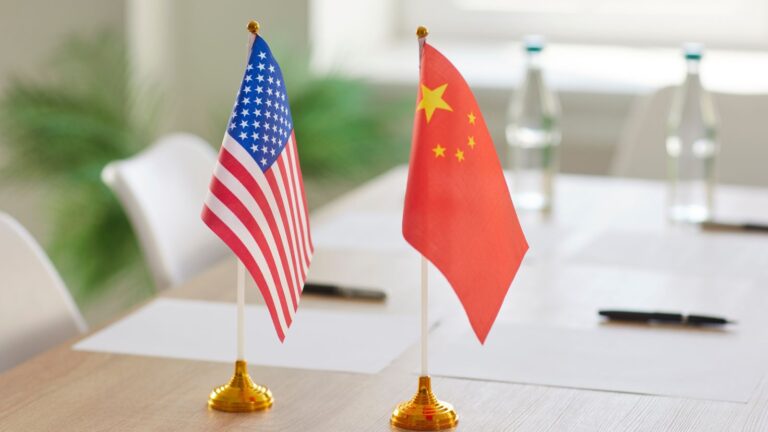
Washington has reopened a high-level negotiating channel with Beijing at a striking moment in North American trade relations. U.S. Treasury Secretary Scott Bessent and Trade Representative Jamieson Greer are meeting Chinese Vice Premier He Lifeng in New York to work through trade, artificial intelligence and critical-mineral disputes ahead of a planned Trump-Xi summit in Washington. At the same time, formal Canada-U.S. trade negotiations remain suspended after talks broke down in August and were followed by new tariffs and counter-tariffs.
The contrast does not mean Washington and Beijing have settled their much larger disagreements. It does, however, show how differently the United States is managing two economically important relationships: actively searching for limited accommodations with China while no comparable negotiating round with Canada has been announced.
Washington and Beijing Are Back at the Table
Washington Opens New China Talks While Canada-U.S. Trade Negotiations Stay Frozen
- Washington and Beijing Are Back at the Table
- The China Talks Are Focused on Practical Deliverables
- Canada-U.S. Negotiations Remain Suspended
- The Breakdown Has Already Produced Real Tariffs
- Canada Is Still Far More Dependent on the U.S. Market
- Trade Data Show Canada Is Already Looking Elsewhere
- The Economic Risk Comes From Uncertainty as Well as Tariffs
- Washington Is Negotiating Selectively, Not Retreating From Trade Talks
- Critical Minerals and AI Are Reshaping Trade Diplomacy
- A Restart With Canada Is Still Possible, but No Date Is Set
The latest U.S.-China negotiating round began September 20 in New York, with Bessent, Greer and He at the centre of discussions intended to prepare potential agreements before President Donald Trump meets Chinese President Xi Jinping in Washington. The agenda extends well beyond conventional tariffs. Officials are discussing critical minerals, artificial intelligence and trade commitments, reflecting how closely economic policy has become tied to technology and national security.
The immediate goal appears less ambitious than a sweeping trade settlement. The existing U.S.-China trade truce is scheduled to expire November 10, giving negotiators a clear near-term deadline. The two governments are also revisiting commitments involving Chinese critical-mineral flows, American agricultural exports and market access for less sensitive goods. For companies caught between the world’s two largest economies, even a limited extension of the truce could matter. Predictability over tariffs, minerals and industrial inputs can influence everything from manufacturing contracts to investment plans months before political leaders sign anything.
The China Talks Are Focused on Practical Deliverables
One important feature of the new negotiations is their relatively narrow focus. American officials have been working with Beijing on what they describe as non-sensitive trade, including a proposed mechanism sometimes referred to as a Board of Trade. Rather than attempting to resolve every strategic dispute between the countries, that approach is designed to identify products that can continue moving between the two markets without becoming entangled in the most contentious national-security issues.
That matters because the commercial relationship remains enormous despite several years of tariffs and restrictions. U.S. government figures put total American goods and services trade with China at an estimated $494.6 billion in 2025. Goods exports to China were roughly $106 billion, while goods imports were approximately $309 billion. Agriculture remains another pressure point: U.S. agricultural exports to China fell sharply in 2025. Washington therefore has an economic incentive to secure additional Chinese purchases even while maintaining restrictions in sensitive technology and industrial sectors.
Canada-U.S. Negotiations Remain Suspended
Canada is currently in a very different position. Prime Minister Mark Carney suspended bilateral trade negotiations on August 21, directing Canadian negotiators to return to Ottawa after the government concluded that newly proposed American terms did not provide sufficient economic benefits. Carney’s government said the discussions had previously made substantial progress but that last-minute changes prevented an agreement.
There has been no announced resumption of the formal negotiating process comparable to the meeting now taking place with China. In the days immediately after the breakdown, U.S. Trade Representative Jamieson Greer said no new talks were planned. More recently, Carney has left the door open rather than declaring negotiations permanently finished. Speaking at the Canada Investment Summit on September 15, he said Canada would be ready when conditions existed for a mutually beneficial arrangement. That distinction is important: the relationship is frozen at the negotiating-table level, but diplomatic and economic contact between the two countries has not stopped.
The Breakdown Has Already Produced Real Tariffs
The negotiating freeze is no longer simply a disagreement over possible future trade rules. New measures have already taken effect. Ottawa says Washington imposed 50% tariffs on $27.6 billion worth of Canadian goods beginning August 22. Canada responded with matching countermeasures covering $27.6 billion of imports from the United States, with Canadian tariff rates of 15%, 25% or 50% depending on the product.
The Canadian measures took effect September 8 and target areas including steel, dairy products, appliances, agricultural equipment, pulp and paper, and electronics. Washington subsequently announced additional action of its own, including restrictions on selected Canadian products and plans to remove $50 billion worth of Canadian-origin products from U.S. General Services Administration purchasing schedules. The two governments dispute responsibility for the breakdown: Ottawa argues the final U.S. demands became unacceptable, while USTR says Canada walked away from a near-final agreement and chose retaliation. Those competing accounts remain an important part of the unresolved dispute.
Canada Is Still Far More Dependent on the U.S. Market
The diplomatic contrast with China is particularly significant because Canada remains much more closely integrated with the American economy. Statistics Canada reported that 71.7% of Canadian merchandise exports went to the United States in 2025. That was already down notably from 75.9% in 2024, but it still illustrates how difficult it would be for Canadian producers to rapidly replace the U.S. market.
At the same time, most cross-border commerce has not stopped. Carney said in September that roughly 80% of trade with the United States remained tariff-free, underscoring the unusual nature of the dispute: enormous volumes of goods continue crossing the border while targeted sectors face potentially severe barriers. For an auto-parts producer, steel company or exporter directly affected by the measures, the distinction may offer little comfort. But for the broader economy, continued tariff-free access under much of the existing North American framework helps explain why the conflict has not produced an immediate collapse in bilateral trade.
Trade Data Show Canada Is Already Looking Elsewhere
Canada’s diversification strategy is beginning to show up in official trade figures. Statistics Canada reported that Canadian exports to the United States fell 6.6% in July, helping shrink Canada’s monthly merchandise trade surplus with its southern neighbour from $10.3 billion in June to $5.9 billion. The July decline was the sharpest percentage drop in U.S.-bound Canadian exports since April 2025.
The same report contained another striking number. Exports to countries other than the United States climbed 7.4% in July to a record $25.6 billion, representing 33.7% of all Canadian merchandise exports for the month. Increased shipments to markets including the Netherlands, China and Germany contributed to that rise. One month of data does not establish a permanent structural shift, and the United States remains Canada’s dominant customer by a wide margin. Still, the figures illustrate why Ottawa is intensifying economic engagement with Europe, Asia and other markets instead of treating an immediate U.S. agreement as its only available option.
The Economic Risk Comes From Uncertainty as Well as Tariffs
The Bank of Canada has emphasized that the consequences of the dispute extend beyond the products appearing on tariff lists. Its September deliberations noted that the latest American tariffs affected roughly 5% of Canadian goods exports to the United States. Policymakers judged that the direct economy-wide effect could be relatively modest, especially with government support measures cushioning some affected firms and workers.
The larger concern is prolonged uncertainty. Businesses are less likely to add machinery, expand factories or hire aggressively when they cannot confidently estimate future market access or input costs. The Bank said renewed trade uncertainty could weigh on consumer and business confidence, investment and employment, especially if the confrontation escalates. Ottawa has responded with a new $7.5-billion package of support measures for tariff-affected workers and businesses, on top of earlier assistance. That support can soften immediate damage, but it cannot give exporters the same long-term certainty that a stable cross-border trade framework would provide.
Washington Is Negotiating Selectively, Not Retreating From Trade Talks
The activity surrounding China also comes as Washington continues negotiating with Mexico. Mexican President Claudia Sheinbaum said on September 18 that her government was making progress toward a bilateral arrangement with the United States after discussions with Trump. Mexico has been seeking relief from American tariffs affecting products including steel, aluminum and automobiles.
That makes the Canadian situation more unusual. Both of Canada’s CUSMA partners are deeply integrated with the American economy, yet Washington’s conversations with Mexico are moving forward while Canada’s formal negotiating channel remains suspended. The United States is simultaneously talking to Beijing despite much deeper strategic disagreements involving technology, industrial policy and national security. This does not necessarily indicate that Washington considers China or Mexico more important than Canada. Each negotiation has its own disputes, leverage and objectives. It does demonstrate that the U.S. administration is willing to keep negotiating where officials believe the terms and political circumstances justify continued engagement.
Critical Minerals and AI Are Reshaping Trade Diplomacy
Traditional trade negotiations once concentrated heavily on tariffs, quotas and agricultural access. The latest U.S.-China discussions demonstrate how much that agenda has expanded. Critical minerals are now central because they feed technologies ranging from advanced electronics to defence systems and artificial-intelligence infrastructure. U.S. officials have argued that Chinese deliveries of certain critical minerals have not fully matched previous commitments, making supply-chain security a major negotiating issue.
Artificial intelligence has also entered the diplomatic conversation. Bessent has said the two governments can discuss safeguards intended to reduce shared risks while the United States continues competing aggressively in AI development. Those talks are notable because economic rivalry and national-security concerns increasingly overlap. Canada faces the same changing environment from a different position. Its own economic strategy emphasizes critical minerals, energy, advanced manufacturing and trade diversification. Whatever happens with Washington, Ottawa is increasingly treating strategic resources and technology capacity as bargaining assets rather than simply commodities for export.
A Restart With Canada Is Still Possible, but No Date Is Set
Neither side has formally closed the door on renewed Canada-U.S. negotiations. Carney said September 15 that a mutually beneficial arrangement remained possible and that Canada would be ready when the timing and conditions were appropriate. Washington, meanwhile, continues to describe its trade measures as an attempt to secure greater reciprocity and market access for American producers. The gap therefore remains substantial, but it is a gap over terms rather than an announced decision to end economic negotiations permanently.
For now, the calendar looks much clearer on the China file. Bessent, Greer and He are meeting ahead of the Trump-Xi summit, with the November expiration of the existing trade truce creating another deadline after that. Canada has no equivalent negotiating date publicly scheduled. That leaves businesses facing an unusual situation: Washington and Beijing are attempting to stabilize selected parts of one of the world’s most difficult economic relationships while one of America’s closest and largest trading relationships waits for conditions that could bring negotiators back to the table.
This Options Discord Chat is The Real Deal
While the internet is scoured with trading chat rooms, many of which even charge upwards of thousands of dollars to join, this smaller options trading discord chatroom is the real deal and actually providing valuable trade setups, education, and community without the noise and spam of the larger more expensive rooms. With a incredibly low-cost monthly fee, Options Trading Club (click here to see their reviews) requires an application to join ensuring that every member is dedicated and serious about taking their trading to the next level. If you are looking for a change in your trading strategies, then click here to apply for a membership.