35,000+ smart investors are already getting financial news, market signals, and macro shifts in the economy that could impact their money next with our FREE weekly newsletter. Get ahead of what the crowd finds out too late. Click Here to Subscribe for FREE.
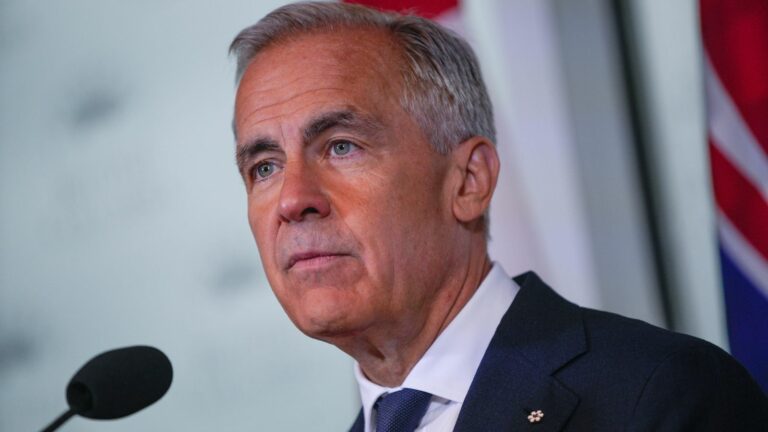
Prime Minister Mark Carney is heading to New York for the United Nations General Assembly at a moment when Canada’s relationship with its largest trading partner remains unusually unsettled. His September 21–23 visit will include meetings with international leaders, investors and business figures, but Canadian officials said no meeting with President Donald Trump or other members of the U.S. administration was scheduled as of September 18.
The absence comes nearly a month after Canada-U.S. trade negotiations collapsed and both countries moved ahead with new economic measures against each other. Yet New York will also showcase another part of Carney’s strategy: expanding Canada’s relationships with Europe and other markets while leaving open the possibility of eventually returning to negotiations with Washington.
A New York Trip Without a Washington Breakthrough
Carney Heads to New York With No Trump Meeting Scheduled as Canada-U.S. Trade Talks Remain Frozen
- A New York Trip Without a Washington Breakthrough
- The August Breakdown Still Defines the Relationship
- Ottawa and Washington Tell Different Stories About Why Talks Failed
- Tariffs Are Now Reaching Beyond the Negotiating Table
- CUSMA Is Still Alive, but Its Review Has Become a Pressure Point
- The Economic Stakes Remain Enormous
- New York Fits Carney’s Diversification Strategy
- Europe and India Are Becoming More Important Test Cases
- The Next Deadlines Matter More Than a Hallway Encounter
Carney will be in New York from September 21 to 23 for the 81st Session of the United Nations General Assembly. Ottawa says his schedule will focus on international leaders, investors, economic and security partnerships, maritime security and efforts to reform the UN. Unlike many national leaders attending the gathering, Carney is not scheduled to deliver Canada’s formal address to the General Assembly; Foreign Affairs Minister Anita Anand is expected to do that instead.
The U.S. relationship will nevertheless hover over the visit. Canadian officials acknowledged that Carney and Trump could encounter one another because of the scale of UN high-level week, but stressed that no meeting with members of the U.S. administration was on the schedule. That distinction matters. An unscheduled encounter in a corridor or at an event would be diplomatically notable, but it would not amount to a restart of the formal negotiations suspended in August.
The August Breakdown Still Defines the Relationship
The immediate backdrop is the collapse of intensive bilateral trade negotiations on August 21. Carney ordered Canadian negotiators back to Ottawa after saying late changes to the U.S. proposal were unacceptable. His government said it had sought continued tariff-free access for most Canadian trade, lower U.S. tariffs on strategic industries and protection for Canadian economic and policy independence.
The rupture came after both governments had suggested substantial progress was being made. Only three days earlier, Carney said negotiations had advanced enough for Washington to postpone implementation of planned 50% tariffs until the end of August 21. Ottawa later said U.S. demands introduced near the deadline changed the economics of the proposed agreement. Washington disputed that characterization. The result was not simply another missed negotiating deadline: the talks were formally suspended, and no new bilateral negotiating round has since been announced.
Ottawa and Washington Tell Different Stories About Why Talks Failed
One of the largest obstacles to restarting negotiations is that the two governments publicly disagree about what caused them to collapse. Ottawa says the final U.S. terms demanded too many concessions and threatened important Canadian industries and Canada’s freedom to make independent economic decisions. Carney has said a mutually beneficial agreement remains possible, but only under different negotiating conditions.
Washington presents a sharply different account. U.S. Trade Representative Jamieson Greer said Canada walked away from what he described as a near-final agreement offering exceptionally favourable treatment. American officials have continued raising concerns about Canadian dairy policies, alcohol restrictions, automotive trade and market-access barriers. Those competing narratives are important because neither side is treating the August breakdown as a technical scheduling problem. Each government says substantive policy differences must change before another agreement can be reached.
Tariffs Are Now Reaching Beyond the Negotiating Table
The economic consequences have continued expanding since the talks stopped. Canada says the United States imposed 50% tariffs on $27.6 billion worth of Canadian goods, prompting Ottawa to introduce matching counter-tariffs covering $27.6 billion in U.S. imports. Canadian rates of 15%, 25% and 50% took effect September 8 on targeted products including steel, dairy goods, appliances, agricultural equipment, pulp and paper, plastics and electronics.
Washington has since moved into additional areas. White House proclamations issued September 8 provide for bans on selected Canadian alcoholic beverages, dairy products and motor-vehicle-related products beginning September 29. Then, on September 16, Trump directed U.S. officials to identify Canadian-origin goods that could be removed or made unavailable from the federal civilian procurement system, arguing that the measure responds to Canadian purchasing preferences. These steps mean the dispute increasingly affects individual products, procurement decisions and supply chains rather than remaining confined to broad tariff negotiations.
CUSMA Is Still Alive, but Its Review Has Become a Pressure Point
Despite the escalation, the Canada-United States-Mexico Agreement has not expired. CUSMA entered into force in July 2020 and remains legally in effect until 2036. At its first scheduled joint review on July 1, 2026, Canada supported extending the agreement for another 16-year term. Mexico also favoured renewal, but the United States declined to agree to an extension at that stage.
Under the agreement’s review mechanism, that decision does not automatically terminate CUSMA. Instead, annual reviews can continue while the pact remains in force, giving the three governments additional opportunities to agree on an extension. USTR has said Washington wants unresolved issues addressed before recommending renewal, while Ottawa continues to argue that preserving and strengthening the agreement benefits all three economies. The distinction is significant: North American free trade rules remain operational, even as the political negotiations surrounding their future have become much more contentious.
The Economic Stakes Remain Enormous
Canada has been diversifying, but the United States remains overwhelmingly its largest export market. Global Affairs Canada data show Canadian merchandise exports to the U.S. totalled $564.6 billion in 2025, representing 72.5% of the country’s merchandise exports. That share was lower than the previous year and at its lowest level since the early 1980s, but it still illustrates how difficult replacing American demand would be.
Recent data show both the dependence and the beginnings of diversification. Statistics Canada reported that exports to the United States fell 6.6% in July 2026, while exports to countries other than the U.S. climbed 7.4% to a record $25.6 billion. Even so, July exports to the American market were still worth about $50.5 billion. Canada has also estimated that roughly $3.5 billion in goods and services crossed the Canada-U.S. border each day in 2025. Those numbers explain why frozen talks can have consequences far beyond Ottawa and Washington.
New York Fits Carney’s Diversification Strategy
Carney’s UN itinerary reflects a broader effort to make diplomatic meetings double as economic outreach. Ottawa says he will meet global leaders and investors in New York while promoting Canada as a partner in areas ranging from energy and security to ocean protection. He is also scheduled to participate in events involving European Commission President Ursula von der Leyen, European Council President António Costa and other international leaders.
That approach follows the Canada Investment Summit held in Toronto on September 14 and 15. The federal government says the gathering produced nearly $500 billion in investment commitments and brought together investors from almost 30 countries managing more than $100 trillion in assets. Ottawa also announced an expanded capital-investment tax deduction, while Reuters reported that the government is trying to catalyze $1 trillion in investment over five years. Those commitments will ultimately have to translate into completed projects, but they demonstrate the scale of the government’s economic diversification campaign.
Europe and India Are Becoming More Important Test Cases
Europe has become the most visible component of that strategy. Days before the New York trip, Carney addressed the European Parliament and promoted a deeper Canada-EU relationship covering critical minerals, defence production, artificial intelligence, energy, digital trade and other strategic industries. European Commission President Ursula von der Leyen has proposed an unprecedented form of “associate member” relationship with Canada, though its legal and practical meaning remains undefined.
The economic relationship is already substantial: Ottawa says the EU was Canada’s second-largest trading partner in goods and services in 2025, with approximately $178 billion in bilateral trade. Canada will host an EU-Canada summit in Montreal on October 29 and 30. India is another emerging focus; Trade Minister Maninder Sidhu said September 19 that Canada hopes to conclude negotiations on a comprehensive economic partnership agreement with India by the end of 2026. Diversification is therefore becoming tangible, although the scale of U.S. trade means it cannot quickly substitute for the American market.
The Next Deadlines Matter More Than a Hallway Encounter
Attention in New York may naturally focus on whether Carney and Trump cross paths, but several scheduled developments are likely to be more consequential. The U.S. import restrictions announced for selected Canadian alcohol, dairy and motor-vehicle-related products are due to take effect September 29. Canada’s counter-tariffs are already in place, and Washington’s procurement directive is moving through the federal purchasing system.
Beyond September, Canada and the EU are preparing for their October 29–30 summit in Montreal, while the CUSMA framework provides future annual opportunities to revisit the North American agreement. Neither Ottawa nor Washington has ruled out renewed bilateral negotiations. Carney has said Canada can return when conditions support what his government considers a mutually beneficial agreement, while U.S. officials maintain that significant Canadian trade practices need to change. For now, however, there is no announced negotiating round and no Trump-Carney meeting on the New York calendar. The relationship remains economically indispensable, but its immediate trade diplomacy is still on hold.
This Options Discord Chat is The Real Deal
While the internet is scoured with trading chat rooms, many of which even charge upwards of thousands of dollars to join, this smaller options trading discord chatroom is the real deal and actually providing valuable trade setups, education, and community without the noise and spam of the larger more expensive rooms. With a incredibly low-cost monthly fee, Options Trading Club (click here to see their reviews) requires an application to join ensuring that every member is dedicated and serious about taking their trading to the next level. If you are looking for a change in your trading strategies, then click here to apply for a membership.