35,000+ smart investors are already getting financial news, market signals, and macro shifts in the economy that could impact their money next with our FREE weekly newsletter. Get ahead of what the crowd finds out too late. Click Here to Subscribe for FREE.
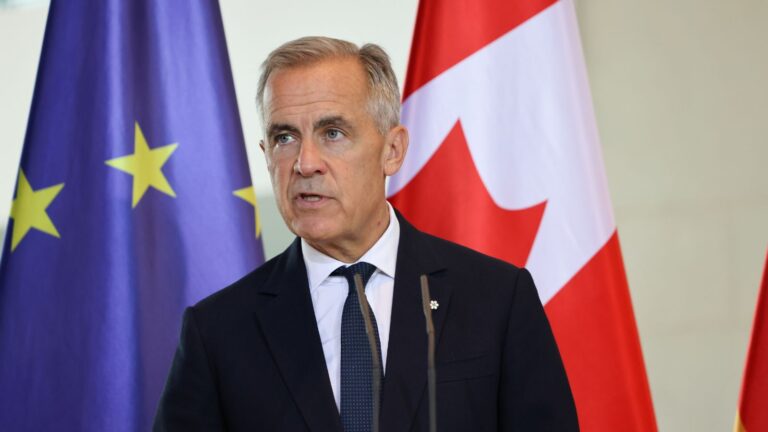
Canada’s long-standing assumption that its most important economic relationship would also remain its most dependable one is being tested in real time. Prime Minister Mark Carney is travelling to Europe from September 15 to 17 as the trade confrontation with U.S. President Donald Trump moves beyond tariffs into threatened and scheduled import restrictions.
The immediate stops are Strasbourg and Liverpool, but the larger objective reaches much further. Ottawa wants deeper European trade, investment, defence, energy and technology ties that can reduce the risks created by Canada’s extraordinary dependence on the American market. Europe cannot replace the United States overnight. Carney’s wager is that it does not have to. The goal is to give Canadian businesses, workers and governments more places to turn when Washington becomes unpredictable.
Europe Is Becoming Part of Canada’s Economic Security Strategy
Carney Heads to Europe Looking to Break Canada’s Dependence on U.S. as Trump Trade Fight Deepens
- Europe Is Becoming Part of Canada’s Economic Security Strategy
- The Numbers Show Why Washington Is So Hard to Replace
- Trump’s Escalation Has Made Diversification More Urgent
- Carney Wants a ‘Unique Alliance,’ Not EU Membership
- CETA Gives Canada a Head Start That Most Countries Do Not Have
- Easier Movement of Workers Could Become a Major Prize
- Defence Cooperation Has Already Moved Faster Than Trade
- Energy, Critical Minerals and AI Offer the Clearest Economic Fit
- The UK Stop Shows the Strategy Extends Beyond Brussels
- Breaking Dependence Will Take Years, Not One Trip
Carney’s itinerary makes clear that this is not being treated as a conventional diplomatic tour. From September 15 to 17, the prime minister is scheduled to visit Strasbourg, France, and Liverpool in the United Kingdom. In Strasbourg, he will attend European Commission President Ursula von der Leyen’s State of the European Union address as a guest of honour and then deliver a formal address to the European Parliament on September 17. European Parliament President Roberta Metsola’s official schedule lists a welcome for Carney at 11 a.m., followed by his address at 11:30 a.m.
The symbolism is significant because Ottawa is trying to turn political alignment into practical economic alternatives. Canada’s government says the discussions will cover trade, investment and security, while European lawmakers expect Carney to address economic security, Russia’s war against Ukraine, foreign interference and relations with the United States. For Canadian exporters facing uncertainty south of the border, those diplomatic conversations increasingly have commercial consequences. Europe is being treated not simply as an ally, but as a market, capital source and strategic counterweight.
The Numbers Show Why Washington Is So Hard to Replace
The scale of Canada’s U.S. dependence explains both the urgency of Carney’s strategy and its limitations. Statistics Canada reported that 71.7% of Canadian merchandise exports went to the United States in 2025. That was already a meaningful decline from 75.9% in 2024, but it still means roughly seven dollars out of every ten in Canadian merchandise exports were tied to one foreign market. On the import side, the American share fell from 62.3% to 58.8%.
There are signs that diversification has started rather than remaining a political slogan. Canadian merchandise exports to countries other than the United States jumped 17.2% in 2025, while two-way merchandise trade with non-U.S. countries climbed 14.3%, from $484 billion to $553 billion. Those gains are substantial, yet geography, integrated transportation networks and decades of cross-border investment still favour U.S. commerce. A factory in Ontario can often reach an American customer by truck within hours. Replacing that convenience with transatlantic trade requires ports, infrastructure, contracts and years of corporate investment.
Trump’s Escalation Has Made Diversification More Urgent
Canada has pursued new markets for years, but the current U.S. confrontation has changed the calculation from long-term diversification to economic risk management. Washington imposed 50% duties on a range of Canadian goods in August, prompting Ottawa to announce matching countermeasures. Canada’s Department of Finance says its latest counter-tariffs cover $27.6 billion of U.S. imports and apply rates of 15%, 25% and 50% across products including steel, dairy, appliances, agricultural equipment, pulp and paper, plastics and electronics.
The confrontation is also moving beyond ordinary tariffs. White House proclamations dated September 8 state that certain Canadian alcoholic beverages, dairy products and motor-vehicle products will be excluded from U.S. importation beginning September 29. Some affected products were previously subject to 50% additional duties. Trump has separately reiterated plans for further action affecting Canadian cars, trucks and auto parts. For businesses deciding where to build the next plant or sign a five-year supply agreement, uncertainty itself becomes a cost. Carney’s European push is therefore partly about creating options before the next trade shock arrives.
Carney Wants a ‘Unique Alliance,’ Not EU Membership
Speculation about Canada somehow joining the European Union grew rapidly after reports of discussions about an “associate” status. Carney has drawn a clear boundary around that idea. He said Canada is not looking to become an EU member and instead wants negotiations around what he called a “unique alliance” reflecting common values, priorities and complementary economic strengths. Canadian officials have similarly indicated that Ottawa is not seeking to copy arrangements used by Norway or Switzerland.
That distinction matters. Full EU membership would bring extensive institutional, regulatory and political obligations that neither side is proposing. What Ottawa appears to want is much more targeted: deeper access in strategically important areas without surrendering Canadian policymaking authority. Reports surrounding the talks point to investment, energy, artificial intelligence, defence, critical minerals and worker mobility as potential components. Even the label remains unsettled. The important question is whether Canada can achieve something materially deeper than an ordinary free-trade relationship while remaining outside the EU’s single-market structure. That will require detailed negotiation rather than simply a new diplomatic title.
CETA Gives Canada a Head Start That Most Countries Do Not Have
Carney is not starting the European pivot from zero. The Comprehensive Economic and Trade Agreement between Canada and the EU has been provisionally applied since September 2017 and already eliminated the vast majority of tariffs between the two economies. European Commission figures show that bilateral trade in goods and services reached roughly €130 billion in 2025, about 80% higher than the €72.1 billion recorded in 2016. Canada puts combined goods-and-services trade at $178.6 billion in 2025.
The structure is therefore already in place for companies that want to expand. By 2024, approximately 99% of tariff lines covered by the agreement had been eliminated, while bilateral services trade reached €49 billion in 2025. Yet CETA also shows how difficult European integration can be. The agreement is still only provisionally applied because the ratification process across EU national and, where required, regional legislatures remains unfinished. That history is a useful warning. Even when Canada and Brussels agree politically, implementation can move slowly. Carney’s challenge is to build on CETA without becoming trapped in another decade-long institutional process.
Easier Movement of Workers Could Become a Major Prize
One of the more ambitious ideas under discussion concerns people rather than physical goods. The Associated Press reported, citing a senior Canadian official familiar with the negotiations, that Ottawa plans to seek an arrangement giving Canadians greater freedom to live and work in Europe without conventional visa requirements. The official described investment as the core of the proposed strategic partnership and stressed that Canada was not seeking the same institutional relationship enjoyed by Norway or Switzerland.
Any such arrangement would be economically meaningful because modern supply chains often depend on specialized workers moving alongside investment. Canadian engineers helping construct European energy infrastructure, European technicians working on Canadian defence production, or AI researchers moving between technology hubs can face barriers that tariffs do not address. Reports have also pointed to discussions about facilitating movement of goods, services and workers tied to strategic sectors. Nothing resembling a finished mobility agreement has been announced, however. Visa rules remain politically sensitive and often involve both EU-level and national competencies, meaning this part of Carney’s agenda could prove considerably more difficult than reducing customs barriers.
Defence Cooperation Has Already Moved Faster Than Trade
The strongest evidence that Canada-Europe integration can move beyond speeches may be found in defence. Canada became the first non-European country permitted to participate in the EU’s Security Action for Europe, or SAFE, procurement framework. The bilateral agreement was signed in February 2026 and formally concluded by the Council of the European Union in June. SAFE is a €150-billion financing instrument intended to increase European defence-industrial production through collaborative procurement.
For Canadian manufacturers, participation creates access to procurement activity that would otherwise heavily favour European suppliers. It also ties Canadian industrial policy more closely to Europe at a moment when Ottawa is trying to expand domestic defence production. The development builds on the Canada-EU Security and Defence Partnership signed at the 2025 summit. Defence is particularly important because it demonstrates how diversification can work in practice: rather than attempting to replace American demand across the entire economy, Canada can identify strategically valuable sectors where European demand and Canadian capabilities overlap. Critical minerals, aerospace, cybersecurity and advanced manufacturing could follow a similar model if governments can convert political commitments into contracts.
Energy, Critical Minerals and AI Offer the Clearest Economic Fit
Europe’s need for secure energy and raw-material supplies overlaps unusually well with Canadian strengths. Canada and the European Commission have already been discussing greater cooperation involving liquefied natural gas, nuclear energy, electrification, clean technology and critical minerals. Canadian and EU officials have also expanded work on raw-material supply chains, including investment, processing, refining and regulatory cooperation. Those discussions matter because Europe is simultaneously trying to reduce vulnerabilities associated with Russian energy and concentrated mineral supply chains.
Technology is becoming another pillar. Canada and the EU launched negotiations on a Digital Trade Agreement in March 2026, while bilateral initiatives with European countries have expanded into semiconductors, artificial intelligence and digital infrastructure. Reports surrounding Carney’s proposed alliance have gone further, raising possibilities including data centres, cloud infrastructure, satellite networks and undersea cables. Some of those proposals remain preliminary rather than committed projects. Still, they illustrate the economic logic behind the European strategy. Canada is unlikely to beat the United States on geographic convenience, but it can compete as a politically stable supplier of energy, minerals, computing capacity and strategic technologies that Europe increasingly views through a security lens.
The UK Stop Shows the Strategy Extends Beyond Brussels
Carney’s second major stop, Liverpool, underlines that Ottawa’s European strategy is broader than its relationship with EU institutions. He is scheduled to meet British Prime Minister Andy Burnham for the first time, with the Canadian government identifying defence and security, energy, artificial intelligence and critical minerals as core subjects. Britain is outside the European Union, but it remains one of Canada’s closest political, financial and security partners and offers another route for reducing excessive reliance on the United States.
The choice of sectors is revealing because Ottawa is increasingly pursuing a network of overlapping partnerships rather than searching for one replacement market. A critical-minerals project could involve Canadian extraction, British financing and European processing. Defence technology could be developed with one partner and sold across several allied markets. The same logic applies to artificial intelligence and energy infrastructure. Diversification becomes more achievable when it means dozens of new commercial relationships instead of shifting an impossible volume of existing U.S.-bound trade to a single destination. Europe, in that sense, is less a substitute for America than the centre of a broader portfolio.
Breaking Dependence Will Take Years, Not One Trip
There is a major difference between reducing vulnerability to the United States and economically separating from it. Canada’s geography, railways, pipelines, auto plants and continental supply chains cannot simply be redirected across the Atlantic. Economic research has long found that neighbouring countries tend to trade disproportionately with one another, and Canada is an unusually strong example. Even after years of CETA-driven growth, the EU remains a much smaller Canadian trade partner than the United States. Europe itself also maintains regulatory, agricultural and political barriers that can slow deeper integration.
Success should therefore be judged incrementally. More Canadian exports moving through Atlantic ports, greater European investment in Canadian energy and mining, procurement contracts for Canadian defence companies, easier labour mobility and joint infrastructure projects would all reduce the cost of a future Washington dispute. The next Canada-EU summit, scheduled for October 29 and 30, will provide an early test of whether Carney’s September trip produces concrete commitments. The strategic objective is not to stop trading with America. It is to ensure that Canada is never again left with so few alternatives when that relationship breaks down.
This Options Discord Chat is The Real Deal
While the internet is scoured with trading chat rooms, many of which even charge upwards of thousands of dollars to join, this smaller options trading discord chatroom is the real deal and actually providing valuable trade setups, education, and community without the noise and spam of the larger more expensive rooms. With a incredibly low-cost monthly fee, Options Trading Club (click here to see their reviews) requires an application to join ensuring that every member is dedicated and serious about taking their trading to the next level. If you are looking for a change in your trading strategies, then click here to apply for a membership.