35,000+ smart investors are already getting financial news, market signals, and macro shifts in the economy that could impact their money next with our FREE weekly newsletter. Get ahead of what the crowd finds out too late. Click Here to Subscribe for FREE.
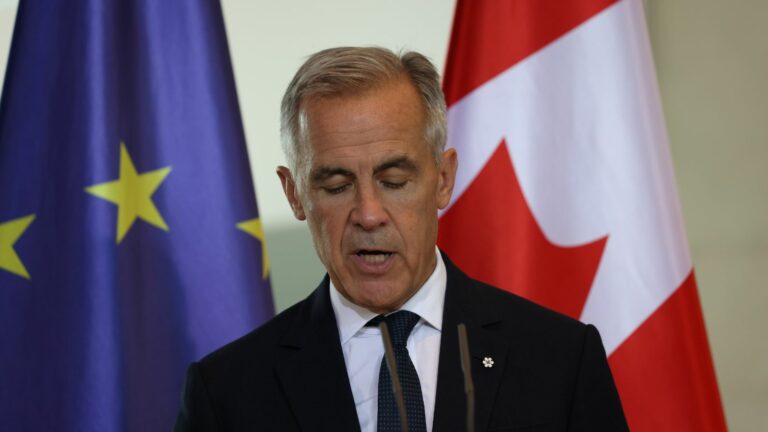
Canada’s attempt to build a much deeper relationship with Europe has opened an unexpected domestic political front. Prime Minister Mark Carney has confirmed that “enhanced labour mobility” could form part of a new Canada-European Union partnership, prompting Conservatives to warn that Ottawa must not recreate the immigration pressures Canadians have spent the past several years debating.
The dispute comes as Carney travels to Europe seeking alternatives to Canada’s long dependence on the United States, with the Trump administration’s tariff campaign accelerating Ottawa’s diversification strategy. What began as a discussion about trade, investment, defence and research is therefore becoming something larger: a debate over how far Canada should integrate with Europe, who might gain the right to work across the Atlantic, and whether economic diversification can be separated from immigration policy.
Conservatives Turn Labour Mobility Into an Immigration Fight
Conservatives Sound Immigration Alarm Over Carney’s EU Labour-Mobility Talks as Canada Pivots From U.S.
- Conservatives Turn Labour Mobility Into an Immigration Fight
- What Carney Has Actually Put on the Table
- “Associate Membership” Is Not an Existing EU Status
- Labour Mobility Does Not Automatically Mean Open Borders
- Canada and Europe Already Have Worker-Mobility Rules
- Immigration Pressures Make the Proposal Politically Explosive
- Canada’s Temporary Population Is Already Falling
- Trump’s Trade Fight Is Driving the European Pivot
- Europe Is Growing in Importance, but It Cannot Replace America
- Skilled Workers Could Be Part of Carney’s Economic Strategy
- The Real Fight Will Be Over the Safeguards
The Conservative response sharpened after Carney publicly acknowledged that a deeper EU arrangement could contain elements of enhanced labour mobility. Conservative immigration critic Michelle Rempel Garner warned that Canada should not “import” Europe’s migration problems as Ottawa explores a closer relationship with the 27-country bloc. Pierre Poilievre has also attacked the broader integration project, questioning what deeper European ties could eventually mean for Canadian immigration rules, sovereignty and regulation.
Those warnings give Conservatives a politically potent way to challenge Carney’s Europe strategy without arguing against trade diversification itself. Immigration remains closely connected in the public debate to housing availability, health-care capacity and employment prospects. The timing matters as well. Statistics Canada reported youth unemployment at 12.9% in August, above the 10.8% average recorded between 2017 and 2019. Against that backdrop, even a still-undefined proposal to make cross-border employment easier can quickly become a question about whether Canadian workers would face additional competition.
What Carney Has Actually Put on the Table
Carney has not announced European-style freedom of movement between Canada and the EU. In an interview published ahead of his European trip, he said a new partnership could include “elements of enhanced labour mobility,” while immediately acknowledging limits because Europe’s four single-market freedoms are interconnected. He also pointed to expanded educational opportunities and research cooperation as areas where Canada and Europe could go further.
That distinction is important because no detailed Canada-EU mobility treaty has yet been unveiled. There are no publicly announced Canadian quotas, eligibility categories, residency rules or provisions granting every EU resident an automatic right to work in Canada. Carney has described the coming negotiations as the beginning of a high-ambition process, rather than an agreement that will be completed during his September visit. Reports that Ottawa has explored visa-free live-and-work arrangements for Canadians in Europe therefore represent an indication of negotiating ambitions, not a finished immigration regime ready to take effect.
“Associate Membership” Is Not an Existing EU Status
Part of the political confusion stems from reports that Canada could someday obtain something resembling “associate membership” in the European Union. Carney has rejected the idea that Canada is pursuing EU membership, instead describing the goal as a “unique alliance” built around common strategic interests. Importantly, the EU currently has no formal category called associate membership that could simply be extended to Canada under existing rules.
That means any new arrangement would have to be negotiated largely from scratch or assembled from existing agreements in trade, security, mobility, research and investment. Ottawa and Brussels have discussed cooperation in areas including energy, critical minerals, artificial intelligence, defence and education. Carney’s government appears interested in making those relationships operate more like one integrated strategic partnership. For Conservatives, however, the ambiguity creates an opening: until Canadians know exactly which rights and obligations Ottawa is negotiating, opponents can reasonably press the government to explain where economic cooperation ends and deeper regulatory or migration integration begins.
Labour Mobility Does Not Automatically Mean Open Borders
One of the most important distinctions in the debate is between labour mobility and general immigration. Within the EU, citizens of member states enjoy extensive rights to live and work across participating countries without ordinary work permits. Those rights belong primarily to EU citizens. A non-EU migrant living legally in France, Germany or Italy does not automatically acquire the same unrestricted right to move to every other EU country simply because that person resides in Europe.
That matters when evaluating warnings that a Canada-EU agreement could automatically transfer Europe’s broader migration pressures to Canada. No evidence currently shows that Ottawa is proposing unrestricted Canadian entry for asylum seekers or all third-country nationals living in Europe. A future agreement could be narrow, covering students, researchers or designated professionals, or considerably broader. Until negotiating text is available, either outcome remains possible. The legitimate policy question is therefore not whether labour mobility equals uncontrolled migration—it does not—but precisely which European citizens or residents would qualify and under what Canadian conditions.
Canada and Europe Already Have Worker-Mobility Rules
Cross-border worker access between Canada and Europe is not new. The Canada-European Union Comprehensive Economic and Trade Agreement, or CETA, already contains temporary-entry provisions intended to make it easier for particular business people and skilled professionals to work across the Atlantic. Covered groups include intra-company transferees, investors, contractual service suppliers, independent professionals and certain short-term business visitors.
The existing rules are much narrower than EU freedom of movement. Canada’s own CETA implementation guidance explicitly states that the provisions do not cover general labour or low-skilled jobs and do not create rights to permanent employment, citizenship or residency. Some contractual service suppliers must have at least three years of relevant professional experience, while independent professionals can require at least six. That history provides a possible model for Carney: expand mobility in specific areas without creating an unrestricted labour market. It also demonstrates why the details matter more than the phrase “labour mobility” on its own.
Immigration Pressures Make the Proposal Politically Explosive
The Conservatives are raising the issue in a country that has already undergone a major immigration-policy reversal. Ottawa’s 2026–2028 Immigration Levels Plan aims to stabilize permanent resident admissions at 380,000 annually while sharply reducing new temporary-resident arrivals. The government set a 2026 target of 385,000 new temporary residents, including 230,000 workers and 155,000 international students, down substantially from the 673,650 temporary-arrival target established for 2025.
The reductions followed years in which population growth ran far ahead of housing construction and infrastructure expansion in many communities. The Carney government itself now says immigration must align more closely with housing, health care and labour-market capacity. That creates an obvious political vulnerability. Conservatives can argue that Ottawa should demonstrate that its existing reduction targets are working before establishing another route for foreign workers. Liberals, meanwhile, can counter that carefully targeted mobility for needed professionals is fundamentally different from the rapid expansion of temporary migration that produced the earlier backlash.
Canada’s Temporary Population Is Already Falling
Recent demographic data complicates the argument that Canada is still accelerating temporary migration. Statistics Canada estimated Canada’s population at about 41.42 million on April 1, 2026, down roughly 55,000 during the first quarter. The estimated number of non-permanent residents dropped 4.4% during the quarter to approximately 2.56 million, continuing the adjustment produced by tighter student and temporary-worker policies.
Ottawa’s stated goal is to reduce temporary residents to less than 5% of Canada’s population by the end of 2027. Immigration officials reported earlier this year that the non-permanent-resident share had already fallen from a peak of 7.6% to roughly 6.5%. That does not eliminate concerns about housing, employment or public services, but it changes the context surrounding the EU argument. Any new mobility framework would arrive while Canada is deliberately shrinking parts of its temporary migration system. The government would therefore face pressure to explain whether European entrants count inside existing targets or represent an additional stream.
Trump’s Trade Fight Is Driving the European Pivot
The European outreach is difficult to understand without the deterioration in Canada-U.S. trade relations. Canada has spent decades constructing an economy in which the United States is overwhelmingly its most important customer. Even after a significant diversification push, Global Affairs Canada calculated that the U.S. still received 67.2% of Canadian goods and services exports in 2025. That concentration gives Washington enormous leverage when tariffs or other trade restrictions are imposed.
The pattern began shifting last year. Canadian exports to the United States fell 3.7% in 2025, while exports to non-U.S. markets increased 11.1%. Exports to the European Union climbed 16.4%, with goods exports alone increasing 23.5%, helped by crude oil, aluminum and agricultural commodities. Carney’s calculation is straightforward: Canada cannot change its geography, but it can reduce the economic damage caused when one customer controls such a large share of demand. Europe’s roughly 450-million-person market makes it one of the few partners large enough to matter strategically.
Europe Is Growing in Importance, but It Cannot Replace America
CETA has already produced a substantial expansion in transatlantic commerce. European Commission data show EU-Canada goods trade reached €81.5 billion in 2025, roughly 76% above its 2016 level. Trade in services reached approximately €49 billion, about 91% higher than in 2016. Canada’s own trade figures show exports to Europe accelerating particularly quickly as businesses seek alternatives to the U.S. market.
Yet Europe remains nowhere close to replacing the United States. Canadian goods-and-services exports to the EU totalled about C$67.7 billion in 2025, compared with roughly C$683.3 billion exported to the U.S. Geography, integrated supply chains and decades of infrastructure make that gap impossible to close quickly. Even CETA itself is still only provisionally applied because 17 of the EU’s 27 member countries have completed national ratification. The realistic objective is therefore diversification rather than substitution—building enough additional markets that a future confrontation with Washington cannot disrupt Canada’s economy as severely.
Skilled Workers Could Be Part of Carney’s Economic Strategy
There is an economic argument for carefully designed mobility. Canada is simultaneously trying to accelerate infrastructure construction, increase defence production, develop mines and critical-mineral processing, expand electricity systems and strengthen advanced technology sectors. Ottawa has already announced plans to recruit and train up to 100,000 skilled trades workers by 2031, illustrating the size of the workforce challenge attached to its investment agenda.
A reciprocal European agreement could make it easier for engineers, researchers, technicians and specialized employees to move temporarily where projects require them. Canadians could receive similar opportunities in European laboratories, universities and companies. But professional mobility is rarely frictionless. Licensing requirements for nurses, engineers and other regulated occupations can remain provincial or national even when immigration barriers are removed. Europe itself is working on better recognition of professional qualifications because those barriers continue to restrict movement inside its own single market. A useful Canada-EU system would therefore need to address credentials and worker protections, not merely issue more work authorizations.
The Real Fight Will Be Over the Safeguards
The political battle is likely to intensify long before a final agreement exists. Conservatives will press Carney to disclose who could qualify, whether mobility would be reciprocal, whether European workers would count against immigration targets and whether access could eventually extend beyond citizens of EU member states. Those are substantive questions, particularly when Canada is simultaneously trying to reduce its temporary population and improve employment prospects for younger Canadians.
Carney’s answer will be that reducing dependence on the United States requires relationships deeper than conventional tariff agreements. Trade increasingly follows investment, research, talent and defence cooperation, and businesses operating across two continents often want employees to move with them. The government therefore faces a balancing act: make Canada easier to connect with Europe without recreating the migration-policy mistakes it has spent the past two years correcting. Until Ottawa publishes concrete negotiating objectives, both opportunity and risk will remain largely theoretical. Once those details emerge, Canadians will be able to judge whether “enhanced labour mobility” means a targeted economic tool—or something far more sweeping.
This Options Discord Chat is The Real Deal
While the internet is scoured with trading chat rooms, many of which even charge upwards of thousands of dollars to join, this smaller options trading discord chatroom is the real deal and actually providing valuable trade setups, education, and community without the noise and spam of the larger more expensive rooms. With a incredibly low-cost monthly fee, Options Trading Club (click here to see their reviews) requires an application to join ensuring that every member is dedicated and serious about taking their trading to the next level. If you are looking for a change in your trading strategies, then click here to apply for a membership.