35,000+ smart investors are already getting financial news, market signals, and macro shifts in the economy that could impact their money next with our FREE weekly newsletter. Get ahead of what the crowd finds out too late. Click Here to Subscribe for FREE.
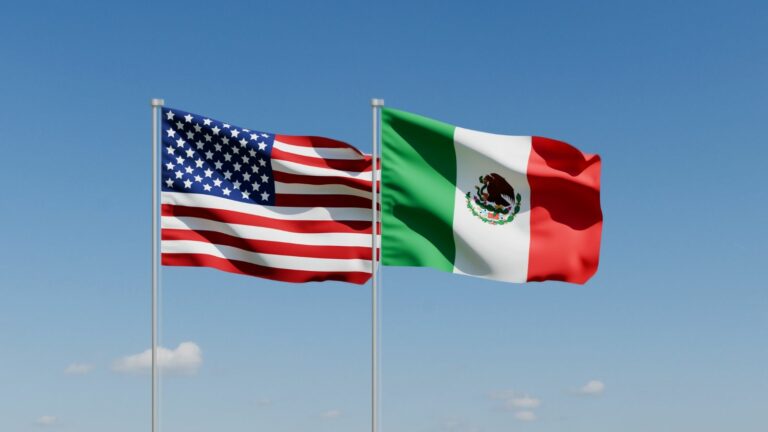
North America’s trade fight is suddenly moving on two very different tracks. Mexico and the United States are accelerating negotiations toward an interim bilateral agreement, while Canada remains outside active trade talks with Washington after negotiations broke down in August. The contrast is raising an uncomfortable question in Ottawa: could Mexico secure tariff relief first and leave Canadian exporters facing tougher terms in the same continental market?
That outcome is not inevitable, and Canada has not been pushed out of CUSMA. The three-country agreement remains in force. But the political balance is changing quickly. With U.S. midterm elections approaching, Mexico seeking certainty for investors, and Washington escalating measures against Canada, a bilateral U.S.-Mexico breakthrough could dramatically alter Canada’s bargaining position.
Washington and Mexico Are Suddenly Working Against the Clock
U.S. and Mexico Race Toward Trade Deal After Canada Talks Collapse, Raising Risk Ottawa Gets Isolated
- Washington and Mexico Are Suddenly Working Against the Clock
- Canada’s Failed Negotiations Became a Warning for Mexico
- CUSMA Has Not Collapsed, but Its Review Has Become a Pressure Point
- Autos Could Determine Who Gets the Better Deal
- Chinese Investment Has Become Part of the Bargaining Equation
- Mexico Has Powerful Economic Reasons to Secure Certainty First
- Canada Remains Deeply Exposed to the U.S. Market
- The Trade Fight Has Already Moved Beyond Ordinary Tariffs
- A U.S.-Mexico Agreement Could Leave Ottawa Negotiating Alone
- Ottawa Still Has Ways to Prevent Isolation
U.S. and Mexican negotiators are trying to make significant progress before the November 3 U.S. midterm elections. Reuters reported on September 11 that six people familiar with the negotiations said the two countries were racing toward an interim bilateral trade arrangement. There is no formal deadline, according to Mexico’s economy ministry, but political considerations are clearly compressing the calendar. A trade announcement before the election could allow both governments to argue that months of uncertainty had produced something concrete.
The immediate objective appears narrower than replacing CUSMA with an entirely new treaty. Mexico is seeking relief from some U.S. tariffs, while Washington wants concessions involving automobiles, manufacturing content and economic security. The pace has already picked up. U.S. Commerce Secretary Howard Lutnick spoke virtually with Mexican President Claudia Sheinbaum on September 10, adding another senior-level contact to negotiations that have been unfolding through several bilateral rounds. For factories and suppliers trying to plan production months in advance, even an interim agreement could materially change investment decisions.
Canada’s Failed Negotiations Became a Warning for Mexico
Canada entered August appearing relatively close to improving its tariff position with Washington. That changed on August 21, when Prime Minister Mark Carney suspended negotiations and ordered Canadian negotiators home. Carney said last-minute changes in the American terms were unfair, economically unacceptable and serious enough to raise doubts about the reliability of a deal. The breakdown was followed by additional tariffs and, eventually, U.S. import restrictions targeting selected Canadian products.
Mexico appears to have drawn a different lesson from the confrontation. Reuters described Canada’s experience as a cautionary tale influencing Mexico’s strategy, with Mexican officials emphasizing cooperation rather than direct retaliation. One source familiar with Mexico’s approach described it as continuing to cooperate and avoiding a public confrontation. The economic incentive is substantial: more than four-fifths of Mexican exports go to the United States, making prolonged uncertainty particularly uncomfortable for manufacturers, investors and policymakers. That does not mean Mexico will accept every American demand, but it helps explain why Mexico City sees keeping negotiations alive as strategically important.
CUSMA Has Not Collapsed, but Its Review Has Become a Pressure Point
The biggest misconception surrounding the current confrontation is that the North American trade agreement has already expired. It has not. CUSMA entered into force in July 2020, and the Canadian government says the agreement remains in effect until 2036. The 2026 review was designed as a scheduled examination of the pact rather than an automatic expiry date. If all three governments had agreed to extend it, another 16-year term could have been secured and the next joint review would have occurred six years later.
Instead, Washington declined in July to provide that long-term renewal. The result is greater uncertainty and the prospect of repeated reviews while disagreements continue. That distinction matters for Canada. Even if the United States strikes an interim arrangement with Mexico, Ottawa does not automatically lose its existing CUSMA rights. Yet commercial relationships depend on more than treaty language. If one partner obtains materially better tariff treatment, investment incentives can shift long before the underlying three-country agreement disappears. For Canadian manufacturers, that competitive difference may matter nearly as much as formal membership.
Autos Could Determine Who Gets the Better Deal
Few sectors demonstrate the stakes more clearly than automobiles. North American vehicle manufacturing was built around parts, engines, materials and finished vehicles moving repeatedly between Canada, the United States and Mexico. That model becomes far harder to operate when tariffs are applied at rates large enough to influence where companies assemble their next generation of vehicles. Current U.S. national-security tariffs have placed severe pressure on steel, aluminum, automobiles and auto parts from both neighbouring countries.
Reuters reports that automakers believe Mexico could ultimately receive a version of the tariff arrangement discussed with Canada before Ottawa’s negotiations failed. Industry sources have floated a possible 15% vehicle tariff, with reductions tied to U.S. content potentially lowering the effective rate further for qualifying vehicles. That is a negotiating scenario, not a confirmed agreement. Mexico may also be asked to increase the American content of vehicles, including engines, electronics and software. If such terms materialize while Canadian vehicles remain exposed to substantially higher barriers, future model allocation decisions could increasingly favour Mexican plants.
Chinese Investment Has Become Part of the Bargaining Equation
The negotiations increasingly extend beyond ordinary questions such as tariff rates. Washington has repeatedly raised concerns about Chinese companies using Mexico or other trading partners as pathways into North American supply chains. U.S. trade officials have framed parts of the CUSMA review around economic security, rules of origin and preventing what they describe as “free-riding” by countries outside the agreement. Those concerns are particularly sensitive in vehicles, batteries, electronics and other strategic manufacturing industries.
Mexico has already shown signs of responding. Sheinbaum recently proposed legislation that would expand the Mexican government’s authority to review and potentially block foreign acquisitions, creating an investment-screening mechanism closer to systems used by Canada and the United States. Reuters reported that the initiative is widely viewed as connected to American pressure over Chinese investment. That gives Mexico another negotiating lever: instead of answering U.S. demands only with tariff concessions, it can offer greater alignment on investment security. Canada also has foreign-investment screening, but without active negotiations it currently has less opportunity to turn regulatory alignment into immediate bargaining value.
Mexico Has Powerful Economic Reasons to Secure Certainty First
Mexico’s willingness to move quickly is not difficult to understand when viewed through the scale of its relationship with the American economy. U.S. Census Bureau data show that the United States imported roughly US$534 billion in goods from Mexico in 2025, compared with about US$382 billion from Canada. Through the first seven reported months of 2026, U.S. goods imports from Mexico had already reached roughly US$359 billion. Mexico has become indispensable to U.S. supply chains even as Washington complains about the size of the bilateral trade deficit.
Mexican policymakers are also thinking about investor confidence. Reuters reported that officials see a U.S. agreement as particularly important as the Sheinbaum government manages economic weakness and concerns surrounding sovereign credit ratings. Manufacturing companies make factory decisions years ahead, so uncertainty surrounding tariffs can become nearly as damaging as the tariffs themselves. A company deciding whether to expand in Monterrey, Ontario, Michigan or elsewhere does not need the entire trade system resolved immediately; it needs enough visibility to estimate costs. Mexico is trying to obtain that visibility before Canada does.
Canada Remains Deeply Exposed to the U.S. Market
Canada has made measurable progress in diversifying trade, but geography still gives the United States enormous influence. Statistics Canada reported that 71.7% of Canadian merchandise exports went to the United States in 2025. That was down from 75.9% in 2024, showing diversification is occurring, but more than seven out of every 10 export dollars still depended on the American market. The federal government estimates that Canada and the United States exchanged nearly $3.5 billion worth of goods and services every day in 2025.
That dependence cuts both ways. Canadian energy, minerals, fertilizer, metals and manufacturing inputs remain important to American industries. U.S. refineries consume millions of barrels of Canadian oil every day, while American agriculture relies heavily on Canadian potash. Integrated production also means tariffs can increase costs for businesses on both sides of the border. Canada therefore has leverage, but using it aggressively can hurt Canadian exporters at the same time. Ottawa’s challenge is finding pressure points strong enough to influence Washington without inflicting disproportionate damage on Canadian companies and workers.
The Trade Fight Has Already Moved Beyond Ordinary Tariffs
Canada’s August decision to suspend negotiations was quickly followed by another round of economic retaliation. Ottawa announced counter-tariffs of 15%, 25% and 50% on C$27.6 billion worth of American imports, with the measures taking effect September 8. The targeted categories include steel, dairy, appliances, agricultural equipment, pulp and paper, electronics and other products affected by U.S. actions. Canada also announced billions of dollars in additional assistance intended to help workers and companies absorb the disruption.
Washington subsequently escalated in a different direction. The Trump administration announced import bans affecting selected Canadian dairy products, alcoholic beverages and motorcycles beginning September 29 and moved to restrict Canadian products from certain large federal procurement contracts. Carney has nevertheless signalled restraint rather than automatically announcing another retaliation package, describing Washington’s newest measures as relatively modest compared with earlier actions. The distinction matters: Ottawa is leaving room for talks to restart even while maintaining existing countermeasures. Canada has not abandoned negotiations permanently; the question is whether Washington sees enough reason to return.
A U.S.-Mexico Agreement Could Leave Ottawa Negotiating Alone
The most politically sensitive part of the current U.S.-Mexico push is what it could mean for Canada. Canadian and Mexican officials continue publicly supporting a trilateral North American arrangement. Privately, however, Reuters reports that some Mexican officials believe their government should not sacrifice Mexican interests simply to secure better treatment for Canada. An automotive industry source also told Reuters that the Trump administration sees an agreement with Mexico as a way to increase pressure on Ottawa before another round of Canadian measures expected later in the trade dispute.
That does not establish an official American policy of expelling Canada from continental trade. It does demonstrate how bilateral negotiations can reshape a trilateral relationship. If Washington and Mexico announce tariff reductions while Canada remains locked in retaliation, the United States could present Mexico as evidence that cooperation produces concessions and portray Canada as responsible for its own impasse. Ottawa would then face both economic and political pressure to return to negotiations. The danger is therefore less immediate exclusion from CUSMA than being temporarily isolated at the bargaining table.
Ottawa Still Has Ways to Prevent Isolation
Canada’s position is difficult, but it is far from hopeless. Carney said on September 10 that Canada remains willing to negotiate if discussions are professional and respect Canadian sovereignty. Ontario Premier Doug Ford, despite taking a much more confrontational public tone toward Trump, has also argued that an agreement before the U.S. midterms may still be possible. Those comments suggest the door is not closed; Ottawa is trying to avoid appearing desperate to walk through it.
The next development will be crucial. If Mexico obtains significant relief on automobiles, steel or aluminum, Canada will have to assess whether remaining outside negotiations risks widening the competitiveness gap for Canadian producers. At the same time, accepting terms that Ottawa believes would undermine strategic industries could create longer-lasting costs. Canada is therefore pursuing two strategies at once: keeping open the possibility of renewed talks while investing in domestic capacity and trade diversification. A U.S.-Mexico agreement would not automatically isolate Canada, but it could turn an uncomfortable negotiating position into a far more urgent one.
This Options Discord Chat is The Real Deal
While the internet is scoured with trading chat rooms, many of which even charge upwards of thousands of dollars to join, this smaller options trading discord chatroom is the real deal and actually providing valuable trade setups, education, and community without the noise and spam of the larger more expensive rooms. With a incredibly low-cost monthly fee, Options Trading Club (click here to see their reviews) requires an application to join ensuring that every member is dedicated and serious about taking their trading to the next level. If you are looking for a change in your trading strategies, then click here to apply for a membership.