35,000+ smart investors are already getting financial news, market signals, and macro shifts in the economy that could impact their money next with our FREE weekly newsletter. Get ahead of what the crowd finds out too late. Click Here to Subscribe for FREE.
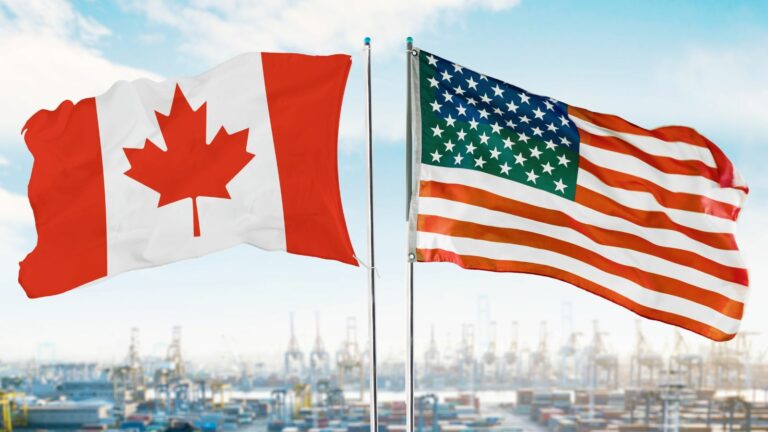
Quebec’s election campaign has collided with a responsibility no governing premier can simply leave on the campaign bus. Christine Fréchette is stepping away from regular campaign activity to convene her ministers as Canada prepares to impose a new round of retaliatory tariffs on American goods. The virtual cabinet meeting, scheduled for Monday evening, comes only hours before Ottawa’s measures take effect on September 8.
For Fréchette, the moment carries two sets of consequences. Quebec businesses are deeply exposed to the U.S. market, making the trade conflict an immediate economic problem. At the same time, every decision made from the premier’s chair is unfolding in the middle of a competitive October 5 election, giving opposition parties an opening to question where governing ends and campaigning begins.
A campaign pause with real governing stakes
Quebec’s Election Gets Pulled Into Canada-U.S. Trade War as Fréchette Puts Governing Duties Ahead of Campaign Trail
- A campaign pause with real governing stakes
- Ottawa’s counter-tariffs arrive at midnight
- Quebec’s dependence on the U.S. raises the stakes
- Aluminum puts industrial Quebec near the front line
- Quebec already has programs designed for tariff-hit firms
- Fréchette and Ottawa do not see retaliation exactly the same way
- Opposition leaders are challenging the politics of the pause
- The trade war is becoming part of Quebec’s ballot question
- Carney already showed how campaigning and governing can collide
- The real test begins after the cabinet meeting
Fréchette’s office confirmed that the special cabinet meeting will be held virtually at 6 p.m. Monday. The timing is unusual: Quebec is already in an official provincial election period, meaning Fréchette is simultaneously premier and leader of the Coalition Avenir Québec. Special cabinet meetings during campaigns are comparatively rare, but governments do not stop operating when the legislature is dissolved. An international trade shock capable of affecting employment, investment and business costs gives the premier a substantial reason to return temporarily to governing mode.
The timing also makes the meeting difficult to dismiss as routine. Canada’s new tariffs begin at 12:01 a.m. Tuesday, leaving Quebec companies only hours between the cabinet discussion and the new import regime. The government has not publicly released the cabinet agenda, so it would be premature to claim that new provincial measures will emerge. What is confirmed is that Fréchette has chosen government duties over a normal day of campaigning precisely as the next stage of the Canada-U.S. confrontation begins.
Ottawa’s counter-tariffs arrive at midnight
The federal measures are broad enough to touch supply chains far beyond companies that directly export to the United States. Ottawa says it will impose tariffs of 15, 25 and 50 per cent on U.S.-origin goods covering approximately $27.6 billion in imports. The targeted categories include steel and aluminum products, dairy, appliances, agricultural equipment, pulp and paper, plastics and electronics. Canada says the rates are designed to match the corresponding American measures on a dollar-for-dollar, rate-for-rate basis.
For individual Quebec firms, however, retaliation can create a second problem alongside the original U.S. tariffs. A manufacturer that sells into the American market may be paying more to stay competitive there while simultaneously facing higher costs for an American machine, component or material imported into Canada. Ottawa has retained a tariff-remission process for exceptional cases, including situations where necessary inputs cannot reasonably be sourced domestically or from another country. That detail could become particularly important for specialized Quebec manufacturers with tightly integrated continental supply chains.
Quebec’s dependence on the U.S. raises the stakes
Quebec has diversified its international commerce, but the American market remains extraordinarily important. The Institut de la statistique du Québec reported that the province exported about $121.6 billion in merchandise internationally in 2025. Roughly $84.8 billion went to the United States, equivalent to 69.8 per cent of Quebec’s international merchandise exports. That share had fallen from 73.3 per cent in 2024, yet it still means an economic disruption south of the border can quickly be felt in factories and regional communities across the province.
The trend was already weakening before the latest tariff escalation. Quebec exports to the United States declined 6.9 per cent in 2025. During the first five months of 2026, they were another 11.2 per cent below the comparable 2025 period, while exports to non-U.S. destinations increased 12.4 per cent. Those numbers help explain why market diversification has moved from a long-term economic ambition to an urgent political theme. Replacing decades of deeply integrated U.S. commerce, however, cannot happen in a single election cycle.
Aluminum puts industrial Quebec near the front line
Few statistics illustrate Quebec’s exposure better than aluminum. Unwrought aluminum and aluminum alloys were worth approximately $9.1 billion among Quebec’s exports in 2025, making the category one of the province’s largest internationally traded products. About 81.5 per cent went to the United States. Quebec also shipped $7.38 billion worth of unwrought aluminum specifically to American customers, putting communities connected to smelting and processing particularly close to the centre of the dispute.
The Bank of Canada has documented how earlier U.S. aluminum duties caused Canadian shipments to fall sharply before producers redirected some metal toward Europe and U.S. demand later recovered part of the decline. The adjustment has not been painless downstream. Ottawa announced nearly $6.8 million in May for seven tariff-affected aluminum businesses and organizations in Saguenay–Lac-Saint-Jean alone. For workers in such communities, tariff policy is less an abstract argument over negotiating tactics than a question of orders arriving, production lines running and employers having enough breathing room to retain staff.
Quebec already has programs designed for tariff-hit firms
Fréchette’s government is not entering Monday’s meeting without existing tools. After the collapse of the latest Canada-U.S. negotiations in August, Quebec announced two programs aimed at companies experiencing direct damage from American tariffs. The FORCE program, administered by Investissement Québec, targets manufacturing and primary-sector businesses with annual revenue of at least $2 million whose sales are significantly reduced by U.S. duties of 25 per cent or more. Assistance comes through loans designed to provide liquidity while companies change suppliers, diversify markets or adapt their business models.
Smaller firms have a separate channel. Quebec’s tariff-specific PAUPME program, administered through regional county municipalities, can assist eligible companies with annual sales between $1 million and $2 million. Loans can reach $150,000, carry a zero-per-cent interest rate and include a 12-month principal-payment moratorium. FORCE financing can include a principal moratorium of up to 24 months and an interest holiday during the first year. Those details give cabinet a concrete framework to expand, modify or coordinate if the new federal counter-tariffs create additional pressure.
Fréchette and Ottawa do not see retaliation exactly the same way
One of the more politically complicated elements of the dispute is that Quebec and Ottawa broadly agree that American tariffs require a strong response while differing over how retaliation should be designed. Fréchette previously argued for a more strategic federal response rather than simply mirroring American duties. The concern is straightforward: counter-tariffs can punish U.S. exporters, but they can also increase the price Quebec companies pay for American inputs that cannot quickly be replaced.
Ottawa, meanwhile, has paired its retaliation with a new $7.5-billion package for Canadian workers and businesses. The measures include another $1.5 billion for the Regional Tariff Response Initiative, a $2-billion Canada Strong Diversification Fund, $500 million in additional Business Development Bank of Canada liquidity support and $3.5 billion in rapid-response assistance for workers and employers. Monday’s cabinet discussion therefore takes place inside a larger federal-provincial puzzle: how aggressively to retaliate while ensuring the cost of that retaliation does not undermine the same Canadian businesses governments are trying to defend.
Opposition leaders are challenging the politics of the pause
Fréchette’s opponents have not objected equally to the principle of a premier performing government duties during an election, but several have sharply questioned the political presentation. Liberal Leader Charles Milliard accused the government of improvising and predicted a carefully staged display around the cabinet response. Conservative Leader Éric Duhaime characterized the move as political marketing designed to shift attention away from the CAQ’s record. Parti Québécois Leader Paul St-Pierre Plamondon argued that economic policy should not be built around fear of Donald Trump.
St-Pierre Plamondon nevertheless acknowledged the importance of continuity in government and called for Quebec’s party leaders to be directly briefed by Prime Minister Mark Carney if further American retaliation occurs. Québec solidaire spokesperson Ruba Ghazal offered a less confrontational response, recognizing that Fréchette remains premier during the campaign while demanding clearer measures for affected workers. The disagreement therefore is not simply over whether cabinet should meet. It is over whether the CAQ can legitimately turn crisis management into part of its case for re-election.
The trade war is becoming part of Quebec’s ballot question
The election itself is already a tightly structured contest. Quebec’s 39-day campaign began August 27, with approximately 6.4 million registered electors preparing to vote October 5 across 127 electoral divisions. Fréchette opened the campaign by framing the choice partly around which party could best protect Quebec’s interests during the trade confrontation. That framing gives her an incentive to emphasize experience and stability, while rival parties want the campaign centred on affordability, health care, housing and the CAQ’s record after eight years in power.
Polling helps explain why the trade issue is tempting but cannot carry the campaign by itself. A Léger poll conducted from August 28 to 31 put the PQ at 29 per cent, the CAQ at 24, the Liberals at 22, the Conservatives at 15 and Québec solidaire at 10. Separately, 78 per cent supported new Canadian tariffs on some American products, and 66 per cent still supported them when respondents were reminded they could increase prices. Fréchette also led the party leaders, though with only 21 per cent, when respondents were asked whom they trusted most to defend Quebec against Trump’s tariffs.
Carney already showed how campaigning and governing can collide
Fréchette is not the first Canadian leader to confront this dilemma. During the 2025 federal election, Mark Carney interrupted his Liberal campaign three times as prime minister to handle developments in Trump’s trade offensive. One pause followed American auto tariffs; another came as wider global tariff announcements demanded meetings with cabinet and national-security officials. Carney retained the powers needed to carry out urgent government business even while campaigning to remain in office.
The precedent does not erase questions about political advantage, and Quebec’s provincial institutions are not identical to the federal system. It does demonstrate that modern campaigns can be interrupted by events whose economic consequences do not respect election calendars. A premier cannot credibly argue that a tariff threat is serious and then decline to exercise the powers of government because campaign events were scheduled. The harder test comes afterward: separating decisions genuinely required in the public interest from announcements or imagery designed primarily to strengthen the governing party’s electoral message.
The real test begins after the cabinet meeting
The scale of the economic risk makes outcomes more important than Monday’s political optics. Quebec’s 2025-26 budget included a stress scenario examining what could happen under permanent 25 per cent U.S. tariffs on Canadian goods accompanied by Canadian retaliation. Under those assumptions, the Finance Department estimated Quebec real GDP could be 2.7 per cent lower after one year and roughly 160,000 jobs could be lost. Those figures were a hypothetical economic scenario, not a forecast of what the current mix of tariffs will produce, but they demonstrate why governments treat prolonged trade disruption seriously.
That leaves Fréchette with a demanding political standard. Voters can judge whether the cabinet pause results in faster assistance, effective coordination with Ottawa, protection for vulnerable employers and a credible diversification strategy. They can also judge whether the trade conflict is receiving disproportionate campaign attention. When the counter-tariffs begin Tuesday, the argument moves gradually from warnings to evidence: import costs, contracts, investment decisions, employment and applications for government assistance. For Quebec’s premier, governing through those consequences may become as important to the election as campaigning about them.
This Options Discord Chat is The Real Deal
While the internet is scoured with trading chat rooms, many of which even charge upwards of thousands of dollars to join, this smaller options trading discord chatroom is the real deal and actually providing valuable trade setups, education, and community without the noise and spam of the larger more expensive rooms. With a incredibly low-cost monthly fee, Options Trading Club (click here to see their reviews) requires an application to join ensuring that every member is dedicated and serious about taking their trading to the next level. If you are looking for a change in your trading strategies, then click here to apply for a membership.