35,000+ smart investors are already getting financial news, market signals, and macro shifts in the economy that could impact their money next with our FREE weekly newsletter. Get ahead of what the crowd finds out too late. Click Here to Subscribe for FREE.
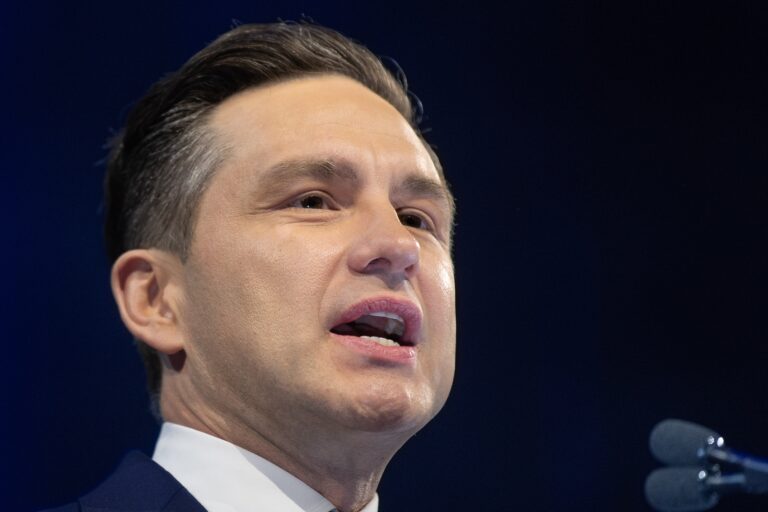
Political parties can weather bad headlines. The more serious danger begins when their own elected members start wondering whether the leader could cost them their jobs. That pressure is now surrounding Conservative Leader Pierre Poilievre.
On August 14, CTV News reported that it had spoken with 17 Conservative caucus members from across Canada, with several voicing deep concerns about Poilievre’s leadership and some questioning whether he will still be leader when the next federal election arrives. The timing is striking. Only months earlier, Poilievre won overwhelming support in a mandatory leadership review. Yet Mark Carney’s Liberals have since opened sizable polling leads, while defections and shifting battlegrounds have made the electoral stakes increasingly personal for Conservative MPs.
Private Doubts Have Become an Electability Problem
Conservative MPs Privately Question Poilievre as Fears Grow Over Losing Seats
- Private Doubts Have Become an Electability Problem
- Poilievre’s 87.4% Leadership Vote Did Not End the Debate
- The 2025 Election Still Hangs Over Every Leadership Conversation
- Floor Crossings Turned Political Unease Into Something More Concrete
- Carney’s Advantage Is Increasingly About the Leader, Not Just the Liberal Brand
- The Conservatives Have the Support — but Not Yet the Geography
- Poilievre’s Political Style Is Both His Strength and His Risk
- A Strong Conservative Vote Could Still Produce Another Liberal Government
- Conservatives Have a Mechanism to Remove a Leader — but No Formal Revolt Has Been Established
The significance of the latest reporting is not simply that Conservatives are debating strategy behind closed doors. Leadership parties routinely contain disagreements. What makes this episode different is the number and geographic range of MPs consulted. CTV News reported speaking with 17 Conservative caucus members from different regions, with several expressing serious concern and some doubting Poilievre will remain leader by the next election. Those comments do not establish an organized revolt, but they suggest the conversation has moved beyond the usual complaints of strategists and former politicians.
The anxiety is easier to understand against the current polling backdrop. Nanos Research’s tracking ending August 7 put the Liberals at 45.6 per cent nationally and the Conservatives at 29.1 per cent among decided voters. Individual polls can move quickly, and an election remains a different test entirely. Still, MPs in marginal ridings rarely experience those numbers as an abstract national debate. A swing of only a few points can determine whether an incumbent returns to Ottawa or begins looking for another job. When a gap reaches double digits, questions about message, strategy and leadership inevitably become harder to dismiss.
Poilievre’s 87.4% Leadership Vote Did Not End the Debate
There is an important contradiction at the centre of the Conservative dilemma: Poilievre remains capable of commanding extraordinary support inside his own party. At the Conservative convention in Calgary in January, 87.4 per cent of delegates voting in the mandatory leadership review backed him. It was far above the level many Conservative insiders had previously described as necessary for a convincing mandate and appeared, at least temporarily, to settle questions about whether he could survive the party’s 2025 election defeat.
But winning the confidence of party delegates and winning a national election are two different political tests. An Angus Reid Institute study released in April found 58 per cent of people who had voted Conservative in 2025 still wanted Poilievre to lead the party over the longer term. That remains substantial support, but it was a more complicated picture than the convention result suggested. MPs facing close races must weigh both constituencies at once: the members who choose leaders, volunteer and donate, and the broader electorate that decides who governs. Replacing a leader popular with the base can fracture a party. Keeping one whom vulnerable MPs increasingly view as an electoral liability can be just as dangerous.
The 2025 Election Still Hangs Over Every Leadership Conversation
The Conservatives’ 2025 result was unusual because it contained evidence for both sides of the Poilievre argument. The party captured 144 seats and 41.3 per cent of the national vote, while the Liberals finished with 169 seats and 43.8 per cent. That was hardly an electoral collapse. Conservatives dramatically increased their representation and came within a relatively narrow popular-vote margin of the Liberals. Supporters can therefore argue that Poilievre built a large national coalition that only requires refinement rather than replacement.
Yet the election also delivered one of the most damaging symbolic defeats possible for a party leader. Poilievre lost his own Ottawa-area seat of Carleton to Liberal Bruce Fanjoy after representing the area in Parliament for more than two decades. He returned to the House through an August 2025 by-election in Alberta’s overwhelmingly Conservative Battle River—Crowfoot riding, winning roughly 80 per cent of the vote. That restored his parliamentary platform but did not answer the question haunting MPs in competitive suburbs and small cities. Dominating one of Canada’s safest Conservative constituencies is very different from persuading swing voters in the ridings that actually determine which party forms government.
Floor Crossings Turned Political Unease Into Something More Concrete
The Conservative caucus has also watched several colleagues make a decision far more dramatic than privately criticizing the leader. Between late 2025 and April 2026, Conservative MPs Chris d’Entremont, Michael Ma, Matt Jeneroux and Marilyn Gladu crossed the floor to join the Liberals. NDP MP Lori Idlout also moved to the Liberal benches during that period. Each politician had individual reasons and circumstances, so the defections cannot fairly be reduced to one explanation or presented as proof of a coordinated rejection of Poilievre.
Their political impact was nevertheless substantial. After the Liberals subsequently won all three federal by-elections held on April 13, Carney’s caucus reached 174 seats, enough at the time for a House of Commons majority. Public perceptions surrounding the defections were also revealing. Angus Reid found 45 per cent of respondents viewed Poilievre himself as a major factor behind Conservative MPs crossing the floor, while 42 per cent identified the appeal of Carney’s Liberals as a major factor. Sixty-one per cent believed concern about personal job security played at least some role. Those figures describe Canadians’ perceptions rather than the actual motivations of individual MPs, but they illustrate why electoral survival has become inseparable from the leadership debate.
Carney’s Advantage Is Increasingly About the Leader, Not Just the Liberal Brand
For Conservatives assessing their prospects, perhaps the most uncomfortable numbers involve the comparison between the two leaders themselves. In Nanos tracking released in August, 53.6 per cent of respondents preferred Carney as prime minister, compared with 18 per cent for Poilievre. That gap was even wider than the difference between their parties, suggesting Conservatives face more than a conventional mid-cycle polling slump.
Léger found a similar pattern from another angle. Its August research put the Liberals at 46 per cent and Conservatives at 34 per cent among decided voters and gave Carney an advantage over Poilievre across every policy comparison tested. Even when respondents were presented with leaders advocating broadly similar objectives, Carney often retained the edge. On reducing immigration pressure on housing and health care, 69 per cent trusted Carney compared with 56 per cent for Poilievre. On increasing Canadian energy production and pipeline capacity, the comparison was 62 per cent to 51 per cent. Such results do not predict a future election, but they challenge a central Conservative assumption: that dissatisfaction with Liberal policies will automatically translate into greater confidence in the Conservative leader.
The Conservatives Have the Support — but Not Yet the Geography
One of the lessons of the 2025 election was that winning a very large share of votes is not enough if those votes are distributed inefficiently. Conservatives received more than 41 per cent nationally and still finished 25 seats behind the Liberals. Canada’s first-past-the-post system rewards parties for winning individual ridings, not for accumulating the largest possible margins in regions they already dominate. Winning an Alberta constituency by tens of thousands of votes does nothing to compensate for losing a suburban Ontario seat by a few hundred.
That is why riding-level projections can generate more anxiety inside caucus than a single national number. As of early August, 338Canada’s model classified Conservative-held seats such as Kenora—Kiiwetinoong and Kapuskasing—Timmins—Mushkegowuk as Liberal-Conservative toss-ups, while other Conservative constituencies remained much safer. Projections are not results and can change substantially before voters cast ballots. But an MP looking at a competitive riding sees the leadership question differently from someone sitting in a fortress seat. For the former, a five-point deterioration in the party’s appeal is not theoretical. It can mean fewer volunteers, tougher conversations at community events and the difference between another term in Parliament and defeat.
Poilievre’s Political Style Is Both His Strength and His Risk
Poilievre’s appeal has long rested on clarity. His political language tends to be direct, adversarial and designed around easily understood economic themes. That approach helped Conservatives consolidate voters angry about housing costs, inflation, taxes and the Trudeau government, and it contributed to the party’s strong 2025 popular-vote showing. It also created a recognizable political brand in an era when many leaders struggle to define themselves.
The challenge is that an opposition style designed to mobilize frustrated voters may not automatically translate into the temperament undecided voters want from a prospective prime minister. Carney’s arrival changed the comparison. Instead of running against Justin Trudeau again, Conservatives now face a former central banker whose public image has been built around economic management, international negotiations and institutional competence. Recent polling suggests that distinction currently benefits Carney. For Conservative MPs, the strategic question is therefore broader than whether Poilievre should become more moderate. They must decide whether his existing political persona can expand beyond an intensely loyal base without losing the qualities that made the base loyal in the first place.
A Strong Conservative Vote Could Still Produce Another Liberal Government
The danger facing Conservatives is not necessarily a collapse in support. It is the possibility of another election in which millions of Canadians vote Conservative but the party fails to convert enough of those votes into seats. The 2025 result demonstrated exactly how that can happen. A 41.3 per cent national vote share would normally look formidable, yet the Liberals still emerged with more seats because their coalition was better positioned across enough individual constituencies.
That distinction helps explain why caucus nerves can rise even when Poilievre continues drawing large crowds or maintaining enthusiastic grassroots support. An incumbent MP does not need to believe the Conservative movement is failing to fear losing personally. The member only needs to believe the party is becoming slightly less competitive in their particular riding. Carney’s current advantage among preferred-prime-minister voters makes that calculation more urgent. Conservatives do not need to win over every Liberal voter, but they do need enough suburban Ontario, British Columbia and urban-adjacent voters to move seats rather than merely increase margins in Conservative strongholds. That is ultimately the metric MPs facing re-election are likely to care about most.
Conservatives Have a Mechanism to Remove a Leader — but No Formal Revolt Has Been Established
There is also a procedural reason private caucus dissatisfaction matters. After the 2025 election, Conservative MPs voted to give their caucus the leadership-review powers contained in Canada’s Reform Act. Under that process, signatures from at least 20 per cent of caucus members can trigger a secret-ballot vote on the leader. If a majority votes to remove the leader, caucus can then select an interim replacement. The threshold means dissatisfaction does not need to encompass most MPs before a formal challenge can begin.
Nothing in the public reporting cited here establishes that Conservatives have reached that threshold or that a formal attempt to remove Poilievre is underway. Private concern should therefore not be mistaken for an imminent coup. The more immediate problem is strategic. Conservatives must decide whether the polling reflects a temporary Carney honeymoon that will fade, weaknesses in the party’s message that can be corrected, or a deeper problem with Poilievre’s ability to broaden his coalition. His 87.4 per cent leadership-review mandate makes a premature challenge risky. But for MPs watching their own constituencies become less secure, waiting carries risks as well. That tension — not an established leadership rebellion — is what makes the current Conservative debate consequential.
This Options Discord Chat is The Real Deal
While the internet is scoured with trading chat rooms, many of which even charge upwards of thousands of dollars to join, this smaller options trading discord chatroom is the real deal and actually providing valuable trade setups, education, and community without the noise and spam of the larger more expensive rooms. With a incredibly low-cost monthly fee, Options Trading Club (click here to see their reviews) requires an application to join ensuring that every member is dedicated and serious about taking their trading to the next level. If you are looking for a change in your trading strategies, then click here to apply for a membership.