35,000+ smart investors are already getting financial news, market signals, and macro shifts in the economy that could impact their money next with our FREE weekly newsletter. Get ahead of what the crowd finds out too late. Click Here to Subscribe for FREE.
A bridge built to move goods faster has become a symbol of how quickly Canada-U.S. politics can jam even the most practical projects. The Gordie Howe International Bridge was supposed to add capacity, redundancy, and modern border processing to one of North America’s most important trade corridors. Instead, its opening has been pulled into a fight involving President Donald Trump, U.S. Ambassador Pete Hoekstra, a billionaire bridge-owning family, and allegations of political influence.
Hoekstra has now denied that donor pressure from the family behind the competing Ambassador Bridge played any role in delaying the new crossing. But the denial has not ended the controversy. It has only sharpened the question hanging over Windsor and Detroit: why is a finished trade bridge still waiting?
Hoekstra Draws a Hard Line Against the Donor Allegation
Trump’s Bridge Fight Gets Messier as U.S. Ambassador Denies Donor Pressure Delayed Gordie Howe Opening
- Hoekstra Draws a Hard Line Against the Donor Allegation
- A Ribbon-Cutting That Suddenly Came Apart
- The Bridge Is Bigger Than a Border Project
- Canada Paid, Michigan Shares, and Trump Wants More
- The Moroun Factor Keeps the Pressure On
- The Ambassador Bridge’s Economic Weight Explains the Stakes
- Border Delays Hit Factories Before They Hit Headlines
- The “Technical Issues” Explanation Faces a Trust Problem
- A Trade Symbol Caught in a Political Season
- The Next Move Will Matter More Than the Denial
U.S. Ambassador to Canada Pete Hoekstra has tried to shut down the most politically explosive claim surrounding the Gordie Howe delay: that the Moroun family’s political donations helped stall a rival bridge. Asked whether the postponement was tied to a US$1-million donation from Matthew Moroun to a Trump-aligned super PAC, Hoekstra rejected the idea directly. He said the bridge’s delayed opening came through mutual agreement between the Canadian and American governments and had nothing to do with the family that owns the Ambassador Bridge.
That denial matters because the timing has become the story. The Gordie Howe crossing competes with the privately owned Ambassador Bridge, long a dominant link between Windsor and Detroit. For years, supporters framed the new public bridge as a way to add resilience to a corridor where a single disruption can ripple through factories, trucking schedules, and local communities. Hoekstra’s statement may reassure some officials, but it also places the administration’s explanation under a brighter spotlight.
A Ribbon-Cutting That Suddenly Came Apart
The messy part is not only that the opening was delayed, but how close the project appeared to be to launching. Invitations had reportedly gone out for a ribbon-cutting event, and local officials were preparing for a milestone moment after years of construction. Then the plan changed. Prime Minister Mark Carney said the delay came at the request of the United States, while Canadian officials described the remaining issues as technical matters that still needed to be worked through.
That language has not satisfied everyone. Windsor has waited years for the bridge to move truck traffic away from local streets and create a direct freeway-to-freeway link between Highway 401 and Interstate 75. For people living near Huron Church Road, the difference is not abstract. It is the sound of transport trucks, the daily presence of border traffic, and the hope that a new crossing could finally shift heavy commercial movement onto infrastructure built for it. The sudden delay turned a civic celebration into a diplomatic guessing game.
The Bridge Is Bigger Than a Border Project
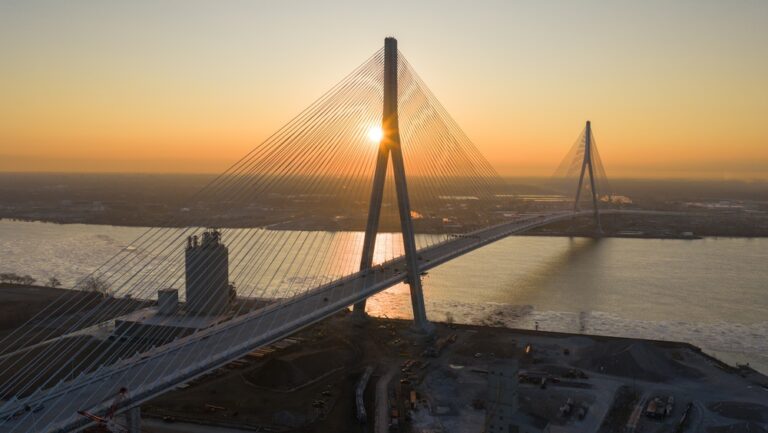
The Gordie Howe International Bridge is not a small piece of infrastructure. It is a six-lane cable-stayed crossing with three Canada-bound lanes and three U.S.-bound lanes. Its total length is about 2.5 kilometres, with an 853-metre clear span that makes it the longest main span of any cable-stayed bridge in North America. It also includes new ports of entry on both sides, a Michigan interchange, and a multi-use path for pedestrians and cyclists.
Those design details help explain why the project has drawn so much attention. It is meant to do more than add another bridge over the Detroit River. The goal is to create a modern border system with more capacity, better inspection facilities, and direct highway connections. For manufacturers, farmers, retailers, and truckers, even small improvements in border flow can matter. A delayed shipment of auto parts can disrupt production. A delayed load of food can affect pricing and freshness. In that sense, the bridge is economic plumbing for two countries.
The financing structure sits at the heart of Trump’s complaint. Under the Canada-Michigan Crossing Agreement, Canada agreed to pay key project costs, including land acquisition and the I-75 interchange connection, while tolls collected on the Canadian side would be used to reimburse the Canadian government. The crossing itself is publicly owned jointly by Canada and Michigan. That arrangement was designed to get the project built after Michigan’s political debate over funding created years of uncertainty.
Trump has argued that the United States deserves more from the deal before the bridge opens. Critics in Canada and Michigan counter that the U.S. is already receiving a major asset without fronting the construction cost. Michigan officials have also emphasized the economic upside: better border capacity, improved supply-chain reliability, and future benefits once Canada recovers its investment. This is why the fight has become so politically sensitive. It is not simply about toll math. It is about whether a signed cross-border agreement can be reopened when the project is essentially ready.
The Moroun Factor Keeps the Pressure On
The Moroun family’s role makes the dispute harder to contain. The family owns the Ambassador Bridge, the long-standing private crossing between Windsor and Detroit. Because the Gordie Howe Bridge is a direct competitor, any delay naturally raises questions about who benefits. Congressional Democrats have launched inquiries into whether Matthew Moroun’s access to Trump administration officials influenced the administration’s posture toward the new bridge.
The strongest available reporting does not prove that donations caused the delay. It does, however, show why the optics are difficult. Matthew Moroun reportedly met with Commerce Secretary Howard Lutnick shortly before Trump publicly attacked the project in February. Campaign finance reporting also showed a US$1-million donation to MAGA Inc. weeks before Trump’s remarks. Hoekstra has said this did not affect the bridge discussions, and the White House has framed Trump’s position as a matter of U.S. interest. Still, in politics, timing often creates its own momentum.
The Ambassador Bridge’s Economic Weight Explains the Stakes
The Ambassador Bridge is not just another toll bridge. It has been one of the most important commercial crossings on the Canada-U.S. border, handling huge volumes of merchandise trade, especially in auto-related sectors. Transport Canada has previously described it as the busiest Canada-U.S. crossing by trade value and number of commercial vehicle crossings. During the 2022 blockade, officials estimated it handled roughly $390 million in trade per day, representing a large share of Canadian road exports and imports.
That scale explains why both bridges have become political flashpoints. The Ambassador Bridge’s private ownership has long made it unusual in a world where major border infrastructure is usually tied closely to public planning. The Gordie Howe Bridge was designed partly to add redundancy, so one crossing would not carry so much strategic weight alone. For businesses, redundancy is not a luxury. It is protection against blockades, accidents, maintenance shutdowns, security incidents, and political turbulence. That is why the delayed opening feels larger than a scheduling problem.
Border Delays Hit Factories Before They Hit Headlines
For ordinary consumers, a bridge delay can sound remote. For manufacturers, it can be immediate. The Detroit-Windsor corridor is deeply tied to the auto industry, where parts often cross the border during production rather than after a product is finished. A component may be stamped in one country, assembled in another, and returned again before becoming part of a vehicle. In that environment, border reliability is part of the production line.
Government freight data shows how much North American trade still depends on surface transportation. In 2025, U.S.-Canada freight was valued at more than US$700 billion, and trucking carried more than half of that trade by value. When trucks slow down, the cost does not stay at the bridge. It can spread to overtime bills, warehouse costs, driver hours, missed deliveries, and production delays. The Gordie Howe Bridge was promoted as a way to reduce that risk. Each additional week of uncertainty undercuts that promise.
The “Technical Issues” Explanation Faces a Trust Problem
Canadian and U.S. officials have repeatedly referred to outstanding or technical issues, but the lack of detail has created space for political suspicion. The Windsor-Detroit Bridge Authority said both countries agreed to delay the opening while unresolved matters are addressed. Carney said there was no great drama and described technical aspects still being handled. Hoekstra said the bridge could open relatively soon and suggested the issue was separate from broader CUSMA negotiations.
The challenge is that the project had already cleared major administrative steps. U.S. Customs and Border Protection established the Gordie Howe International Bridge as a Class A port of entry effective March 2, 2026, and federal rulemaking described final opening-related steps, including CBP staffing, as completed. That does not mean every operational detail was finished, but it does make vague explanations harder to sell. Once a project reaches the ribbon-cutting stage, the public expects clarity when the ribbon disappears.
A Trade Symbol Caught in a Political Season
The Gordie Howe fight lands at a tense moment in Canada-U.S. relations. Trump has tied the bridge dispute to broader frustrations over trade, tariffs, Canadian policy choices, and his view that the United States has not received enough from the arrangement. Canadian officials, meanwhile, have tried to keep the bridge separate from the larger trade file, arguing that the crossing benefits both sides and should not be turned into leverage.
That separation is becoming harder. Hoekstra’s denial is important, but it does not erase the larger pattern: a major economic corridor is now entangled with campaign finance questions, congressional investigations, presidential pressure, and uncertainty over continental trade rules. For Windsor, Detroit, and the companies that rely on the border, the practical need is simple. They need the bridge open, staffed, and predictable. The longer the delay lasts, the more the project shifts from infrastructure success story to test case for political trust.
The Next Move Will Matter More Than the Denial
Hoekstra’s denial may be the clearest public answer yet from the U.S. side, but it is not the final word. The next meaningful development will be whether both governments set a firm opening date and explain what was actually resolved. Without that, questions about donor influence, toll revenue, and Trump’s demands will continue to fill the silence. The bridge can still become what it was built to be: a modern, publicly owned crossing that strengthens North America’s most integrated trade relationship.
For now, the Gordie Howe International Bridge stands as a nearly complete solution caught in a political bottleneck. Its towers and cables are ready to carry traffic, but its opening depends on something harder to engineer: trust between governments. That is what makes this fight so messy. The bridge was designed to reduce congestion. Instead, it has become the latest place where Canada and the United States are stuck.
This Options Discord Chat is The Real Deal
While the internet is scoured with trading chat rooms, many of which even charge upwards of thousands of dollars to join, this smaller options trading discord chatroom is the real deal and actually providing valuable trade setups, education, and community without the noise and spam of the larger more expensive rooms. With a incredibly low-cost monthly fee, Options Trading Club (click here to see their reviews) requires an application to join ensuring that every member is dedicated and serious about taking their trading to the next level. If you are looking for a change in your trading strategies, then click here to apply for a membership.