35,000+ smart investors are already getting financial news, market signals, and macro shifts in the economy that could impact their money next with our FREE weekly newsletter. Get ahead of what the crowd finds out too late. Click Here to Subscribe for FREE.
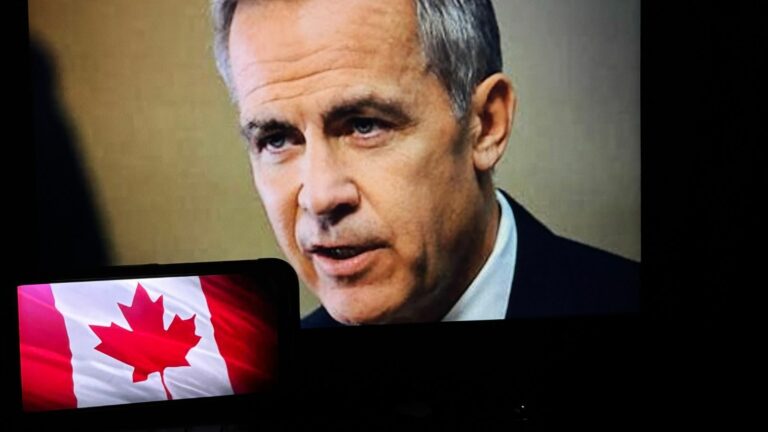
Canada’s most important trade relationship is entering one of its most uncertain periods in decades, and Mark Carney is choosing that moment to make a highly visible move toward the Gulf. The prime minister will visit Saudi Arabia from July 8 to 10 after attending the NATO summit in Türkiye, marking the first trip by a Canadian prime minister to the kingdom in 26 years.
The timing is difficult to ignore. Washington is expected to withhold support for extending CUSMA during the pact’s July 1 review, while Ottawa is trying to reduce its exposure to an increasingly unpredictable U.S. market. Saudi Arabia cannot replace the scale of American demand, but its investment capital, infrastructure spending and appetite for technology give Canada another place to sell expertise—and another way to show that it has options.
A Trip Timed to a North American Trade Shock
Carney Looks Beyond U.S. With Saudi Trade Push as CUSMA Crisis Deepens
- A Trip Timed to a North American Trade Shock
- Saudi Arabia Is a Market Canada Can No Longer Ignore
- The Numbers Show Both Opportunity and Distance
- Ottawa Has Already Laid the Commercial Groundwork
- Critical Minerals and Energy Offer the Clearest Fit
- AI, Infrastructure and Education Broaden the Opening
- Defence Ties Add Opportunity—and Scrutiny
- The Relationship Still Carries Political Baggage
- Diversification Is Leverage, Not a Substitute for the U.S.
Carney’s Saudi announcement landed one day before Canada, the United States and Mexico were due to begin the formal six-year review of CUSMA. The Trump administration is expected to decline an immediate extension, leaving the agreement in annual review rather than renewing it for another 16 years. That would not end free trade overnight. CUSMA would remain in force, and the three countries could continue negotiating until the current term expires in 2036.
The practical danger is prolonged uncertainty. Companies making decisions about factories, supply chains or hiring may hesitate when the rules governing North American trade could be reopened every year. Washington is also pressing for tougher automotive content requirements and has been negotiating formally with Mexico while Canada remains outside those rounds. Against that backdrop, Carney’s stop in Riyadh looks larger than a routine diplomatic visit. It is a statement that Canada intends to build commercial relationships beyond a U.S. market it can no longer treat as permanently predictable.
Saudi Arabia Is a Market Canada Can No Longer Ignore
Saudi Arabia offers something Ottawa urgently wants: a wealthy market that is actively spending to diversify its economy. The kingdom’s Vision 2030 program is directing capital into mining, artificial intelligence, tourism, transportation, health care, clean technology and large urban projects. Its Public Investment Fund reported more than US$900 billion in assets under management, giving Riyadh the ability to finance projects at a scale few governments can match.
Canada also has a foundation to build on. Roughly 150 Canadian companies maintain a long-term presence in the kingdom, and Ottawa identifies opportunities in agriculture, infrastructure, life sciences, education, advanced technology and mining. For a Canadian engineering firm, software developer or college, Saudi demand can mean more than selling a finished product; it can involve training, project design, local partnerships and long-term service contracts. Carney’s meeting with Crown Prince Mohammed bin Salman is intended to move those possibilities closer to the centre of the bilateral relationship rather than leaving them to occasional ministerial missions.
The Numbers Show Both Opportunity and Distance
Canada-Saudi merchandise trade totalled about $3.5 billion in 2025, including $1.3 billion in Canadian exports and $2.2 billion in imports. More than 92% of the imports were energy products, while major Canadian exports included vehicles and parts, industrial machinery, pharmaceuticals, and scientific instruments. For exporters operating in those sectors, Saudi Arabia is already a meaningful customer rather than a speculative future market.
The scale comparison with the United States is nevertheless sobering. Nearly $3.6 billion in goods and services crossed the Canada-U.S. border every day in 2024, roughly equal to an entire year of Canada-Saudi merchandise trade. The lesson is not that the Saudi push is too small to matter. It is that diversification must be built market by market and contract by contract. A handful of successful Canadian firms can gain significant revenue in Riyadh even while the national relationship remains modest. Ottawa’s challenge is to turn those individual wins into a broader, more durable commercial pipeline.
Ottawa Has Already Laid the Commercial Groundwork
Carney is not arriving in Riyadh with a blank agenda. International Trade Minister Maninder Sidhu led a senior Canadian business delegation to Saudi Arabia in January, where officials witnessed approximately $600 million in commercial partnership agreements. Niagara College accounted for more than $580 million through agreements with Saudi education and training institutions, an unusual but revealing example of what Canadian exports can look like in a service-driven economy.
The same visit reactivated the Canada-Saudi Joint Economic Commission, while both governments continued negotiations toward a foreign investment promotion and protection agreement. Air links have also been expanded from four to as many as 14 passenger flights per week for each country, with unlimited all-cargo services. Those changes are not headline-grabbing on their own, but they remove practical barriers. Business relationships are easier to build when executives can travel more directly, equipment can move more freely and investors have clearer rules. Carney’s role is to give political weight to machinery that ministers and companies have already started assembling.
Critical Minerals and Energy Offer the Clearest Fit
Energy may be the most obvious connection between two major resource economies, but the opportunity goes beyond selling oil. Canadian firms have expertise in carbon capture, water management, harsh-environment equipment, engineering and the development of unconventional resources. Saudi Arabia, while remaining a dominant petroleum producer, is investing in gas, petrochemicals, renewable power and lower-carbon technologies as it tries to broaden its industrial base.
Critical minerals could become even more strategically important. In January, Canada and Saudi Arabia signed a memorandum of understanding to promote trade, investment, knowledge sharing and more secure mineral supply chains. Both countries want a larger role in the materials needed for batteries, advanced manufacturing and digital infrastructure. Canada brings geological resources, mining finance and technical expertise; Saudi Arabia brings capital and a desire to develop processing capacity. A successful partnership would therefore be less about shipping raw ore overseas and more about building value chains that connect Canadian projects with Saudi investment, refining ambitions and downstream demand.
AI, Infrastructure and Education Broaden the Opening
Saudi Arabia’s spending plans create openings well beyond natural resources. Canada’s trade officials point to hundreds of infrastructure projects in development or implementation, including transportation, water, housing and work connected to Expo 2030 in Riyadh and the 2034 FIFA World Cup. Canadian companies with experience in public-private partnerships, engineering, construction technology and urban systems are entering a market where deadlines are fixed and the appetite for outside expertise is high.
Artificial intelligence is another priority. Canada’s AI minister visited Riyadh in February and met Saudi technology leaders, including the Public Investment Fund-backed company HUMAIN. Canada offers respected research institutes, specialized talent and enterprise software companies; Saudi Arabia offers energy, capital and plans for large-scale data infrastructure. The education agreements signed by Niagara College show the human side of the same strategy. New airports, laboratories and digital systems require trained workers. Canadian institutions can export curriculum, certification and management expertise alongside technology, creating relationships that can last longer than a single construction contract.
Defence Ties Add Opportunity—and Scrutiny
Defence is explicitly part of Carney’s agenda, reflecting Ottawa’s effort to strengthen Canadian industry while building new security partnerships. During the January trade mission, Sidhu toured a Canadian-operated training centre in Saudi Arabia that was presented as an example of the country’s aerospace and defence capabilities. For Canadian companies, Saudi spending can support contracts in training, maintenance, simulation, communications and advanced manufacturing.
Yet this is also the most politically sensitive part of the relationship. Defence exports attract scrutiny because commercial interests, regional security and human-rights concerns can collide. Carney will therefore have to demonstrate that closer ties are governed by Canadian law and policy rather than treated as a simple race for contracts. The political test is whether Ottawa can pursue legitimate security and industrial opportunities while remaining transparent about safeguards and end use. A trade strategy that ignores those questions could create domestic backlash and weaken the broader case for diversification. Economic pragmatism may be necessary, but it does not eliminate the need for clear boundaries.
The Relationship Still Carries Political Baggage
The planned visit is remarkable partly because the relationship was badly damaged only eight years ago. In 2018, Saudi Arabia downgraded diplomatic ties after Canada publicly called for the release of detained activists. Riyadh expelled Canada’s ambassador, restricted new business and imposed other punitive measures. Full diplomatic relations were restored in 2023 on the basis of mutual respect and shared interests, clearing the way for the recent surge of ministerial engagement.
The history still matters. Human Rights Watch and Amnesty International continue to document serious concerns involving freedom of expression, the justice system, migrant workers and the use of the death penalty. Those issues will make any major defence or investment announcement politically contentious in Canada. Carney’s challenge is to avoid the false choice between total disengagement and silence. Governments routinely maintain relations with partners whose systems and policies they oppose. The credibility of this reset will depend on whether Ottawa can expand trade while continuing to raise rights concerns consistently, rather than allowing commercial urgency to erase them.
Diversification Is Leverage, Not a Substitute for the U.S.
Canada has already shifted some trade away from the United States. The U.S. share of Canadian merchandise exports fell from 75.9% in 2024 to 71.7% in 2025, while exports to other regions helped offset part of the decline. Still, more than seven out of every 10 export dollars in goods went south of the border. Geography, integrated factories and decades of infrastructure make that relationship impossible to reproduce quickly elsewhere.
That is why the Saudi initiative should be judged as part of a portfolio rather than as a replacement plan. New business in the Gulf, Europe, Asia and Latin America can reduce concentration risk, attract investment and give Ottawa more room in negotiations with Washington. It cannot prevent damage if CUSMA deteriorates sharply. The Bank of Canada has warned that an unfavourable outcome would weaken exports, investment and hiring and put the economy on a lower path. Carney’s Riyadh visit is therefore both practical and symbolic: Canada is building alternatives, but the North American trade crisis remains the central economic test.
This Options Discord Chat is The Real Deal
While the internet is scoured with trading chat rooms, many of which even charge upwards of thousands of dollars to join, this smaller options trading discord chatroom is the real deal and actually providing valuable trade setups, education, and community without the noise and spam of the larger more expensive rooms. With a incredibly low-cost monthly fee, Options Trading Club (click here to see their reviews) requires an application to join ensuring that every member is dedicated and serious about taking their trading to the next level. If you are looking for a change in your trading strategies, then click here to apply for a membership.