35,000+ smart investors are already getting financial news, market signals, and macro shifts in the economy that could impact their money next with our FREE weekly newsletter. Get ahead of what the crowd finds out too late. Click Here to Subscribe for FREE.
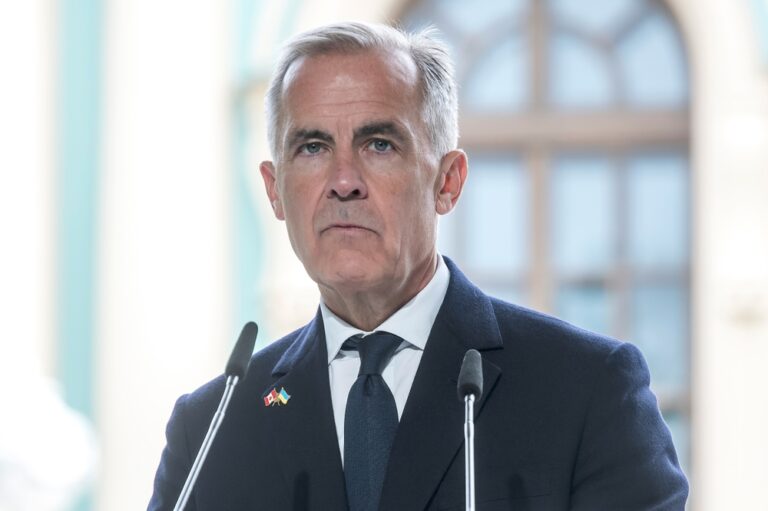
When a country’s largest customer starts questioning the rules of the relationship, every new market begins to matter more. Prime Minister Mark Carney’s planned visit to Saudi Arabia comes at precisely that moment: Washington is preparing to withhold a long-term extension of CUSMA, while Ottawa is trying to prove that Canadian growth does not have to rise or fall entirely with the United States.
The Saudi stop, scheduled after the NATO summit in Ankara, will be the first visit by a Canadian prime minister in 26 years. It is not a substitute for North American trade. It is a calculated attempt to build leverage, attract capital and create additional outlets for Canadian energy, minerals, technology, education and aerospace expertise.
A Saudi Visit With Unusually Heavy Timing
Carney Looks Beyond U.S. With Saudi Trade Push as CUSMA Crisis Deepens
- A Saudi Visit With Unusually Heavy Timing
- The CUSMA Crisis Is Serious, but the Deal Is Not Ending Tomorrow
- Saudi Arabia Is Already Canada’s Biggest Trade Partner in the Region
- Vision 2030 Creates the Opening Carney Wants to Exploit
- Commercial Deals Are Already Moving Beyond Diplomatic Promises
- Critical Minerals Could Become the Centrepiece
- Energy Cooperation Is Broader Than Competing Oil Producers
- Technology, Education and Aerospace Give the Relationship a Human Face
- The Relationship Still Carries Political and Human-Rights Baggage
- Better Air Links Make Trade Ambitions More Practical
- Saudi Trade Is a Hedge, Not a Replacement for the United States
Carney is expected to meet Crown Prince Mohammed bin Salman to discuss expanding trade and investment after attending the NATO summit in Turkey on July 7 and 8. The sequence is significant. Canada is presenting itself abroad as both a security partner and an economic partner, while uncertainty over its access to the U.S. market is becoming harder for businesses to ignore. A prime-ministerial trip gives commercial discussions a level of political attention that ministerial missions rarely command.
The visit also carries symbolic weight because no Canadian prime minister has travelled to Saudi Arabia in 26 years. Ottawa and Riyadh have already spent months rebuilding momentum through ministerial visits, investment talks and sector-specific agreements. Carney’s presence could help move that work from exploratory meetings toward larger commitments. For Canadian executives deciding whether to pursue contracts in the Gulf, a leader-level visit signals that the relationship is no longer peripheral to Ottawa’s economic strategy.
The CUSMA Crisis Is Serious, but the Deal Is Not Ending Tomorrow
The immediate pressure comes from Washington’s expected refusal to confirm a new 16-year extension of CUSMA at the July 1 joint review. That decision would not suddenly erase tariff-free trade across North America. Under Article 34.7, the agreement remains in force while the three countries hold annual reviews during the remainder of its current term. Without a later extension, it would expire in 2036.
The distinction matters because the political shock is larger than the immediate legal change. Businesses can still trade under CUSMA rules, but a decade-long review cycle creates uncertainty around future investment, factories and supply chains. A separate clause also allows a country to withdraw with six months’ notice. Washington is pressing for tougher automotive content rules and measures aimed at preventing Chinese-linked goods from benefiting from North American preferences. Canada therefore faces both a long-term expiry risk and the more immediate threat of sector-by-sector pressure.
Saudi Arabia Is Already Canada’s Biggest Trade Partner in the Region
Saudi Arabia is not a speculative market appearing from nowhere. In 2024, two-way merchandise trade reached approximately C$4.1 billion, including about C$2 billion in Canadian exports and C$2.1 billion in imports. That made the kingdom Canada’s largest merchandise trading partner in the Middle East and North Africa. Canadian exports already include defence products, aircraft, motor vehicles and parts, pharmaceuticals and industrial machinery.
The relationship also has a substantial human and corporate base. Roughly 150 Canadian firms maintain a long-term presence in Saudi Arabia, while the Canadian population there grew from about 13,000 in 2022 to 15,000 in 2024. Those numbers give a trade push practical foundations: existing offices, employees, professional networks and local knowledge. For a Canadian company entering Riyadh, the market is challenging and relationship-driven, but it is no longer unfamiliar territory. Ottawa’s task is to turn that foothold into larger and more diversified commercial flows.
Vision 2030 Creates the Opening Carney Wants to Exploit
Saudi Arabia’s Vision 2030 program is designed to reduce the economy’s dependence on oil by expanding industries such as mining, tourism, technology, logistics, health, education and advanced manufacturing. The World Bank expects non-oil activity to continue growing as the kingdom changes its economic model and encourages a larger private-sector role. That transformation overlaps with several areas where Canadian firms sell specialized expertise rather than only raw commodities.
The scale of Saudi capital is another attraction. The Public Investment Fund reported total assets of 4.54 trillion riyals for 2025, roughly US$1.2 trillion, while annual net profit more than doubled. That does not mean every Canadian proposal will be funded; Saudi projects are increasingly being judged on returns, timing and strategic value. Still, even a small share of PIF-linked investment could materially affect Canadian infrastructure, mining or technology projects. Carney’s likely pitch is straightforward: Canada offers resources, engineering talent and stable institutions, while Saudi Arabia offers capital and a rapidly expanding market.
Commercial Deals Are Already Moving Beyond Diplomatic Promises
The groundwork for Carney’s visit was laid in January, when International Trade Minister Maninder Sidhu travelled to Saudi Arabia with a senior Canadian business delegation. The mission produced approximately C$600 million in announced commercial partnerships. Niagara College’s agreements with Saudi education and training institutions accounted for more than C$580 million, showing that the opportunity extends well beyond oil, mining and defence.
Other agreements involved Canadian technology companies including BlackBerry and OpenText, while the two governments reactivated the Saudi-Canada Joint Economic Commission. Canada and Saudi Arabia are also pursuing negotiations toward a foreign investment promotion and protection agreement, which could create clearer rules for investors on both sides. These steps matter because trade missions are often criticized for producing photographs rather than contracts. In this case, there are already identifiable projects and institutions involved. Carney will be arriving with a base to expand, not merely a blank memorandum to sign.
Critical Minerals Could Become the Centrepiece
Canada and Saudi Arabia signed a memorandum of understanding in January to deepen cooperation across mineral-resource value chains. The agreement is intended to encourage trade, investment, knowledge sharing and more secure supply chains. It aligns Canada’s desire to develop mines and processing capacity with Saudi Arabia’s ambition to become a global hub for mineral processing and industrial investment.
One concrete example is the partnership between Canada’s Northern Graphite and Saudi Arabia’s Obeikan Investment Group to develop a battery-anode-material processing facility in the kingdom. The arrangement shows how the relationship could work: Canadian resources and technical knowledge paired with Saudi capital, industrial capacity and access to regional markets. The potential is larger than shipping unprocessed minerals overseas. Ottawa wants investment that can help finance projects in Canada, while Canadian companies want long-term customers and partners. Success will depend on whether the deals create durable value in both countries rather than simply relocating processing and jobs.
Energy Cooperation Is Broader Than Competing Oil Producers
At first glance, Canada and Saudi Arabia appear to be competitors because both are major petroleum producers. Yet their energy relationship is more complicated. Energy products accounted for more than 97 per cent of Canadian imports from Saudi Arabia in 2024, while both countries are seeking investment in lower-carbon technologies, infrastructure and resource development. Saudi Arabia’s role in global oil markets also gives it influence over energy-security discussions that directly affect Canada.
Carney can present Canada as a reliable supplier of energy, uranium, critical minerals and related technology while seeking Saudi investment in projects that require large amounts of patient capital. The pitch is not that the two countries share identical interests. Rather, both want to convert resource wealth into new industries before global energy demand changes more sharply. Canadian engineering, environmental services and project-management firms may find opportunities in that transition, particularly where Saudi projects require international expertise and credible operating standards.
Technology, Education and Aerospace Give the Relationship a Human Face
The most visible trade statistics can make the relationship seem dominated by commodities and large state-backed projects. In practice, some of the most relatable connections are in classrooms, training centres and technology offices. Niagara College’s Saudi agreements are tied to skills development, while OpenText inaugurated a regional headquarters and BlackBerry was included among the Canadian firms announcing partnerships. These are examples of Canadian services and intellectual property travelling abroad without a pipeline or container ship.
Aerospace and defence are also established parts of Canada’s export mix. Sidhu’s January mission included a visit to the CAE unmanned-aircraft training centre, and Carney and the crown prince have previously discussed aerospace and defence cooperation. These sectors can produce high-value contracts and skilled jobs, but they also require careful export controls and political scrutiny. Ottawa will need to show that commercial ambition does not remove its legal responsibilities or its obligation to assess sensitive exports case by case.
The Relationship Still Carries Political and Human-Rights Baggage
Canada and Saudi Arabia restored full diplomatic relations in May 2023 after a rupture that began in 2018. The earlier dispute followed Canadian calls for the release of detained human-rights activists, after which Saudi Arabia restricted new business and downgraded ties. Restoring ambassadors reopened channels for trade, security discussions and consular work, but it did not erase the issues that caused the breakdown.
Global Affairs Canada has stated that normalization allows more sustained engagement on human rights while acknowledging continuing concerns about political freedom and dissent. That creates a difficult balancing act for Carney. A trade-first visit may be criticized if economic announcements appear to crowd out Canadian values; an overly confrontational approach could again damage commercial access and diplomatic cooperation. The most credible position is neither silence nor public grandstanding. It is consistent private and public engagement, transparent export controls and a clear explanation that economic partnership does not equal agreement on every domestic policy.
Better Air Links Make Trade Ambitions More Practical
Trade strategies often fail on ordinary logistical barriers: too few flights, slow cargo routes, limited local contacts and high travel costs. Canada and Saudi Arabia expanded their air transport agreement in December 2025 to permit as many as 14 weekly passenger-combination flights and unlimited all-cargo services. That makes it easier for executives, students, specialized workers and time-sensitive goods to move between the countries.
Improved connectivity is especially useful for sectors such as pharmaceuticals, aerospace parts, technology services, education and professional consulting. It also supports the thousands of Canadians living in Saudi Arabia and strengthens the personal networks that often precede commercial deals. The agreement alone will not generate billions in trade, and airlines will add service only where demand supports it. Still, it removes a practical ceiling on growth and gives companies more flexibility when planning regional operations. In a diversification strategy, those unglamorous details can matter as much as leader-level announcements.
Saudi Trade Is a Hedge, Not a Replacement for the United States
The scale comparison remains decisive. Nearly 70 per cent of Canadian exports went to the United States last year, totalling roughly C$565 billion, while non-U.S. exports reached C$213.8 billion. More than 85 per cent of Canada-U.S. trade has continued to move tariff-free under CUSMA preferences. Saudi Arabia’s C$4.1-billion merchandise relationship is meaningful, but it cannot absorb the output of Canada’s integrated auto, energy and manufacturing sectors if U.S. access deteriorates.
That is why Carney’s Saudi push should be understood as insurance and leverage rather than economic separation. New Gulf contracts can support individual companies, attract investment and reduce exposure at the margins. A broader network of partners can also make Canada more resilient and strengthen its negotiating position. But the most successful strategy would combine deeper Saudi ties with a workable North American settlement. Canada can look beyond the United States without pretending geography, pipelines and decades of integrated production no longer matter.
This Options Discord Chat is The Real Deal
While the internet is scoured with trading chat rooms, many of which even charge upwards of thousands of dollars to join, this smaller options trading discord chatroom is the real deal and actually providing valuable trade setups, education, and community without the noise and spam of the larger more expensive rooms. With a incredibly low-cost monthly fee, Options Trading Club (click here to see their reviews) requires an application to join ensuring that every member is dedicated and serious about taking their trading to the next level. If you are looking for a change in your trading strategies, then click here to apply for a membership.