35,000+ smart investors are already getting financial news, market signals, and macro shifts in the economy that could impact their money next with our FREE weekly newsletter. Get ahead of what the crowd finds out too late. Click Here to Subscribe for FREE.
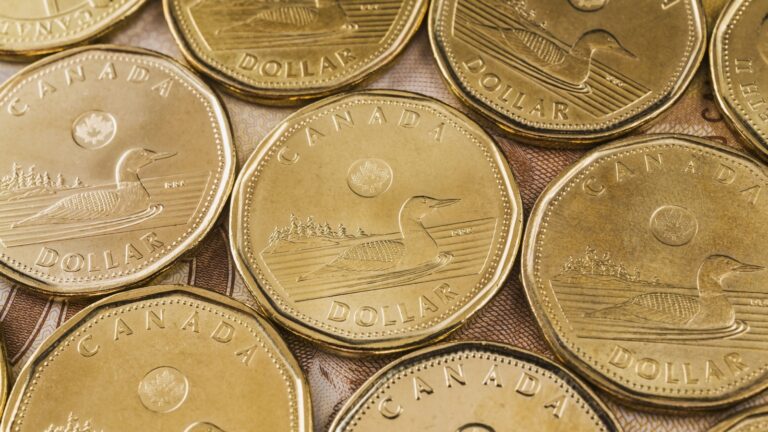
The Canadian dollar’s slow retreat has turned into a much more visible slide. On June 24, the loonie touched C$1.4248 per U.S. dollar—its weakest level since April 2025—before trading near 70.25 U.S. cents. It marked a seventh consecutive daily decline and extended a selloff that has made everything from U.S. vacations to imported equipment more expensive in Canadian-dollar terms.
The latest Bank of Canada meeting summary did little to change the mood. Policymakers signalled flexibility, not a firm commitment to higher rates, while investors remained focused on weaker Canadian growth, falling oil prices and a widening interest-rate advantage for the United States. Together, those pressures have left the currency searching for a clear source of support.
The Slide Has Become a Streak
Canadian Dollar Sinks to 14-Month Low as Bank of Canada Offers Little Relief
- The Slide Has Become a Streak
- The Bank Offered Flexibility, Not a Rescue
- U.S. Rates Are Pulling Capital South
- Oil’s Reversal Removed a Familiar Support
- Canada’s Softer Economy Is Showing Through
- Inflation Has Trapped Policymakers Between Risks
- A Weaker Loonie Creates Winners and Losers
- What Could Finally Stop the Decline?
Currency moves often look small from one day to the next, but the loonie’s recent decline has accumulated quickly. It traded at roughly C$1.4235 per U.S. dollar on June 24 after touching C$1.4248 intraday, its lowest level in 14 months. The move also completed seven straight losing sessions, showing that the weakness was not simply a brief reaction to one economic release or political headline.
The speed of the decline matters because exchange rates filter into everyday decisions. A Canadian family pricing a summer trip to Florida sees hotel rooms, meals and attraction tickets become costlier once converted from U.S. dollars. A small business ordering American software, machinery or replacement parts faces a similar squeeze. The loonie is still far from historic crisis levels, but a sustained move near 70 U.S. cents changes budgets, profit margins and inflation expectations more than a single volatile trading day would.
The Bank Offered Flexibility, Not a Rescue
The Bank of Canada held its policy rate at 2.25% on June 10, arguing that the setting balanced unusually complicated risks. Its later summary of deliberations showed why officials were reluctant to promise a specific direction. New U.S. trade restrictions could weaken Canadian growth enough to justify rate cuts, while persistent energy-driven inflation could require consecutive increases. Both problems could also arrive at the same time.
That “nimble” stance may be sensible for monetary policy, but it gave currency traders little reason to reverse course. A decisive signal that rates would rise could have supported the loonie by improving returns on Canadian assets. Instead, the Bank emphasized uncertainty and its willingness to react to incoming evidence. Markets consequently reduced the amount of tightening expected by December to about 17 basis points, down from roughly 60 basis points a month earlier. For the currency, optionality from the central bank looked more like an absence of immediate support.
U.S. Rates Are Pulling Capital South
The interest-rate gap between Canada and the United States has become one of the loonie’s biggest disadvantages. The Federal Reserve kept its target range at 3.5% to 3.75% on June 17, well above the Bank of Canada’s 2.25% rate. In bond markets, the gap between Canadian and U.S. two-year yields widened to 137 basis points on June 18, the largest spread since May 2025.
Higher U.S. yields can make dollar-denominated bonds and cash instruments more attractive to global investors, increasing demand for the greenback. The effect becomes stronger when the Federal Reserve sounds concerned about inflation while Canada’s central bank remains constrained by weak growth. The U.S. economy has also been supported by solid consumption and strong capital spending, including investment tied to artificial intelligence. Canada, by comparison, has struggled to generate similar momentum. Foreign-exchange markets are therefore pricing not only today’s rate difference, but also the possibility that the gap could remain wide for longer.
Oil’s Reversal Removed a Familiar Support
The Canadian dollar is not mechanically tied to crude oil, but energy remains one of the country’s most important exports. Rising oil prices can improve Canada’s trade income and increase the Canadian-dollar value of revenues earned in U.S. dollars. Falling prices can remove that support, especially when other domestic indicators are already soft.
On June 24, U.S. crude fell 4.1% to about US$70.20 a barrel as signs emerged that more tankers could move through the Strait of Hormuz, easing fears of a supply shortage. The loonie weakened alongside that decline. Earlier geopolitical tension had pushed energy prices higher, but the currency gained surprisingly little from the surge because investors were also worried about slower growth and trade disruption. When oil then reversed, the negative side of the relationship became more visible. That asymmetry suggests traders currently see Canada’s economic vulnerabilities as more powerful than the benefits of temporarily elevated commodity prices.
Canada’s Softer Economy Is Showing Through
Recent Canadian data have given investors reasons to question how much economic strength sits behind the currency. Statistics Canada reported that real gross domestic product was unchanged in the first quarter of 2026 after declining 0.2% in the final quarter of 2025. Final domestic demand edged lower, business and government capital investment weakened, and resale housing activity fell 9.9% during the quarter.
Consumer data offered a similar mixed picture. Retail sales rose 0.5% in April to C$73 billion, but the increase was led by gasoline stations and motor-vehicle dealers. Core retail sales, which exclude those categories, fell 0.7% for a second consecutive monthly decline, while inflation-adjusted retail volumes were essentially flat. Those details matter because foreign-exchange traders look beyond headline spending totals to judge underlying demand. A country with softer consumption, weak investment and trade uncertainty usually has less room to sustain higher interest rates, making its currency less attractive than that of a faster-growing economy.
Inflation Has Trapped Policymakers Between Risks
Canada’s May inflation report complicated the picture just as growth was losing momentum. The Consumer Price Index rose 3.2% from a year earlier, up from 2.8% in April and above the upper edge of the Bank of Canada’s 1% to 3% control range. Gasoline was the main driver, although inflation excluding gasoline also accelerated to 2.2% from 2.0%.
The Bank has so far found limited evidence that higher energy costs are spreading broadly across the economy, and its preferred core measures have been close to 2%. Even so, headline inflation above the target range makes an immediate rate cut harder to justify. Raising rates, meanwhile, could deepen weakness in housing, business investment and household demand. This is the central policy trap behind the loonie’s decline: the economy looks soft enough to discourage aggressive tightening, but inflation is high enough to prevent officials from offering easy relief. Currency markets tend to punish that kind of uncomfortable middle ground.
A Weaker Loonie Creates Winners and Losers
For households, the clearest effect of a weaker currency is reduced purchasing power abroad. U.S.-priced travel, online subscriptions, electronics, produce and imported consumer goods can all become more expensive. Bank of Canada research has found that exchange-rate movements can materially affect Canadian consumer prices, although the pass-through is usually incomplete and does not happen all at once. Retailers may absorb part of the increase, delay price changes or adjust margins depending on competition and demand.
Exporters can benefit. A Canadian company paid in U.S. dollars receives more Canadian dollars when those revenues are converted, while businesses pricing their products in Canadian dollars may become more competitive abroad. Yet the advantage is uneven because many exporters also rely on imported machinery, components and software. Canada’s exposure is substantial: in 2025, 71.7% of merchandise exports went to the United States and 58.8% of merchandise imports came from there. The loonie’s decline therefore redistributes pressure across the economy rather than producing a simple nationwide gain or loss.
What Could Finally Stop the Decline?
Several developments could give the Canadian dollar firmer ground. A rebound in oil, stronger domestic growth, easing Canada–U.S. trade uncertainty or signs of persistent inflation could raise expectations for Bank of Canada tightening. A softer U.S. economy or a less hawkish Federal Reserve could also narrow the yield gap that currently favours the greenback. Improved global risk appetite would help by reducing demand for the U.S. dollar as a safe haven.
None of those changes is guaranteed. The Bank of Canada’s next scheduled decision is July 15, when it will also publish a new Monetary Policy Report. Officials will be watching whether energy inflation spreads, whether economic activity returns to growth and whether new U.S. trade measures threaten Canadian exports. Until those questions become clearer, the Bank’s flexibility may continue to feel unsatisfying to currency markets. The loonie does not need a dramatic rescue to recover, but it does need at least one major force—rates, growth, oil or trade—to begin moving convincingly in its favour.
This Options Discord Chat is The Real Deal
While the internet is scoured with trading chat rooms, many of which even charge upwards of thousands of dollars to join, this smaller options trading discord chatroom is the real deal and actually providing valuable trade setups, education, and community without the noise and spam of the larger more expensive rooms. With a incredibly low-cost monthly fee, Options Trading Club (click here to see their reviews) requires an application to join ensuring that every member is dedicated and serious about taking their trading to the next level. If you are looking for a change in your trading strategies, then click here to apply for a membership.