35,000+ smart investors are already getting financial news, market signals, and macro shifts in the economy that could impact their money next with our FREE weekly newsletter. Get ahead of what the crowd finds out too late. Click Here to Subscribe for FREE.
For Canadian motorists, peace in the Middle East may bring relief at the pump—but not a return to last year’s prices. Oil markets rallied around a preliminary U.S.-Iran agreement that could reopen the Strait of Hormuz, sending crude prices sharply lower. Yet the physical supply system cannot recover as quickly as traders can react to a headline.
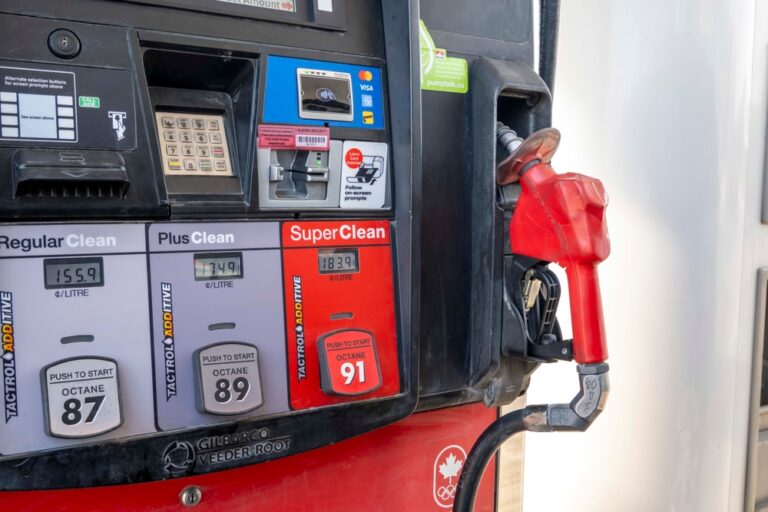
Canada’s average regular gasoline price stood at 165.7 cents per litre on June 15, down considerably from its May peak but still about 31 cents higher than a year earlier. Analysts expect another decline of roughly 10 to 15 cents in the coming days and weeks. That would leave the national average close to $1.50 per litre, with damaged infrastructure, depleted inventories and strong summer demand preventing a much steeper drop.
A Peace Breakthrough Does Not Instantly Restore Supply
Canadian Gas Prices Expected to Stay Near $1.50 Despite U.S.-Iran Peace Deal
- A Peace Breakthrough Does Not Instantly Restore Supply
- The Math Points to a Price Near $1.50
- Crude Oil and Pump Prices Move on Different Timelines
- Reopening the Strait Is a Major Logistics Operation
- Oil Is Cheaper Than It Was, but Still Expensive
- Taxes Create Different Price Floors Across Canada
- Summer Travel and Refining Constraints Could Limit the Decline
- Higher Fuel Costs Will Continue Reaching Household Budgets
- What Must Happen for Prices to Fall Below $1.50
The agreement between Washington and Tehran is an important turning point, but it is more accurately described as a preliminary framework than a permanent settlement. The arrangement extends a fragile ceasefire for another 60 days and is expected to reopen the Strait of Hormuz. Major questions involving Iran’s nuclear program, regional militias and the long-term terms of the truce still have to be negotiated.
Those uncertainties matter because the strait normally handles approximately one-fifth of the world’s oil consumption. Before the conflict, about 20 million barrels of crude oil and refined petroleum products moved through it every day. The disruption therefore removed far more than Iranian oil from the market. It affected shipments from several major Gulf producers at the same time. Financial markets can immediately price in the possibility of peace, but refiners cannot process oil that has not arrived. Until tankers are moving safely and consistently, the agreement will reduce fear faster than it restores fuel supplies.
The Math Points to a Price Near $1.50
The latest national figures explain why analysts are focusing on the $1.50 level. CAA reported an average Canadian gasoline price of 165.7 cents per litre on June 15. A projected reduction of 10 to 15 cents would bring that figure to between approximately 150.7 and 155.7 cents. Prices could fall below that range in some competitive local markets, but a national return to the $1.30 range appears unlikely in the immediate future.
The expected decline would still represent meaningful relief. Canada’s average had been around 188 cents per litre one month earlier, when the energy disruption was placing much greater pressure on oil markets. However, the June 2025 average was only 134.7 cents. At $1.50 per litre, filling a 50-litre tank costs $75. At $1.35, the same fill costs $67.50. That $7.50 difference may appear modest once, but for a household buying 150 litres per month, it adds approximately $270 over a year.
Crude Oil and Pump Prices Move on Different Timelines
Oil futures can plunge within minutes of a diplomatic announcement. Retail gasoline prices move through a longer chain. Crude must be produced, loaded, shipped, delivered to a refinery, converted into gasoline and transported to distribution terminals. Service stations then purchase fuel from wholesalers and set their prices according to replacement costs, local competition, sales volumes and operating expenses.
That process helps explain why pump prices can decline more slowly than crude benchmarks. Retail prices generally begin responding to wholesale-market movements within days or weeks, rather than immediately. Refining margins can also remain elevated even when crude prices fall, particularly when usable inventories are limited. The Canadian dollar adds another variable because internationally traded oil and refined products are commonly priced in U.S. dollars. A weaker Canadian currency can offset part of a decline in global crude prices. Motorists may therefore see several small reductions instead of one dramatic overnight drop, even when oil markets record a large daily decline.
Reopening the Strait Is a Major Logistics Operation
The reopening of the Strait of Hormuz involves more than issuing permission for ships to pass. Tanker operators and insurers need confidence that the route is secure. Ports, loading facilities, pipelines and oil fields also need to be inspected after months of disruption. Some Gulf facilities were damaged, while others reduced production because oil could not be exported or stored indefinitely.
Energy-market forecasts prepared before the latest agreement illustrate the scale of the challenge. The U.S. Energy Information Administration expected shipments to begin recovering during the third quarter of 2026 but did not anticipate a return to pre-conflict traffic until early 2027. The diplomatic breakthrough could improve that schedule, but it does not eliminate the physical work. The International Energy Agency reported that global inventories had fallen sharply and that Gulf production losses had reached extraordinary levels during the closure. Even once ships begin moving, producers must restart wells, replenish storage and rebuild normal delivery schedules. That is why the first tankers through the strait will be a milestone—not the end of the shortage.
Oil Is Cheaper Than It Was, but Still Expensive
West Texas Intermediate crude was trading around US$80 per barrel when the agreement was announced. That was a significant improvement from the roughly US$113 level reached during the conflict in May. However, it remained well above the approximately US$65 price recorded before the war began. In percentage terms, US$80 oil is still roughly 23 per cent more expensive than the pre-conflict benchmark.
The distinction is important because falling prices are not necessarily low prices. Much of the immediate geopolitical premium may have disappeared, but the market is still accounting for depleted inventories, limited Gulf exports and the risk that negotiations could falter. Gasoline also has its own supply-and-demand conditions after crude reaches a refinery. A sharp decline in an oil benchmark therefore does not guarantee an equal percentage decline at Canadian stations. The current direction is favourable for motorists, but the starting point was unusually high. The first stage of relief is likely to remove the most extreme war-related increases rather than restore the cheaper fuel conditions Canadians experienced during the previous winter.
Taxes Create Different Price Floors Across Canada
The amount displayed at a gas station includes more than crude oil and refining costs. Federal and provincial taxes, sales taxes, transportation expenses and retail margins all contribute to the final price. Ottawa introduced a temporary measure reducing the federal gasoline excise tax from its usual 10 cents per litre to zero from April 20 through September 7, 2026. On a 50-litre fill, the direct excise-tax reduction is worth about $5 before considering the interaction with sales taxes.
Provincial fuel taxes remain, and their rates vary considerably. Depending on the location, motorists may also pay GST, HST or Quebec sales tax on the retail price. Vancouver, Victoria and Montreal have additional municipal fuel levies. These differences help explain why a national average near $1.50 will not appear uniformly across the country. A driver in a heavily taxed metropolitan area may continue paying substantially more, while stations in lower-tax regions or highly competitive communities may fall below the national figure. Transportation distances, refinery access and local retail competition can widen the gap further, sometimes even between nearby cities.
Summer Travel and Refining Constraints Could Limit the Decline
The timing of the agreement creates another complication: it arrived during the summer driving season. Canadian gasoline demand generally increases as families take road trips, tourism activity rises and more vehicles travel during warmer weather. Strong demand does not necessarily cause prices to rise if supply is recovering quickly, but it can slow the pace of a decline.
Refiners are also working through the effects of the historic supply disruption. The International Energy Agency reported substantial reductions in global refinery activity as operators dealt with damaged infrastructure, export restrictions and insufficient crude feedstock. Refining margins rose to unusually high levels for several petroleum products during the crisis. Those pressures may ease as Gulf exports return, although rebuilding inventories will require time. The result could be a frustrating pattern for drivers: crude prices fall substantially, while gasoline declines in smaller steps. A family preparing for a long weekend may notice a few cents of relief, but not the dramatic change suggested by financial-market headlines. Summer demand and constrained refining capacity can absorb part of the benefit.
Higher Fuel Costs Will Continue Reaching Household Budgets
The consequences extend beyond the price of a personal fill-up. An analysis by Ontario’s Financial Accountability Office estimated that the Iran conflict could add $8.5 billion to the province’s gasoline and diesel costs during 2026. About $4.1 billion of that amount was attributed directly to households, with the remainder falling largely on businesses. The estimate assumed that oil shipments would begin recovering in June and that crude would decline toward US$80 by year-end—conditions broadly resembling the emerging peace scenario.
Under those assumptions, the FAO estimated an additional annual fuel cost of $648 for the average Ontario household. The calculation did not include indirect effects, such as businesses passing higher transportation, fertilizer or delivery expenses to consumers. A lasting agreement could reduce some of those pressures, particularly if oil production recovers faster than expected. Nevertheless, months of elevated prices have already affected household and business spending. Commuters, contractors and rural families who drive long distances cannot recover money previously spent. Relief at the pump will help future budgets, but it will not erase the accumulated cost of the disruption.
What Must Happen for Prices to Fall Below $1.50
A sustained move well below $1.50 would require several developments to occur together. The ceasefire must hold, the strait must remain reliably open and damaged facilities must be repaired. Gulf producers would need to restore output, tankers would have to rebuild normal shipping schedules and depleted global inventories would need to recover. A stronger Canadian dollar or softer summer fuel demand would provide additional help.
Some analysts believe crude could take three to four months to return to the US$60-per-barrel range, even under favourable conditions. Others expect normalization to require at least six months, with parts of the energy market remaining disrupted into 2027. The range of forecasts reflects the unusual scale of the crisis and the unresolved nature of the agreement. For now, the most likely outcome is gradual relief rather than a collapse in prices. Canadians may soon see averages beginning with “1.5” instead of “1.6,” but consistently cheaper gasoline will depend on ships, refineries and inventories—not simply the signatures attached to a peace agreement.
This Options Discord Chat is The Real Deal
While the internet is scoured with trading chat rooms, many of which even charge upwards of thousands of dollars to join, this smaller options trading discord chatroom is the real deal and actually providing valuable trade setups, education, and community without the noise and spam of the larger more expensive rooms. With a incredibly low-cost monthly fee, Options Trading Club (click here to see their reviews) requires an application to join ensuring that every member is dedicated and serious about taking their trading to the next level. If you are looking for a change in your trading strategies, then click here to apply for a membership.