35,000+ smart investors are already getting financial news, market signals, and macro shifts in the economy that could impact their money next with our FREE weekly newsletter. Get ahead of what the crowd finds out too late. Click Here to Subscribe for FREE.
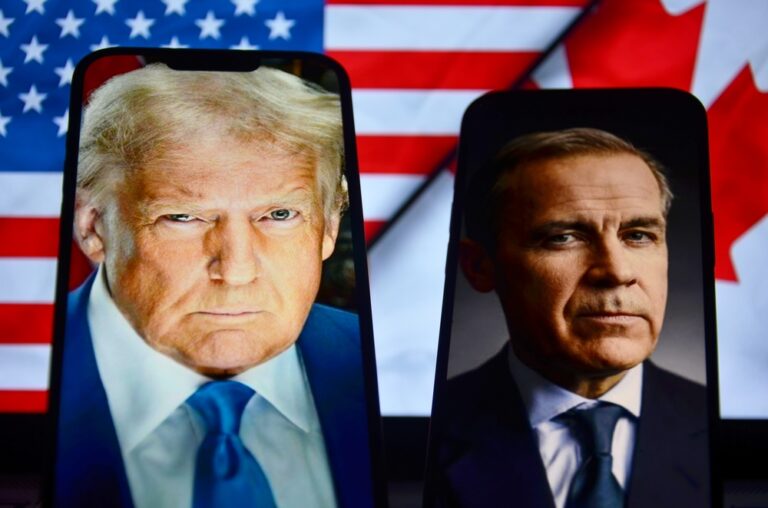
Prime Minister Mark Carney is arriving at the G7 with Canada’s most important economic relationship hanging over the summit — but without a formal one-on-one meeting with U.S. President Donald Trump on the announced schedule. Trump’s planned bilateral talks include the leaders of France, India, Qatar, the United Arab Emirates and Egypt, while U.S. officials say no major Canada-U.S. trade breakthrough is expected in Évian. That absence does not prevent an informal exchange, nor does it mean negotiations have stopped. It does, however, sharpen the contrast between the urgency in Ottawa and Washington’s crowded list of priorities. With the mandatory CUSMA review beginning July 1, Carney must use the summit to keep Canada visible, manage Trump’s latest threat not to extend the pact and create room for the officials doing the detailed bargaining.
A Missing Bilateral Becomes the Story
Carney Heads Into G7 Without a Trump Meeting as CUSMA Deadline Closes In
- A Missing Bilateral Becomes the Story
- July 1 Is a Review, Not a Sudden Expiry
- Trump Has Turned Renewal Into Leverage
- Canada Has More at Stake — But America Is Not Untouched
- Tariffs and Retaliation Are Blocking the Runway
- The Real Negotiation May Happen Below the Leaders’ Level
- Carney Is Building a European Insurance Policy
- The Most Likely Outcome Could Be Years of Uncertainty
The G7 summit in Évian-les-Bains runs from June 15 to 17, bringing together Canada, France, Germany, Italy, Japan, the United Kingdom, the United States and European Union representatives. Trump’s public schedule is dominated by a meeting with French President Emmanuel Macron and separate talks with invited leaders from India and the Middle East. Carney will still share working sessions and informal spaces with the U.S. president, but the absence of a scheduled bilateral matters because such meetings give leaders protected time to settle priorities, authorize compromises and signal political commitment.
The optics are especially difficult for Ottawa because trade is not a secondary file. A year earlier, Carney and Trump used their G7 bilateral in Kananaskis to discuss immediate trade pressures and direct officials to pursue an agreement within 30 days. This time, U.S. officials are describing Canada-U.S. discussions as frequent but informal and are warning against expecting a major summit breakthrough. The difference is visible: Canada is approaching a fixed institutional review, while Trump is arriving focused on Iran, Ukraine and several other relationships. For Carney, even a short unscheduled conversation could therefore become one of the most closely watched moments of the gathering.
July 1 Is a Review, Not a Sudden Expiry
The approaching date is important, but it is often described too dramatically. CUSMA entered into force on July 1, 2020, with a 16-year term. Article 34.7 requires the three governments to conduct a joint review on the agreement’s sixth anniversary and decide whether they want to extend its term for another 16 years. If Canada, the United States and Mexico all confirm an extension, the pact’s horizon moves forward and another review follows six years later. That outcome would provide businesses with the longest possible window of certainty.
If one country refuses to confirm an extension on July 1, CUSMA does not disappear overnight. Instead, the commission must meet every year for the remainder of the current term, giving the parties repeated opportunities to extend the agreement before it expires in 2036. Withdrawal is a separate legal step requiring six months’ written notice. The immediate risk is therefore not a tariff wall appearing on July 2. It is a prolonged period in which manufacturers, farmers and investors must make expensive decisions without knowing whether the rules governing North American trade will remain stable for the next decade.
Trump Has Turned Renewal Into Leverage
Trump escalated the uncertainty on June 10 by saying he was “not looking to renew” CUSMA and repeating his claim that the United States does not need Canadian or Mexican products. His argument is rooted partly in trade balances: the United States recorded a goods deficit of about US$46 billion with Canada and US$197 billion with Mexico in 2025. The president has repeatedly treated deficits as evidence that a trading relationship is unfair, even when much of the Canadian surplus is tied to energy that American households and industries consume.
The comments also function as bargaining leverage. Nearly US$1.6 trillion in annual trade moves among the three CUSMA countries, and the review gives Washington an opportunity to press for changes involving agriculture, rules of origin, digital policy and other disputes. Refusing an immediate 16-year extension would allow the White House to revisit those issues every year. For Canadian negotiators, the challenge is to distinguish between an opening demand and a genuine willingness to live with chronic uncertainty. Trump helped create the agreement during his first term, but he now has an incentive to portray its continuation as a concession that Canada and Mexico must earn.
Canada Has More at Stake — But America Is Not Untouched
Canada’s exposure is unmistakable. Nearly 70% of Canadian exports go to the United States, and Statistics Canada found that 75.9% of domestic merchandise exports were U.S.-bound in 2024. Motor vehicles and parts were even more concentrated, with 94.1% of that export category destined for the American market. For a plant manager in Ontario or a food processor on the Prairies, the review is not an abstract debate about diplomatic language. It affects purchasing contracts, production plans, hiring and whether the next investment is made in Canada or moved closer to U.S. customers.
The dependence is not one-way. Roughly C$3.6 billion in goods and services crossed the Canada-U.S. border each day in 2024, supporting highly integrated production and investment on both sides. Canada is the largest foreign supplier of energy to the United States, while Canada and Mexico together buy nearly one-third of exported U.S. goods. That gives Ottawa allies among American manufacturers, farmers, border states and chambers of commerce. Carney’s strongest case is therefore not that Washington should help Canada. It is that predictable continental trade lowers costs and protects jobs in communities on both sides of the border.
Tariffs and Retaliation Are Blocking the Runway
CUSMA has continued to shelter much of Canadian trade, but it has not prevented Washington from imposing sectoral tariffs under other U.S. laws. Ottawa estimated earlier this year that about 85% of Canadian exports were still entering the United States tariff-free, while steel, aluminum, copper, autos, parts, lumber and other products faced targeted measures. The White House strengthened metals tariffs again in April and adjusted parts of that regime in June, keeping pressure on some of Canada’s most politically sensitive industries.
The retaliation has become a dispute of its own. U.S. Trade Representative Jamieson Greer has argued that Canadian counter-tariffs and provincial restrictions on American alcohol are obstructing progress. Canadian leaders respond that those measures were imposed because Washington acted first and that removing them without a reciprocal agreement would surrender leverage. This creates a classic sequencing problem: each side wants the other to move before talks can accelerate. The stalemate also explains why a leaders’ meeting could have mattered. A political instruction from Carney and Trump might have created a path for staged tariff relief, but without one, negotiators must try to build that sequence themselves.
The Real Negotiation May Happen Below the Leaders’ Level
Canada is not arriving unprepared. Carney appointed veteran public servant Janice Charette as chief trade negotiator to the United States in February, while Dominic LeBlanc has remained the minister responsible for the Canada-U.S. trade relationship. Carney also convened premiers on June 10, briefed them on the talks and emphasized a united “Team Canada” approach. That coordination matters because provinces control important levers, including liquor distribution, energy policy and procurement, while many of the industries most exposed to U.S. action are regionally concentrated.
LeBlanc is expected to meet Greer on the G7 sidelines even without a Carney-Trump bilateral. He has also said the review could be accompanied by bilateral Canada-U.S. and U.S.-Mexico arrangements that sit beside the trilateral framework. That may be the most practical route forward: preserve CUSMA’s continental rules while negotiating narrower deals on tariffs or sector-specific irritants. The likely work in Évian will therefore be less theatrical than a leaders’ handshake. It will involve testing which concessions are politically possible, identifying what can be settled before July 1 and deciding which disputes may need to remain open during annual reviews.
Carney Is Building a European Insurance Policy
Carney’s trip to France and Ireland is also part of a broader response to American unpredictability. Before the G7, he met Macron to discuss trade, defence, artificial intelligence, quantum technology and critical minerals. In Ireland, he argued that middle powers need a dense network of partnerships to navigate what he called a global rupture. The visit carried a personal note as well: Carney travelled to the western Irish village where his grandparents were born, met distant relatives, visited the family grave and planted a tree.
The symbolism supports a concrete economic strategy. Canada has 16 free-trade agreements covering 51 countries and preferential access to about 1.5 billion consumers, while Carney has set a goal of doubling non-U.S. exports over the next decade. Yet diversification is an insurance policy, not a quick replacement for the American market. Europe cannot immediately absorb the volume of Canadian energy, vehicles, food and industrial goods now moving south. The more realistic objective is to reduce vulnerability at the margin, attract investment from additional partners and show Washington that Canada has options even while it works to preserve CUSMA.
The Most Likely Outcome Could Be Years of Uncertainty
The cleanest result would be a three-country agreement to extend CUSMA through 2042, perhaps alongside targeted commitments addressing current disputes. The Bank of Canada has treated that as its base-case assumption, but it has also outlined less favourable paths: a significant renegotiation that raises compliance costs, a withdrawal by one or more members, or annual reviews continuing until an extension is finally reached. Stricter rules of origin, weaker tariff preferences or recurring threats of withdrawal could all make Canadian exports less competitive even if the core agreement technically remains in force.
That is why the absence of a formal Trump meeting is consequential without being decisive. Carney does not need a summit photo to keep CUSMA alive on July 1; the agreement’s legal structure already prevents an immediate collapse. What Canada needs is evidence that the United States sees value in restoring a longer planning horizon. The first signals may come from LeBlanc’s meeting with Greer, any unscheduled Carney-Trump contact and the language each government uses after Évian. If no extension is confirmed, the next phase will not be a sudden end to free trade. It will be a slower, more corrosive test of whether businesses can keep investing while the rules are renegotiated year after year.
This Options Discord Chat is The Real Deal
While the internet is scoured with trading chat rooms, many of which even charge upwards of thousands of dollars to join, this smaller options trading discord chatroom is the real deal and actually providing valuable trade setups, education, and community without the noise and spam of the larger more expensive rooms. With a incredibly low-cost monthly fee, Options Trading Club (click here to see their reviews) requires an application to join ensuring that every member is dedicated and serious about taking their trading to the next level. If you are looking for a change in your trading strategies, then click here to apply for a membership.