35,000+ smart investors are already getting financial news, market signals, and macro shifts in the economy that could impact their money next with our FREE weekly newsletter. Get ahead of what the crowd finds out too late. Click Here to Subscribe for FREE.
Canada’s economy has slipped into a politically charged slowdown at the worst possible moment: just as businesses are trying to plan around U.S. tariff threats, shifting trade rules, and a more uncertain North American market. The latest GDP figures show an economy that is not collapsing, but clearly losing momentum in areas that matter for long-term growth.
The headline number is only part of the story. Household spending is still providing some support, energy prices are helping corporate profits, and inventories cushioned the blow. But beneath the surface, business investment, exports, housing activity, and labour-market confidence are all showing strain. For companies deciding whether to build, hire, expand, or wait, the message from the first quarter was blunt: uncertainty has become an economic drag of its own.
Canada’s Recession Label Comes With an Important Caveat
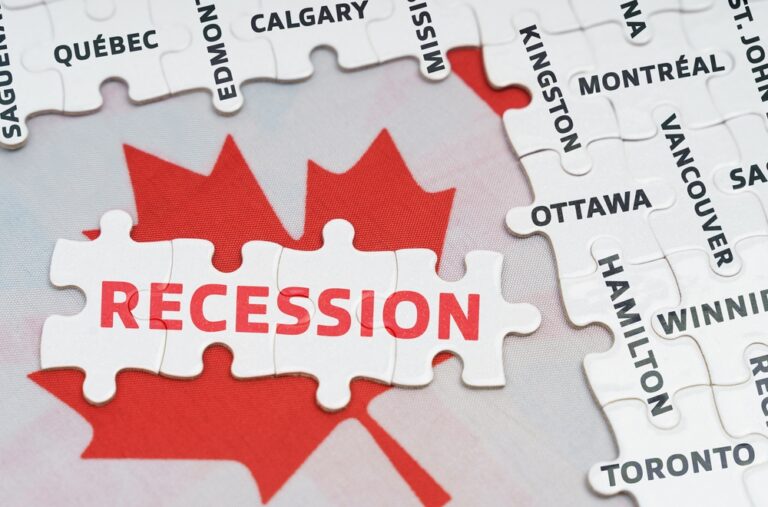
Canada Falls Into Technical Recession as Trump Tariff Uncertainty Hits Investment
- Canada’s Recession Label Comes With an Important Caveat
- Tariff Uncertainty Is Freezing Business Decisions
- Auto Exports Show Where the Pain Is Concentrated
- Households Are Still Spending, But the Cushion Is Thinning
- Imports and Inventories Made the GDP Picture Messier
- Housing and Government Investment Added to the Drag
- The Labour Market Is Not Crashing, But It Is Losing Energy
- The Bank of Canada Faces a Difficult Balancing Act
- The U.S. Relationship Is Still Canada’s Biggest Economic Vulnerability
- What Happens Next Will Decide Whether This Is a Blip or a Broader Downturn
Canada’s latest GDP report created an unusual situation. On a quarter-to-quarter basis, real GDP was unchanged in the first quarter of 2026 after shrinking in the fourth quarter of 2025. But on an annualized basis, GDP posted a second straight decline, which is why some economists and market watchers described the country as entering a technical recession. That makes the downturn real enough to matter, but complicated enough that it should not be confused with a broad economic collapse.
The distinction matters because recession language can shape confidence. A small business owner hearing “recession” may delay hiring. A family renewing a mortgage may cut back. A manufacturer may pause an equipment order. The economy is not flashing the same kind of emergency signal seen during the pandemic, but it is showing the kind of softness that can spread if uncertainty lingers. The first-quarter data revealed a country moving sideways, with enough weakness in key sectors to make the recession label politically and economically powerful.
Tariff Uncertainty Is Freezing Business Decisions
The most damaging part of a tariff shock is not always the tariff itself. It is the uncertainty that follows. Companies can model a known cost, renegotiate contracts, change suppliers, or adjust pricing. What is much harder is planning around rules that may change again in three months. For Canadian firms tied to the U.S. market, that uncertainty is hitting decisions about factories, warehouses, machinery, staffing, and cross-border contracts.
Business capital investment fell again in the first quarter, marking the fifth consecutive quarterly decline. That is one of the clearest signs that companies are becoming more cautious. A postponed expansion does not always look dramatic at first. It may simply mean one fewer production line, one delayed software upgrade, or one supplier contract left unsigned. But across thousands of firms, those delays become a drag on productivity and future growth. The Trump tariff environment has turned investment planning into a waiting game, and waiting is costly.
Auto Exports Show Where the Pain Is Concentrated
The auto sector remains one of the clearest examples of how quickly trade tension can show up in the real economy. Statistics Canada said exports edged lower in the first quarter, with the decline led by fewer exports of passenger cars and light trucks affected by U.S. tariffs. That is a meaningful signal because Canada’s auto industry is deeply integrated with the U.S., with parts and vehicles often crossing the border multiple times before reaching buyers.
For workers and suppliers, the impact can feel much bigger than a modest national GDP number suggests. A slowdown in vehicle exports can affect assembly plants, parts suppliers, transportation firms, tool-and-die shops, and local restaurants near industrial parks. A family in Windsor, Oshawa, Oakville, or parts of the GTA may not follow quarterly GDP tables, but they understand when overtime disappears or hiring freezes arrive. The risk is that tariff pressure in one export-heavy sector can ripple through communities that depend on manufacturing paycheques.
Households Are Still Spending, But the Cushion Is Thinning
Canadian consumers helped prevent the first-quarter numbers from looking worse. Household spending rose, led by categories such as financial services and food. That suggests many families are still spending on essentials and services, even as the broader economy slows. In that sense, consumers remain one of the economy’s stabilizers.
But there are warning signs under the surface. The household saving rate fell to its lowest level in two years, while fewer Canadians travelled abroad and purchases of new vehicles weakened. Those details matter because they suggest households may be becoming more selective. Spending on groceries, rent, insurance, banking, and everyday services can stay firm even when confidence is fading. Big-ticket purchases are often the first to get delayed. When people hesitate on cars, vacations, renovations, or furniture, it usually means they are protecting cash flow. That is not panic, but it is caution.
Imports and Inventories Made the GDP Picture Messier
The first-quarter GDP report was not a simple story of demand falling everywhere. Imports rose sharply, with gold-related categories playing a major role. At the same time, business inventories built up, helping offset the drag from imports. This made the headline GDP number harder to read because the economy was affected by accounting movements as well as underlying demand.
Inventories can be a useful buffer, but they can also hide weakness. If businesses are intentionally stockpiling goods because they fear future tariff disruptions, that may support activity in one quarter while creating risk later. If demand disappoints, those same inventories can become a reason to reduce future orders. In practical terms, a warehouse filled ahead of expected trade disruption may look like resilience at first. But if customers slow down, that warehouse becomes a financial burden. The first-quarter inventory build helped steady GDP, but it does not erase the deeper concern about investment and exports.
Housing and Government Investment Added to the Drag
The slowdown was not limited to trade-exposed industries. Residential investment also weakened, with resale-related activity falling sharply. That is important because housing has long been a major driver of Canadian economic activity. When resale activity slows, the impact reaches beyond real estate agents. Mortgage brokers, movers, furniture stores, renovation contractors, lawyers, appraisers, and local service businesses can all feel the effects.
Government capital investment also fell in the first quarter after notable strength in 2025. Statistics Canada tied much of that decline to lower investment in weapons systems compared with the high level seen at the end of last year. Even though that category remained high by historical standards, the quarterly pullback still mattered for GDP. Together, weaker housing investment, reduced government capital spending, and falling business investment created a broader drag. The economy was not just dealing with one bad sector; several important engines were sputtering at once.
The Labour Market Is Not Crashing, But It Is Losing Energy
Canada’s labour market remains mixed rather than disastrous. Employment was little changed in April, but the unemployment rate rose to 6.9% as more people searched for work. Full-time employment also weakened over the first four months of the year. That combination creates a frustrating environment: not a wave of mass layoffs, but enough softness to make job seekers and workers nervous.
This matters because labour-market psychology feeds directly into consumer spending. A worker who fears layoffs may cancel a car purchase. A young graduate who cannot find stable work may delay moving out. A business owner seeing softer sales may reduce shifts instead of cutting staff outright. These choices are small individually, but collectively they can cool the economy. The danger is not only job loss; it is the spread of caution. If tariff uncertainty continues to weigh on exporters and manufacturers, the labour market could become another channel through which trade stress reaches households.
The Bank of Canada Faces a Difficult Balancing Act
The Bank of Canada is in a difficult position. Slower growth would normally increase pressure for lower interest rates. But tariffs and higher global oil prices can also push some prices higher, complicating the inflation picture. The central bank has already acknowledged that Canada is adjusting to U.S. tariffs, trade uncertainty, and geopolitical shocks, while keeping its policy rate at 2.25% in late April.
That creates a narrow path. Cutting rates too quickly could risk reigniting inflation if energy and tariff-related costs keep moving through the economy. Holding rates too high for too long could worsen the slowdown by keeping borrowing costs elevated for households and businesses. For a manufacturer considering new machinery or a family thinking about a home purchase, interest rates still matter. But the bigger issue may be confidence. If firms believe the trade rules are unstable, cheaper credit alone may not be enough to unlock investment.
The U.S. Relationship Is Still Canada’s Biggest Economic Vulnerability
Canada has been trying to diversify trade, and exports to non-U.S. markets have grown. But the U.S. remains the country’s dominant goods export destination. That makes American tariff policy especially powerful. When access to the U.S. market becomes less predictable, the shock is not limited to one industry or one province. It affects boardrooms, ports, rail lines, trucking routes, factory floors, and commodity producers.
The long-term question is whether Canada can turn this pressure into a push for diversification and productivity. New export markets, energy infrastructure, critical minerals, defence procurement, advanced manufacturing, and domestic investment incentives could all become more important. But diversification takes time. A company that has sold into Michigan or Ohio for 30 years cannot replace those customers overnight. The immediate economic problem is that uncertainty is arriving faster than adaptation. Canada’s recession scare is, in many ways, a warning about dependence.
What Happens Next Will Decide Whether This Is a Blip or a Broader Downturn
There are reasons not to overstate the weakness. Statistics Canada’s advance estimate pointed to growth in April, and energy-sector strength provided support in the first quarter. Corporate incomes rose, helped by higher energy prices. Household spending also continued to grow. Those details suggest Canada may avoid a deeper downturn if trade uncertainty eases and investment begins to recover.
But the risks remain serious. A technical recession can be mild and still damage confidence. If businesses continue delaying capital spending, if auto exports remain under pressure, or if households become more defensive, the slowdown could become harder to reverse. The next few months will matter because they will show whether companies are merely pausing or actively pulling back. Canada’s economy has not fallen off a cliff, but it has entered a more fragile phase. The biggest threat is no longer just tariffs themselves; it is the uncertainty that keeps investment, hiring, and confidence on hold.
This Options Discord Chat is The Real Deal
While the internet is scoured with trading chat rooms, many of which even charge upwards of thousands of dollars to join, this smaller options trading discord chatroom is the real deal and actually providing valuable trade setups, education, and community without the noise and spam of the larger more expensive rooms. With a incredibly low-cost monthly fee, Options Trading Club (click here to see their reviews) requires an application to join ensuring that every member is dedicated and serious about taking their trading to the next level. If you are looking for a change in your trading strategies, then click here to apply for a membership.