35,000+ smart investors are already getting financial news, market signals, and macro shifts in the economy that could impact their money next with our FREE weekly newsletter. Get ahead of what the crowd finds out too late. Click Here to Subscribe for FREE.
What started as a provincial retail decision quickly became a test of how far Canadian governments were willing to go in a worsening trade fight with Washington. Manitoba Premier Wab Kinew’s stance on U.S. liquor was framed not just as retaliation, but as a public signal that provincial leaders were prepared to make everyday consumer spaces part of a broader political battle.
The episode also revealed something larger than one headline-grabbing sound bite. It showed how provincial liquor systems can still be used as economic leverage, how buy-Canadian sentiment hardened during the tariff dispute, and how symbolic acts can shape real conversations about trade, sovereignty and political pressure. These 10 sections examine the message, the machinery and the larger consequences behind Manitoba’s position.
A Shelf Ban Became a Political Message
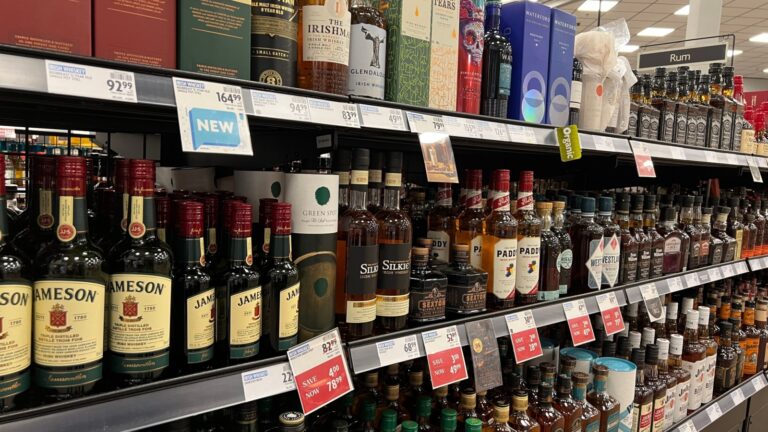
Manitoba Won’t Return U.S. Liquor Until Trump Drops Tariffs — and Releases Epstein Files
- A Shelf Ban Became a Political Message
- Liquor Was Chosen Because Manitoba Could Move Fast
- The Real Stakes Were Far Bigger Than the Bottles
- The Ban Matched a Wider Buy-Canadian Mood
- Ottawa and the Provinces Were Not Playing Exactly the Same Game
- American Distillers Felt the Damage Quickly
- The Policy Carried Costs and Contradictions Too
- Manitoba Used the Fight to Sell a Broader Economic Agenda
- The Epstein-Files Remark Imported U.S. Culture-War Energy Into a Trade Story
- This Was Really About Trust in the Canada-U.S. Relationship
Kinew’s reported refusal to restore U.S. liquor unless all tariffs on Canadian goods were removed turned a retail policy into a blunt diplomatic statement. His added reference to the Epstein files pushed the remark even further beyond a routine trade comment and into the kind of headline territory designed to travel quickly across television, social media and partisan debate. The point was not only what was being kept off shelves, but what kind of public pressure Manitoba wanted to project.
That helped explain why liquor became such a visible battleground. A tariff dispute is usually abstract, buried in customs notices, exemptions and compliance language. Pulling products from stores makes the conflict tangible. Manitoba had already used that visibility earlier in the trade fight, and Kinew’s rhetoric suggested he saw the policy as something more than a temporary response. It had become a symbol of resistance, a retail-level reminder that the province wanted the dispute felt in public, not just discussed in briefing books.
Liquor Was Chosen Because Manitoba Could Move Fast
Manitoba’s liquor system gave the province unusual room to act quickly and cleanly. Manitoba Liquor and Lotteries is a Crown corporation responsible for the sale and distribution of liquor in the province, and it operates the Liquor Mart network while also supplying private retailers. That kind of structure matters in a trade confrontation. A government with centralized control over distribution does not need to persuade hundreds of independent stores; it can issue a direction and have the market change almost overnight.
That made liquor a politically efficient pressure point. It was highly visible, simple to explain and tied directly to provincial authority. It also carried financial significance because liquor profits ultimately flow back to Manitoba’s general revenue and help fund public services. In other words, this was never just about optics. By targeting a category that sits inside a Crown-controlled system, the province found a tool that combined symbolism, administrative ease and fiscal relevance. Few consumer products offer all three at once, which is why alcohol so often becomes an early target in trade retaliation.
The Real Stakes Were Far Bigger Than the Bottles
The liquor fight drew attention because it was easy to see, but Manitoba’s deeper vulnerability lay in trade dependence. Provincial budget documents and Manitoba Bureau of Statistics data show how heavily the province relies on the United States as a customer and supplier. In 2024, Manitoba’s exports to the U.S. accounted for more than 70 per cent of all provincial exports, while imports from the U.S. made up roughly three-quarters of its international merchandise imports. That is not a marginal relationship; it is a central pillar of the provincial economy.
Budget 2025 made the danger plain. Manitoba pegged annual bilateral trade with the U.S. at about $39 billion and said more than 51,000 Manitoba jobs were linked to exports to the American market at their 2019 peak. It also warned that a 25 per cent tariff scenario, combined with retaliation, could cut provincial incomes by $1,420 per person and reduce GDP by as much as 3.8 per cent. Against numbers like those, the liquor ban looks less like a culture-war flourish and more like one small, public-facing piece of a much larger defensive posture.
The Ban Matched a Wider Buy-Canadian Mood
Manitoba’s policy did not land in a vacuum. By early 2025, the tariff fight had already pushed many Canadians toward more openly nationalist buying habits. Angus Reid polling found that among those planning to change their shopping behaviour, 98 per cent said they were looking for Made in Canada products, while 78 per cent said they intended to buy more Canadian goods overall. Nearly three in five said they would boycott U.S. products. That is a remarkable level of consumer alignment in a country that usually treats shopping as a private choice, not a patriotic act.
The Manitoba government leaned into that mood. In Budget 2025, it said the decision to remove American liquor had generated broad support and claimed the move would pull about $80 million a year out of the U.S. economy. The province also tied the shelf policy to a larger Support Manitoba, Buy Local campaign. That combination matters. Governments can announce retaliation, but public sentiment determines whether those measures feel performative or powerful. In Manitoba’s case, the liquor ban fit neatly into a consumer mood that was already shifting toward domestic substitution and visible economic solidarity.
Ottawa and the Provinces Were Not Playing Exactly the Same Game
One of the most revealing parts of the episode was that federal and provincial responses did not always move in lockstep. Ottawa’s tariff tools are formal trade instruments, governed by negotiations, legal frameworks and national economic priorities. Provinces, by contrast, can use procurement choices, shelf space and public messaging as a different kind of leverage. That split became clearer when Canada later removed many of its 25 per cent counter-tariffs on U.S. goods, while keeping measures on steel, aluminum and autos. Provincial politics, however, had already developed their own momentum.
Manitoba’s behaviour showed how those tracks can diverge. Even as federal policy evolved, the province kept presenting liquor policy as a political signal rather than a purely technical response to tariff schedules. At the same time, Manitoba and Ontario were signing agreements to tear down internal trade barriers and expand opportunities for producers and workers inside Canada. That is a telling combination: retaliate outward, integrate inward. The shelf ban was part protest, part pressure tactic and part argument that Canada needed stronger domestic economic links if cross-border reliability could no longer be taken for granted.
American Distillers Felt the Damage Quickly
However symbolic the politics seemed from Manitoba’s side, the commercial pain for U.S. spirits producers was real. Industry data and reporting from Reuters and The Associated Press showed a sharp collapse in American spirits sales and exports tied to the Canadian backlash. Reuters reported that sales of U.S. spirits in Canada fell 66.3 per cent between March 5 and the end of April 2025, while AP reported an 85 per cent plunge in U.S. spirits exports to Canada during the second quarter of that year. Those are not routine market fluctuations; they are trade-war numbers.
That helps explain why liquor became such a sensitive point in the broader dispute. Spirits trade has long depended on cross-border openness, and distillers on both sides have argued that the industry is deeply interconnected. In that sense, Manitoba’s position was not just a local gesture in a prairie province. It was part of a multi-province front that sent a message straight into American export markets, especially bourbon and whiskey country. When Canadian governments turned shelves into leverage, they did not merely inconvenience brands. They disrupted a business relationship that many producers had assumed was politically safer than it turned out to be.
The Policy Carried Costs and Contradictions Too
Retaliation may be emotionally satisfying, but it is rarely cost-free. Reuters also reported that Spirits Canada said the boycott hurt not only American imports but broader spirits sales, with overall sales in Canada down 12.8 per cent in the initial period studied. The same reporting said the shelf removals also affected Canadian revenues, consumers and hospitality businesses. That complicates the clean political story. A province can score points for toughness while still producing losses for restaurants, retailers and distributors working inside its own economy.
That contradiction runs through almost every modern trade fight. Governments want to be seen as defending local interests, yet the very industries they use as pressure tools often sit inside integrated supply chains. The more interconnected the market, the harder it is to isolate pain to one side. Manitoba’s stance reflected that tension. It gave the province a visible way to answer tariffs, but it also underscored how retaliation can spill beyond the intended target. Even a policy that seems morally straightforward in public can produce muddier commercial results once it reaches the real economy.
Manitoba Used the Fight to Sell a Broader Economic Agenda
The liquor ban was only one part of Manitoba’s response, and perhaps not even the most important one in policy terms. Budget 2025 tied the tariff fight to a bigger agenda that included an Export Support Program, a review of procurement rules, support for onshoring manufacturing and a renewed emphasis on local production. The government also announced tax deferrals and later highlighted loan and grant supports meant to help businesses deal with trade disruption. In that context, the shelf ban worked as the visible edge of a wider strategy.
There is a political logic to that sequencing. A dramatic move grabs attention, then government uses that attention to roll out more technical measures that might otherwise get ignored. Manitoba appeared to do exactly that. The province paired consumer-facing symbolism with business supports, internal trade talks and a procurement message favouring Canadian suppliers. That turned a narrow story about store shelves into a larger narrative about resilience, diversification and provincial self-protection. Whether one agreed with the tactic or not, it was clearly designed to show that the government was not merely protesting Washington. It was trying to reframe Manitoba’s economic posture at home.
The Epstein-Files Remark Imported U.S. Culture-War Energy Into a Trade Story
The most unusual part of Kinew’s reported comment was not the tariff condition but the Epstein-files line. That moved the conversation from a trade dispute into a volatile piece of American political theater. By 2026, the U.S. Justice Department had already published millions of pages under the Epstein Files Transparency Act, and the department’s own watchdog had launched a review of how those releases were handled. In other words, the files were already a live and messy transparency issue in Washington when Kinew invoked them.
That mattered because the remark changed the register of the story. It was no longer just about Manitoba’s economic retaliation; it became a jab aimed at the wider legitimacy problems surrounding Trump-era politics in the United States. Whether that was clever, reckless or both depends on the audience. Supporters could see it as a sharp expression of frustration. Critics could see it as a distraction that mixed unrelated controversies into trade policy. Either way, it reflected the current media environment: economic disputes no longer stay economic for long. They are pulled almost instantly into the same spectacle machine that governs everything else.
This Was Really About Trust in the Canada-U.S. Relationship
At the deepest level, the Manitoba story was about trust. Tariffs are damaging, but unpredictability can be just as corrosive. When businesses, provinces and consumers stop believing the rules will stay stable, they begin looking for substitutes, domestic partners and symbolic ways to harden their position. Manitoba’s stance reflected that mood. The province was not only answering specific U.S. measures; it was reacting to a broader sense that the trading relationship had become more erratic, more politicized and less dependable than it once appeared.
That is why a liquor policy could resonate so far beyond the liquor file. It captured a wider Canadian fear that the old assumptions about cross-border commerce no longer held. Provinces started experimenting with tools once treated as too theatrical or too blunt, and consumers increasingly followed them with buy-local behaviour of their own. Manitoba’s message, whatever one thinks of its tone, fit that moment precisely. It suggested that in the current phase of Canada-U.S. relations, sovereignty is not only defended at negotiating tables. It is also performed in procurement rules, shopping habits and, sometimes, the empty spaces left on a store shelf.
This Options Discord Chat is The Real Deal
While the internet is scoured with trading chat rooms, many of which even charge upwards of thousands of dollars to join, this smaller options trading discord chatroom is the real deal and actually providing valuable trade setups, education, and community without the noise and spam of the larger more expensive rooms. With a incredibly low-cost monthly fee, Options Trading Club (click here to see their reviews) requires an application to join ensuring that every member is dedicated and serious about taking their trading to the next level. If you are looking for a change in your trading strategies, then click here to apply for a membership.